
Share purchase agreement and due diligence documents in a bright Bucharest law office

Share Purchase Agreement in Romania: Key Issues for Buyers and Sellers

Corporate transactions • M&A • Romania

A share purchase agreement in Romania is not simply a document for transferring shares. It allocates the risks discovered in due diligence, defines what the buyer receives, protects the seller’s position and determines how the transaction moves from signing to closing and post-closing claims.

What is a share purchase agreement in Romania?

An SPA records the sale and purchase of shares in a joint-stock company (SA) or social parts in a limited liability company (SRL). It normally covers the parties, the transferred interests, price, conditions precedent, signing and closing, warranties, indemnities, limitations of liability, confidentiality, announcements, governing law and dispute resolution.

For a Romanian company, the agreement must be coordinated with the company’s articles, the shareholders’ register, corporate approvals and the formalities required under Romanian corporate law to ensure that the transfer is recognised by the company and, where applicable, registered with the competent authorities. The contract should not be drafted in isolation from the corporate records.

For Romanian SRLs, a transfer of social parts to third parties may require approval by the shareholders in accordance with Law No. 31/1990 and the company’s articles of association. These requirements, together with any contractual consent or pre-emption arrangements, should be reviewed before signing.

This article focuses on transaction negotiation and risk allocation. It is distinct from a procedural guide about changing shareholders and from a shareholder agreement, which regulates the relationship between shareholders after or independently of a particular share sale.

SPA, share transfer document and shareholder agreement

Transaction navigator

Select the document question

Click or tap a card to see the first issue to resolve.

Deal document

The SPA records the commercial bargain, price, conditions, closing mechanics and the parties’ remedies. It should be read together with any disclosure letter and ancillary documents.

What should buyers check before signing?

The buyer should understand what it is buying before it negotiates the warranty package. Legal due diligence is not only a search for defects. It identifies which risks require a condition, protection, price response or post-closing plan.

Share purchase agreement review matrix
Review areaWhat to verifyPossible contractual response
Ownership, encumbrances, transfer restrictions, any pre-emption or consent rights and authority to sell.Title warranty, release of security, consent or condition precedent.
Articles, shareholder records, resolutions, beneficial ownership and pending filings.Closing deliverable, corporate warranty or pre-closing remediation.
Accounts, debt, working capital, cash, leakage, tax exposures and contingent liabilities.Price mechanism, locked-box protection, completion accounts or specific indemnity.
Change-of-control clauses, termination rights, consent requirements and key customer or supplier dependencies.Consent condition, disclosure, warranty or transition covenant.
Employment claims, incentives, key-person risk, restrictive covenants and consultation duties.Specific warranty, retention plan, indemnity or post-closing obligation.
Licences, sector rules, GDPR, cybersecurity, permits and investigations affecting the target.Regulatory condition, remediation covenant, warranty or indemnity.
Selected-row principle: the more specific the risk identified in due diligence, the less useful a generic “compliance with law” warranty becomes.

Price mechanisms in a Romanian SPA

The price clause should match how the parties understand the business at signing and at completion. A locked-box structure relies on an agreed historical balance sheet and restrictions on value leakage. A completion-accounts mechanism adjusts the price after closing by reference to agreed accounting principles, debt, cash and working capital.

Earn-outs and deferred consideration can be useful where valuation depends on future performance, but they create additional questions about measurement, control, accounting policy, access to information and dispute resolution. The SPA should define the calculation process in enough detail to reduce avoidable disputes.

Warranties, indemnities and limitations

Warranties describe the state of the target; indemnities allocate a defined risk. They are not interchangeable and should be negotiated against the due-diligence findings and the information disclosed by the seller.

Warranties may address title, capacity, accounts, tax, contracts, employees, litigation, intellectual property, data protection, technology and regulatory compliance. An indemnity may be appropriate where a known risk can be described and valued more precisely. The parties should also agree disclosure standards, knowledge qualifiers, materiality, thresholds, de minimis amounts, baskets, caps, time limits and conduct-of-claims procedures.

A buyer should avoid assuming that a broad warranty solves every issue. A seller should avoid accepting a warranty that creates liability for matters fairly disclosed or outside the seller’s reasonable control.

Signing, conditions precedent and closing

Signing and closing may occur simultaneously, or the parties may sign first and complete later after conditions are satisfied. Conditions can include corporate approvals, regulatory clearances, third-party consents, release of security, financing, accuracy of warranties and the absence of a material adverse event, where negotiated and clearly defined by the parties.

The closing checklist should identify each document, signatory, filing, payment, register update, power of attorney, resignation or appointment and handover item. A clear checklist reduces the risk that the SPA is signed but the parties disagree about whether completion has occurred.

Tax notifications, registration steps and supporting documents for transfers of interests in Romanian companies should also be checked against the rules in force at the time of the transaction. Recent legislative changes may affect the timing or evidence required for particular SRL transfers, so the SPA timetable should allow for a current tax and corporate-formality review.

How We Assist in Practice

Protecting a buyer through SPA negotiations following due diligence findings

A client negotiating the acquisition of interests in a Romanian company instructed Atrium Romanian Lawyers after legal due diligence revealed several areas of potential concern, including regulatory compliance matters, contractual risks and historical liabilities that had not been reflected in the initial commercial discussions.

Atrium reviewed the proposed share purchase agreement, analysed the diligence findings and assisted the client in restructuring the contractual protection package. The SPA was revised to include enhanced warranties, disclosure obligations, specific indemnity protections and detailed claims procedures designed to address the identified risks.

In parallel, our team coordinated the transaction documentation with the company’s corporate records, shareholder approvals and closing requirements in order to reduce execution risk and avoid implementation delays.

The parties ultimately completed the transaction under a revised framework that more accurately reflected the legal and commercial position of the target company and established a clear mechanism for managing post-closing issues.

This example is anonymised and provided for illustrative purposes only. Past results do not guarantee similar outcomes in future matters.

How Atrium Romanian Lawyers can assist

Atrium Romanian Lawyers can assist buyers, sellers, shareholders and investors with SPA structuring, due diligence, negotiation, warranties, indemnities, conditions precedent, closing documentation and post-closing claims. The appropriate scope depends on the company, transaction structure, documents, timetable and risks identified.

Frequently asked questions

Is an SPA required for every share sale in Romania?

The required documents depend on the company, parties, share type, transaction structure and applicable formalities. An SPA is commonly used in commercial transactions, particularly where the parties wish to regulate price mechanics, warranties, indemnities and risk allocation. Some transfers may instead be documented through a share-transfer agreement, transfer deed, shareholders’ resolution or simpler corporate documentation. Any chosen structure must still be coordinated with the applicable corporate and transfer formalities.

What is the difference between an SPA and a shareholder agreement?

An SPA records a sale and purchase of shares or social parts. A shareholder agreement regulates the relationship, governance and protections between shareholders. They may be connected but serve different purposes.

Can the SPA be governed by foreign law?

The parties may choose a foreign governing law for the SPA, subject to applicable private international law rules. However, mandatory Romanian corporate, regulatory, employment, tax and registration rules may still apply to the transaction and the target company.

When should due diligence take place?

Due diligence should begin early enough for findings to influence valuation, conditions, warranties, indemnities and the closing timetable. A late review may reduce the buyer’s ability to obtain a practical remedy.

What happens if a warranty is inaccurate?

The SPA should define the buyer’s remedies, exclusions, thresholds, time limits and claim procedure. The effect depends on the wording, disclosure, loss and the surrounding facts.

Can the parties amend an SPA after signing?

Amendment usually requires compliance with the agreement’s amendment clause and the necessary authority of the parties. Changes affecting corporate records, approvals or closing conditions may require additional documents or filings.

AI due diligence checklist for foreign investors assessing a Romanian company

AI Due Diligence in Romania: What Foreign Investors Should Check

Foreign investment • AI governance • Romania

AI due diligence in Romania asks whether a target company’s AI use, data, contracts and public claims support the investment case. It is not a technical demonstration of a model and it is not a generic AI policy review. For a buyer, investor or lender, the question is whether the target has identified the systems it uses, can lawfully operate them, owns or can use the assets it relies on, and has a credible plan for the risks that will remain after closing.

What is AI due diligence in a Romanian transaction?

AI due diligence is a transaction-focused legal and commercial review. It identifies whether the target’s use of AI creates liabilities, restrictions, missing rights or implementation costs that could affect price, risk allocation or post-closing operations.

For a Romanian target, the review should cover the target’s Romanian operations and any AI outputs used in the European Union. The EU AI Act is directly applicable across the EU and operates alongside the GDPR where personal data is processed. A seller’s statement that it uses only a third-party AI tool does not end the inquiry: the target may still be a deployer, customer, controller, employer or regulated business with its own duties.

This guide has a different purpose from our analysis of AI vendor contracts in Romania, which focuses on the agreement with a supplier, and from DPIA vs FRIA in Romania, which focuses on assessment triggers for a deployment. Here, the investor is deciding what must be verified before, at and after a deal.

Start with the target’s actual AI footprint

Do not begin with a broad question such as “Does the company use AI?” Ask what system or model is used, for which decision, with which data, by whom, and whether the target sells, deploys, develops, fine-tunes or merely accesses the tool.

A useful data-room request separates customer-facing products from internal tools. It should identify models, APIs, software providers, hosting and cloud dependencies, integrations, datasets, prompts or knowledge bases, material outputs, users and the decisions influenced by each use case. The inventory should also record planned products or features that have not yet launched but are material to the investment thesis.

Deal-side navigator

Select a deal question to see the first evidence to request

Click or tap a card. Keyboard users can Tab to a card and press Enter or Space. Each selection stays visible until you choose another one.

Business model and footprint

Request a system inventory, product descriptions, roadmaps, supplier contracts, architecture summary and evidence of the target’s material AI claims. Compare marketing language with the technology and operating model actually in use.

Which legal and commercial issues should an investor test?

Click or tap a row to highlight the diligence takeaway. On a small screen, swipe the table sideways.

AI due diligence matrix for a Romanian target
Review areaWhat to testPossible deal response
Whether the target’s product, sales material and internal inventory describe the same systems, functions, limits and dependencies.Correct the diligence scope, ask for technical confirmation and qualify representations that are broader than the evidence.
Whether a use case may be prohibited, high-risk, subject to transparency rules or linked to a general-purpose AI model supply chain.Obtain a classification record, identify compliance timing and budget for any remediation or implementation work.
Data flows, controller/processor roles, legal bases, Article 22 issues, DPIA screening, security measures and cross-border transfers.Require a privacy remediation plan, review the DPA and test whether the target can continue the relevant processing after closing.
Whether datasets, prompts, files or customer information may lawfully be used for development, fine-tuning, testing or supplier improvement.Limit or stop impermissible use, obtain consents or contractual permissions where appropriate, and reserve a specific risk allocation.
Ownership and licences for software, open-source components, models, training materials, brand assets, output and third-party claims.Confirm chain of title, address licence conflicts and tailor warranties or indemnities to the assets that support the valuation.
Model, cloud and subprocessor dependencies, location, termination, audit evidence, model changes and service continuity.Seek consent, amendment, transition assistance or a post-closing migration plan if a dependency cannot support the buyer’s intended use.
Policies, ownership, AI literacy, logs, testing, monitoring, incident response, complaint handling and escalation records.Set a post-closing governance plan with owners, deadlines and evidence requirements rather than relying on a generic policy.

The European Commission describes the AI Act as a risk-based framework for developers and deployers. It identifies employment, credit scoring and access to essential services among the examples that may be high-risk. See the Commission’s AI Act overview and application timetable.

AI Act review: classify before you value the risk

Do not treat “AI Act compliant” as a sufficient diligence answer. Contractual, sector-specific, data-protection and AI Act obligations must be assessed separately. The investor should identify the system, its intended purpose, the target’s role and the rules that apply now or later. The relevant date can affect both risk allocation and integration planning.

The AI Act’s prohibitions, AI literacy obligations, governance rules, GPAI-model obligations and transparency rules have different application dates from the rules for high-risk systems. The Commission states that Annex III high-risk use cases, including employment and credit-scoring examples, are scheduled to apply from 2 December 2027, while high-risk systems embedded in regulated products have a later date of 2 August 2028. A diligence report should distinguish obligations already applicable from future obligations that could require a funded implementation plan. At the time of publication, the applicable AI Act timetable should be verified against the latest EU legislation and implementation guidance, including the official AI Act Service Desk timeline.

The analysis should also ask whether the target is developing an AI system, placing it on the market, deploying it in its own business, importing it, distributing it or using a third-party service. These labels are not interchangeable with GDPR controller and processor roles. For the contract-facing part of that review, see AI Vendor Contracts in Romania.

GDPR and data review: look beyond the privacy policy

The decisive question is what happens to personal data at each stage of the AI lifecycle. A target may process personal data in training, testing, deployment, monitoring, logs, prompts, support and human review, even where the product is marketed as automated or anonymised.

The review should map the data categories, purposes, retention, recipients, access, transfer mechanisms and contractual roles. Where the use involves profiling, recruitment, credit, insurance, pricing or decisions that may significantly affect individuals, check the actual decision flow and safeguards rather than relying on a generic human-review statement. Article 35 GDPR requires a DPIA where processing is likely to result in a high risk to the rights and freedoms of natural persons; Article 22 has separate rules for certain solely automated decisions.

The European Data Protection Board has also confirmed that the anonymity of an AI model trained with personal data must be assessed case by case. That matters for a target relying on a statement that a model, dataset or output is anonymous. Read EDPB Opinion 28/2024. For the broader framework, see our guide to GDPR compliance when using AI in Romania.

Data, intellectual property and contract rights

AI value is often dependent on rights that sit outside the target’s own code. The investor should trace the legal basis for using data, third-party models, cloud infrastructure, open-source components, output and confidential information.

Review the complete contract suite, not only the signed master agreement. Order forms, online terms, acceptable-use policies, data-processing agreements, security schedules, open-source notices and API terms can all affect the target’s rights. In particular, check whether a provider can use customer or target data for model training, whether the provider can change the model or service unilaterally, and whether the target can export its data and configurations on exit.

Ownership language for AI-generated output should be read carefully. A contractual promise may create a licence or allocation between the parties, but it does not necessarily guarantee exclusivity or copyright protection in every output. The copyright status of AI-generated content may vary depending on the level of human creative input and the applicable jurisdiction. The review should identify the use the target needs to make of the output and whether third-party rights, human authorship requirements, confidentiality or contractual restrictions could limit that use.

What should the investor request in the data room?

  1. Request a current AI inventory. Include internal tools, customer-facing products, models, APIs, plugins, fine-tuning, integrations and material planned features.
  2. Obtain a use-case map. Record intended purpose, users, affected people, decisions, data inputs, outputs, human review and country of deployment.
  3. Collect AI governance records. Ask for role assessments, policies, training records, system documentation, risk logs, testing, monitoring and incident procedures.
  4. Review AI Act screening. Identify prohibited practices, potential high-risk systems, transparency obligations, GPAI dependencies and the applicable timetable.
  5. Map personal-data processing. Review privacy notices, legal bases, Article 22 analysis, DPIAs, processor arrangements, security controls and transfers.
  6. Trace data rights. Check source, licence, consent or other permission for data used in development, testing, fine-tuning and ongoing service delivery.
  7. Review the contract stack. Read supplier, customer, cloud, API, DPA, security, outsourcing and change-control documents together.
  8. Confirm IP and open-source position. Request code provenance, licences, notices, ownership assignments, third-party claims and output-use restrictions.
  9. Test material statements. Compare product marketing, investor materials and customer commitments against the available technical and legal evidence.
  10. Assign the deal response. Separate issues requiring price, warranty, indemnity, condition, remediation, disclosure or post-closing integration action.

How should findings affect the transaction documents?

Translate each material finding into an owner, timing and remedy. A diligence report is useful only if the SPA, investment agreement, disclosure process and integration plan reflect the issues that have been identified.

The appropriate response will depend on the transaction structure and the seller’s ability to remediate. A buyer may need targeted warranties concerning data rights, AI-related regulatory compliance, ownership, contract compliance, absence of claims or material incidents. Confirmed gaps may justify a specific indemnity, a pre-closing remediation covenant, a post-closing plan, a condition or a tailored disclosure. The drafting should not assume that a general compliance warranty captures the actual issue.

Post-closing planning is equally important where the buyer will integrate systems, move data, introduce a new group policy, change suppliers or expand the target’s use case. These changes can alter the GDPR and AI Act analysis. If an assessment is required, the timing should be addressed before the relevant processing or deployment begins. Our DPIA vs FRIA guide explains why those two assessment routes must be screened separately.

When does a separate specialist review become necessary?

A focused AI legal review should be coordinated with corporate, technical, information-security, employment and commercial due diligence when the target develops AI products, relies on proprietary datasets, makes regulated-sector decisions, uses AI in recruitment or credit processes, processes sensitive personal data, markets compliance claims, or has important dependencies on a small number of providers. The workstreams should share the same factual inventory, but each should retain its own legal questions and conclusions.

How Atrium Romanian Lawyers can assist

Atrium Romanian Lawyers can coordinate the legal workstream for AI-related due diligence in a Romanian investment, acquisition or internal reorganisation. The review can cover AI Act role and use-case screening, GDPR and data-contract questions, supplier and customer terms, intellectual property, employment and operational governance, and the translation of findings into transaction documents or an integration plan.

Client experience

AI due diligence during the acquisition of a Romanian technology company

An international investor considered acquiring a Romanian technology company that relied extensively on AI-enabled software products and third-party AI services.

During the due diligence process, the buyer requested confirmation regarding AI Act compliance, data rights, intellectual-property ownership and the target’s dependencies on external AI providers.

The review identified gaps between the target’s public marketing materials and its internal documentation, uncertainties regarding the scope of rights over certain datasets, and contractual limitations affecting the use of third-party AI services after closing.

Atrium Romanian Lawyers coordinated the legal review of the AI use cases, supplier contracts, GDPR implications and intellectual-property position. The findings were translated into targeted warranties, disclosure items and a post-closing remediation plan.

The transaction proceeded with a clearer allocation of regulatory, contractual and operational risks and with a structured roadmap for post-closing compliance measures.

This example has been anonymised and simplified for publication. The appropriate legal analysis depends on the system, data, contract structure and facts of each matter.

Frequently asked questions

Does every investment in a Romanian company need AI due diligence?

No. The scope should be proportionate to the target’s actual use of AI and the importance of that use to the transaction. A company using a limited internal tool may require a focused review. A target selling AI-enabled products, using sensitive data or making decisions affecting people may need a deeper legal and technical workstream.

Is AI due diligence the same as an AI Act compliance audit?

No. AI Act compliance is one part of the review. Transaction diligence also considers ownership, licences, customer commitments, personal data, confidentiality, technical dependencies, product claims, change control and what the buyer will need after closing. The correct scope follows the investment thesis and the target’s operating reality.

Can a seller rely on a supplier’s AI compliance statement?

Supplier information can be relevant evidence, but it does not by itself establish that the target’s own deployment is compliant. The investor should check whether the statement identifies the actual system, model, purpose, data, users, territory, contract terms and responsibilities relevant to the target’s use case.

Should a buyer ask for the target’s DPIAs?

Where the target operates AI systems involving personal data and has conducted or screened for a DPIA, the relevant material should be reviewed subject to confidentiality controls. The question is not simply whether a document exists, but whether it reflects the current processing, risks, safeguards, changes and any residual issues requiring follow-up.

Can AI findings be addressed after closing?

Sometimes. The decision depends on the nature of the issue, legal exposure, urgency, operational dependency and the buyer’s ability to control remediation. A defensible post-closing plan should identify the owner, evidence, budget, deadlines and the effect on continued use. Some issues may need to be resolved before closing or before a planned deployment.

What is the most common gap in AI diligence?

A frequent gap is that the target has a high-level AI policy or vendor contract but no reliable inventory linking systems, use cases, data, roles, evidence and decision owners. The first practical step is usually to build that factual map before drawing legal conclusions or negotiating transaction protection.

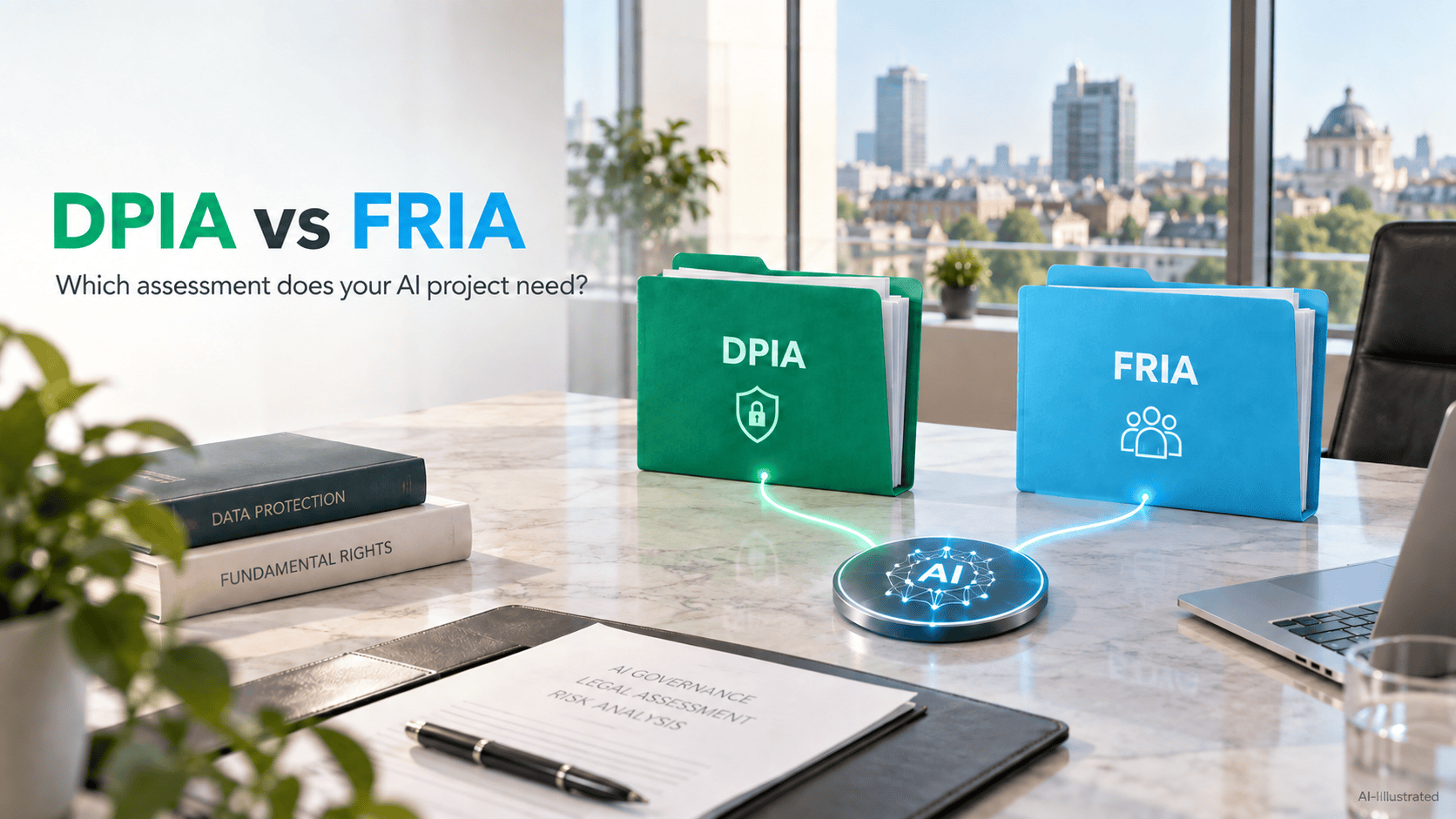
DPIA and FRIA assessment paths for an AI project in Romania

DPIA vs FRIA in Romania: Which Assessment Does Your AI Project Need?

AI governance • Romania • Assessment decisions

DPIA vs FRIA in Romania is a question of two different legal tests. A data protection impact assessment (DPIA) addresses risks arising from personal-data processing under the GDPR. A fundamental rights impact assessment (FRIA) under the AI Act applies to specified deployers of certain high-risk AI systems. Your project may require one, both, or neither mandatory assessment.

When do these obligations apply?

The GDPR assessment requirements already apply. Under the AI Act’s consolidated timetable, Chapter III Sections 1–3, including Article 27, apply to Annex III high-risk systems from 2 December 2027. The corresponding date for Article 6(1)/Annex I product systems is 2 August 2028; that does not extend Article 27 to every product system.

Article 111 contains separate transition provisions for existing systems. A project review should record when the system was placed on the market or put into service and whether subsequent design changes affect its treatment. The future FRIA timetable does not postpone GDPR duties. Source: consolidated AI Act, Articles 111 and 113.

DPIA vs FRIA: the differences that change your project

Both assessments examine potential harm to people. A DPIA is not limited to confidentiality or cybersecurity: it also examines other rights and freedoms affected by personal-data processing. FRIA addresses the impact of the specified AI deployment on fundamental rights.

Click or tap a row to reveal its practical takeaway. Keyboard users: Tab to a green label and press Enter or Space. Swipe the table sideways on a small screen.

Two assessments, separate applicability tests
Decision pointDPIA: GDPR Article 35FRIA: AI Act Article 27
Personal-data processing likely to create high risks to individuals, assessed in its context.A covered deployer using an in-scope Article 6(2)/Annex III high-risk system.
The controller, with DPO advice where a DPO is designated and relevant processor assistance.The deployer covered by Article 27.
Processing, necessity, proportionality, risks to people and safeguards.Deployment context, affected groups, risks of harm, human oversight and responses.
Before the relevant processing begins; review when risk changes.Before first use where the obligation applies; update changed or outdated elements.
Prior consultation when the Article 36 threshold is met; no universal filing requirement for every DPIA.Notify results to the market surveillance authority under Article 27(3), subject to its exception.
Shared evidence can support the assessment of the actual processing.Relevant DPIA sections may be cross-referenced or incorporated; remaining requirements still need coverage.

GDPR Articles 28, 35–36 and 39; AI Act Article 27.

When does an AI project need a DPIA?

AI use alone does not automatically trigger a DPIA. The controller must assess whether the nature, scope, context and purposes of the processing make a high risk to people likely. Article 35 expressly recognises the relevance of new technologies.

The GDPR identifies particular situations, including systematic and extensive automated evaluation underpinning decisions with legal or similarly significant effects, large-scale processing of special-category or criminal-offence data, and large-scale systematic monitoring of publicly accessible areas. Applicable supervisory-authority lists must also be checked.

For a Romanian deployment, the file should therefore address the applicable requirements and guidance of the Romanian data protection authority, ANSPDCP, alongside Article 35. Record the reasons for a negative screening conclusion too. A supplier’s description of a product as “low risk” is not an assessment of your processing.

Where required, the DPIA must describe the processing and purposes, assess necessity and proportionality, evaluate risks to individuals and specify safeguards. This is a substantive project assessment, not simply a signed template. Source: GDPR Article 35.

For the broader data-protection framework, see our guide to GDPR compliance when using AI in Romania.

Who needs a FRIA under the AI Act?

The Article 27 obligation does not cover every business using high-risk AI. It concerns Article 6(2) high-risk systems and specified categories of deployer, with an exclusion for the critical-infrastructure area in Annex III point 2.

  • Bodies governed by public law deploying qualifying systems.
  • Private entities providing public services deploying qualifying systems. This status requires analysis; it is not synonymous with every company selling services to the public.
  • Deployers of qualifying creditworthiness or credit-scoring systems for natural persons under Annex III point 5(b), which excludes systems used to detect financial fraud.
  • Deployers of qualifying life and health insurance risk-assessment or pricing systems for natural persons under Annex III point 5(c).

Classification under Article 6 must be checked first, including the conditions of any applicable exception. The exact intended purpose matters. A financial-sector tool is not automatically a creditworthiness system, and a medical product is not automatically within the Article 27 FRIA route. Source: AI Act Articles 6 and 27 and Annex III.

Explore four deployment scenarios

These hypothetical examples explain the screening logic. They assume the stated facts and do not replace an assessment of the actual system, applicable dates or transition rules.

Candidate ranking: DPIA and FRIA can diverge

A private manufacturer uses extensive automated applicant evaluation to support hiring decisions. These facts point to a DPIA requirement under Article 35(3)(a), even if a person makes the final decision. Recruitment may also fall within Annex III. However, on the assumption that the manufacturer is neither a public-law body nor a private public-service provider, its employer status alone does not trigger Article 27 FRIA.

Consumer credit: prepare for both assessments

A lender uses an in-scope high-risk system to score individuals for loan eligibility. Systematic and extensive profiling with significant consequences can trigger a DPIA. Article 27 separately covers qualifying deployers under Annex III point 5(b). Address the applicable FRIA timetable and any transition provisions, rather than assuming both duties started on the same date.

Public benefits: assess deployment and processing together

A public body uses a qualifying high-risk system to assess eligibility for essential assistance benefits. Its status and use case bring Article 27 into the analysis. The personal-data processing needs separate DPIA screening, including relevant public-task legislation and any Article 35(10) position. One completed assessment does not automatically discharge the other.

Drafting assistant: examine the actual workflow

A team drafts generic product descriptions without personal data or decisions about people. On those narrow facts, the workflow does not itself establish a DPIA or Article 27 FRIA requirement. Check account data, logs and supplier processing separately. Introducing customer records, employee evaluation or regulated decisions changes the analysis. Other duties may still apply.

Can one assessment document cover DPIA and FRIA?

A coordinated file can reduce duplicated work, provided each legal requirement remains identifiable. The consolidated Article 27(4) expressly allows relevant DPIA sections to be cross-referenced or incorporated into FRIA where they already meet the corresponding obligations.

Start with a shared description of the system, purposes, data flows, affected people and safeguards. Then keep a requirement map showing which sections satisfy GDPR Article 35 and which satisfy AI Act Article 27. Identify gaps rather than renaming a DPIA “FRIA”. Source: AI Act Article 27(4)–(5).

As a practical drafting approach, include a separate deployment chapter addressing who may be affected beyond the immediate users, how mistakes influence access to opportunities or services, who can intervene, and how complaints lead to corrective action. Avoid treating GDPR as only a privacy checklist: the DPIA itself must consider risks to rights and freedoms.

What the FRIA needs to address

Article 27 requires the deployment process and intended use, duration and frequency, affected people and groups, specific risks of harm, implementation of human oversight, and measures if risks materialise, including governance and complaint mechanisms. Reusing a supplier assessment in similar cases is permitted, but the deployer must check its fit and update changed or outdated elements. Source: AI Act Article 27(1)–(2).

Who prepares, reviews and owns the decision?

The controller remains responsible for the DPIA; the covered deployer remains responsible for FRIA. A consultant, DPO or supplier can contribute without taking over the organisation’s statutory role.

For the DPIA, seek the designated DPO’s advice and preserve their independent advisory and monitoring function. Obtain relevant processor assistance. For the deployment review, involve the business owner, technical team and people responsible for oversight and complaints. A useful internal decision records outstanding conditions, the person accountable for each safeguard and the circumstances requiring a fresh review. Source: GDPR Articles 28(3)(f), 35(2) and 39; AI Act Article 27.

Contractual cooperation should cover the evidence you need to assess the deployment. Our AI vendor contracts guide addresses information rights, changes and supplier responsibilities.

Must the assessment be sent to an authority?

A DPIA and a FRIA follow different authority procedures. Under GDPR Article 36, prior consultation is required where high residual risk remains that cannot be sufficiently mitigated. There is no general GDPR obligation to submit every DPIA for approval.

Article 27(3) provides for notification of FRIA results to the market surveillance authority using the relevant template, subject to the Article 46(1) exception. That notification is not the GDPR prior-consultation procedure and should not be described as automatic permission to deploy. Confirm the competent authority and operational submission arrangements for the specific deployment. GDPR Article 36; AI Act Article 27(3).

A practical assessment file before deployment

  1. Define the use case. Identify the system, version, intended purpose, users, affected people and decisions it informs.
  2. Map roles separately. Record GDPR controller/processor roles and the relevant AI Act roles.
  3. Screen the legal route. Check prohibited practices, AI classification, DPIA triggers and Article 27 deployer coverage.
  4. Record timing. Distinguish existing GDPR duties from future AI Act requirements and applicable transition provisions.
  5. Collect evidence. Obtain data-flow information, supplier instructions, meaningful performance limitations, oversight arrangements and relevant testing.
  6. Assess harms and safeguards. Describe how the actual deployment may affect people and how controls reduce those risks.
  7. Map shared sections. Make each DPIA and FRIA requirement traceable, retaining any necessary separate analysis.
  8. Resolve escalation. Identify prior consultation, notification, unresolved risks and conditions preventing launch.
  9. Assign review triggers. Consider changes in purpose, model, data, affected groups or decision authority, and evidence from incidents or complaints.

How Atrium Romanian Lawyers Assisted an International Manufacturing Group

Anonymised client matter. The description below omits identifying information and focuses on the legal work performed.

Questions examined

  • Whether the candidate-data processing required a DPIA;
  • Whether the use of the system could trigger a FRIA under the AI Act;
  • What human-oversight and documentation measures were needed before implementation.

Legal analysis

Our review of the recruitment process identified extensive automated evaluations of candidates with a significant impact on access to employment opportunities. The company therefore decided to complete a DPIA before implementation.

We also carried out a separate analysis of the system’s classification under the AI Act, including the organisation’s status and the obligations applicable to the deployer. The review confirmed that the DPIA and any FRIA analysis had to be treated separately because their legal triggers differ.

Measures adopted

  • Documentation of the decision logic and system limitations;
  • Mandatory stages of human verification;
  • Internal procedures for challenging results and handling complaints;
  • Updated contractual documentation and AI-governance workflows.

Practical result

Following the project, the company was able to continue the implementation on the basis of stronger documentation concerning compliance and risk management.

A focused consultation can clarify which assessment route applies and what your team needs before making deployment commitments.

Frequently asked questions

Does every AI project need both a DPIA and a FRIA?

No. Screen personal-data processing under GDPR Article 35 and, separately, the system and deployer under AI Act Article 27. One assessment may be mandatory while the other is not. A negative screening result does not remove other applicable legal obligations.

Does human review remove the need for a DPIA?

Not automatically. Article 35 has its own risk test, and its automated-evaluation category is not confined to solely automated decisions. Genuine human oversight can affect risks and safeguards, but a human signature does not by itself settle DPIA applicability.

Does a private employer need a statutory FRIA for recruitment AI?

Not solely because it is an employer using high-risk recruitment AI. Article 27 covers specified deployers and uses. Check whether the organisation is a public-law body or private public-service provider, while independently assessing its GDPR and other AI Act obligations.

Can we rely on the supplier’s impact assessment?

Supplier evidence can support the work, and Article 27 permits reliance on existing assessments in similar cases. The organisation still needs to check whether the document addresses its actual deployment, affected groups, safeguards and applicable obligations. A generic assurance is insufficient evidence of that fit.

Can we wait until the FRIA application date to conduct a DPIA?

No, if GDPR already requires a DPIA for the proposed processing. The DPIA must precede that processing. The AI Act timetable and transition provisions must be analysed separately and do not suspend GDPR requirements.

Does completing an assessment authorise the project?

No. An assessment documents analysis and safeguards; it does not supply a missing legal basis, legalise prohibited AI or override unresolved legal restrictions. Complete any required consultation or notification procedure and resolve conditions that prevent lawful deployment.

AI vendor contracts in Romania under the EU AI Act and GDPR

AI Vendor Contracts in Romania: EU AI Act and GDPR Clauses

An AI vendor contract should do more than grant access to a platform. It should identify the system and intended use, allocate regulatory roles, control the use of business and personal data, preserve evidence, set performance and security obligations, and provide a workable exit if the supplier, model or law changes.

Key points for companies buying AI services in Romania:

  • Classify the AI use and the parties’ roles before negotiating warranties and liability.
  • Do not assume that a standard SaaS agreement or a GDPR DPA covers AI-specific risk.
  • State whether prompts, files, outputs and usage data may be retained or used for training.
  • Require enough information, logs and cooperation to meet the customer’s own legal duties.
  • Connect service changes, security incidents and regulatory events to notice, remediation and exit rights.

This guide is intended for Romanian companies, foreign groups operating in Romania, technology suppliers, procurement teams and businesses implementing generative or other AI tools. It focuses on contract structure. For the wider regulatory framework, read our EU AI Act guide for foreign companies.

Why does an AI vendor contract need a separate review?

AI services can change after signature. A supplier may replace a model, add a subprocessor, change data-retention settings, modify safety controls or alter the geographic delivery chain. Outputs may also be probabilistic rather than repeatable. These features create risks that are not fully addressed by ordinary clauses on software access, uptime and confidentiality.

The EU AI Act allocates obligations according to the system, risk category and operator role. The GDPR applies in parallel where personal data is processed. The contract cannot transfer away statutory responsibility, but it can secure the information, instructions, evidence and cooperation needed for each party to perform its own obligations.

Practical distinction: the AI Act analysis, the GDPR role analysis and the commercial allocation of risk are related but separate. A supplier described as a “provider” under the AI Act is not automatically a “processor” under the GDPR.

Start with the AI use, not the vendor’s template

Before redlining the agreement, the customer should record what the system will do, whose decisions it will influence, what data enters the system, who receives the output and whether the tool will be integrated into employment, credit, insurance, education, essential services, biometric or other sensitive workflows. The same product can create different legal exposure when deployed for a different purpose.

Contract navigator
Build the AI contract in five connected layers

Select a layer to see the question that should be answered before signature.

System and intended use

Identify the product, model, version, functions, integrations, users, prohibited uses and decision context. Classification begins with the actual deployment.

AI vendor due diligence before contract negotiation

A customer cannot negotiate intelligently without basic information about the service. The due-diligence request should be proportionate to the use and risk, but it commonly covers:

  • the legal entity supplying the service and the entities supporting it;
  • the model or models used, hosting locations and material third-party dependencies;
  • the intended purpose, known limitations and prohibited uses;
  • data sources, retention rules and whether customer data is used for training or improvement;
  • security controls, incident history, business continuity and disaster recovery;
  • testing, accuracy or performance information relevant to the deployment;
  • subcontractors, subprocessors and international data transfers; and
  • the supplier’s process for regulatory requests, complaints, audit evidence and system changes.

For high-risk deployments, the customer may require contractual access to sufficient documentation, instructions, logs and compliance information to enable it to perform its own obligations under the AI Act. The scope of access should reflect the parties’ respective roles and may need to protect the supplier’s trade secrets and intellectual-property rights. The European Commission’s AI Act information page and its AI Act Service Desk are useful starting points, but the contract must still reflect the particular system and transaction.

What if the service relies on a general-purpose AI model?

Where the service relies on a general-purpose AI model, the customer should also consider whether contractual information rights are needed regarding the model provider, model updates, transparency documentation and downstream restrictions affecting the deployment. These provisions should be tailored to the customer’s position in the AI value chain and should not imply that the customer is entitled to the provider’s complete technical documentation.

What clauses should an AI vendor agreement contain?

Contract layerWhat the clause should resolveRisk if unclear
System and permitted useProduct, model, version, functionality, users, integrations, territories, intended purpose and prohibited uses.The service is used outside its tested or agreed purpose.
Regulatory rolesAI Act operator roles, GDPR roles, responsibility matrix and cooperation duties.Each party assumes the other will supply evidence or perform a mandatory task.
Data and trainingPermitted inputs, retention, model training, improvement, isolation, deletion and export.Confidential or personal data is retained or reused beyond the customer’s expectation.
Performance and oversightRelevant metrics, limitations, testing, human review, logs, notices and remediation.Outputs cannot be evaluated, challenged or reconstructed when a problem occurs.
Security and incidentsTechnical measures, vulnerability management, notification triggers, timing and cooperation.The customer learns too late or receives too little information to respond lawfully.
IP and output rightsRights in inputs, outputs, configurations, documentation, feedback and third-party materials.The customer lacks the rights needed for its intended commercial use.
Change controlNotice of model, policy, subprocessor, location and functionality changes, plus testing and objection rights.A compliant deployment becomes materially different during the contract.
Liability and exitWarranties, indemnities, caps, insurance, suspension, termination, transition, export and deletion.The remedy is commercially unusable when the service fails or must be withdrawn.

Click a row, or focus it and press Enter, to highlight one negotiation layer.

1. Define the system, version and intended purpose

The agreement should identify what is actually being supplied. “AI services” is rarely sufficient. The specification should address the model or service version, functions, interfaces, customer environment, authorised users, territories, dependencies and intended use. If classification or performance depends on a specific configuration, that configuration should be documented.

2. Allocate AI Act and GDPR roles separately

The parties should record their assumed roles under the AI Act and set out who provides instructions, documentation, logs, notices and regulatory cooperation. A separate analysis is required under the GDPR. Depending on the facts, the parties may be controller and processor, independent controllers or, in a narrower class of cases, joint controllers.

Where the supplier processes personal data on the customer’s behalf, Article 28 GDPR terms may be required. See our dedicated guide to the Data Processing Agreement in Romania. The DPA should not be treated as the complete AI contract, and the main agreement should not conflict with it.

3. Control prompts, files, outputs and training use

The contract should distinguish customer content, personal data, telemetry, feedback and output. It should state whether each category may be stored, reviewed by humans, used to improve the service or used to train a shared model. Where “no training” is promised, the clause should explain its scope, including whether safety review, abuse monitoring or service analytics remain permitted.

The European Data Protection Board has emphasised that whether an AI model is anonymous must be assessed case by case. A supplier’s assertion that its model is anonymous should therefore be supported by facts rather than accepted as a label. See the EDPB’s summary of Opinion 28/2024.

4. Make performance, limitations and human oversight usable

Conventional uptime metrics do not measure output quality. Depending on the use, the contract may need agreed tests, documented limitations, error reporting, performance monitoring, bias or drift controls, escalation and human-review requirements. The AI Act’s accuracy requirements should not be treated as a guarantee of error-free outputs. Any contractual accuracy or performance commitment should define the relevant task, dataset, test method, threshold and remedy.

5. Require evidence and audit cooperation

The customer may need records to complete an impact assessment, answer a regulator, investigate a complaint or demonstrate human oversight. The agreement should define which information is available, in what format, how quickly and subject to what confidentiality protections. In practice, enterprise suppliers may satisfy some audit requirements through independent certifications, reports and controlled information-sharing mechanisms rather than unrestricted customer audits. Those materials can support due diligence, but they do not automatically answer system-specific questions.

6. Coordinate security and incident notification

Security clauses should address access controls, encryption where appropriate, vulnerability management, segregation, personnel access, business continuity and incident cooperation. Notification should be triggered by defined events and delivered early enough for the customer to meet its own legal and operational duties. Different events may activate different regimes, so a personal-data breach, an incident affecting the AI system and an ordinary service outage should not be collapsed into one undefined term.

7. Address intellectual property and third-party claims

The contract should distinguish rights in customer inputs, supplier technology, configurations, fine-tuning, documentation, feedback and outputs. It should also allocate responsibility for claims involving training material, output, trademarks, confidential information and third-party components. Broad statements that the customer “owns the output” may be insufficient if the supplier cannot grant exclusivity or if protectability depends on applicable law and human contribution. Ownership language should be assessed together with applicable copyright rules, which may require sufficient human authorship for copyright protection.

8. Control subcontractors, subprocessors and model dependencies

An AI service may depend on model providers, cloud infrastructure, safety services and specialist subprocessors. The contract should identify the relevant chain, require notice of material changes and preserve appropriate objection or termination rights. For personal data, the subprocessor mechanism must align with Article 28 GDPR and any applicable international-transfer safeguards.

9. Regulate model and policy changes

Suppliers often reserve broad rights to modify models, acceptable-use policies and technical features. The customer should seek prior notice of material changes, enough information to reassess the deployment and a remedy when a change materially reduces functionality, alters data use, affects compliance or creates an unacceptable risk.

10. Connect liability to the risks that matter

Liability provisions should be read together with warranties, indemnities, insurance and remedies. A general cap may be commercially unsuitable for confidentiality breaches, unlawful data use, IP claims or deliberate misconduct, while unlimited liability for every model error may be unacceptable to a supplier, particularly where outputs remain subject to human review. The negotiated position should reflect control, foreseeability, fees, insurance and the consequences of the intended use.

11. Preserve suspension, termination and transition rights

The contract should explain what happens if the service becomes prohibited, materially non-compliant, insecure or unsuitable for the agreed purpose. Exit terms should cover data and prompt export, configuration records, transition assistance, continuing access where necessary, deletion, certification and surviving confidentiality or audit duties.

12. Align the whole contract suite

The main agreement, order form, specification, DPA, security schedule, service levels and online policies should be checked together. An order of precedence is important where one document allows training while another prohibits it, or where a linked policy can be changed unilaterally. Our broader contract review checklist explains the commercial clauses that remain relevant alongside the AI-specific controls.

Customer and supplier priorities are not identical

A customer usually seeks transparency, stable functionality, control of its data, evidence for compliance and practical exit rights. A supplier needs a defined intended use, customer cooperation, restrictions against misuse, protection for reusable technology and a liability position proportionate to fees and control. A balanced contract should not hide this tension. It should identify which party can prevent, detect and remedy each risk.

Practical experience: how Atrium approaches an AI contract review

A typical client mandate begins with the operating facts, not a generic AI checklist. Atrium Romanian Lawyers first maps the proposed use, data flows, parties, model dependencies and decisions affected by the tool. We then review the full contract suite, identify provisions that do not match the deployment and separate mandatory compliance points from negotiable commercial risk.

The work may include a priority risk report, tracked changes, replacement clauses and a negotiation list for the business and technical teams. Particular attention is given to training rights, confidentiality, GDPR roles, security incidents, documentation, model changes, intellectual property, liability and exit. This section describes our review method and does not disclose any client’s confidential facts.

AI vendor contract checklist before signature

  1. Document the system, intended use, users and decision context.
  2. Complete the AI Act role assessment and determine whether the deployment may involve prohibited, high-risk, transparency or other regulated AI use cases.
  3. Map personal data, confidential information and international transfers.
  4. Collect the main agreement, order, DPA, security schedule and linked policies.
  5. Confirm whether customer data, prompts or outputs may be used for training.
  6. Test whether supplier documentation supports the customer’s compliance duties.
  7. Define relevant performance measures, limitations and human oversight.
  8. Align incident notification with legal and operational deadlines.
  9. Review IP ownership, licences, third-party material and claims.
  10. Control material changes to models, policies, locations and subcontractors.
  11. Model liability for realistic failure scenarios.
  12. Plan suspension, export, transition and deletion before deployment begins.

Frequently asked questions

Does every AI vendor contract need a GDPR DPA?

No. A DPA is required where the factual relationship meets the controller-processor conditions under Article 28 GDPR. Other arrangements may involve independent or joint controllers. The roles should be assessed from the actual processing, not only from the labels in the contract.

Can an AI supplier use customer prompts to train its model?

That depends on the contract, product settings, supplier role, transparency and applicable data-protection and confidentiality rules. The agreement should state clearly which data may be used, for what purpose, for how long and whether an effective opt-out or enterprise isolation applies.

Does an AI Act clause transfer compliance responsibility to the supplier?

No. A contract can allocate tasks, information duties, warranties and remedies, but it cannot remove statutory obligations imposed on a party by law. Each operator should understand and perform the duties attached to its own role.

Should the contract name the underlying AI model?

Usually, the system and relevant dependencies should be described with enough precision to understand what is being supplied. If the supplier may change the underlying model, the contract should address notice, testing, material degradation, data implications and the customer’s available remedies.

Who owns AI-generated output?

The answer depends on the contract, the output, applicable intellectual-property law, human contribution and third-party material. The agreement should distinguish ownership from a licence to use and should address infringement claims and supplier restrictions.

Can a Romanian lawyer review a foreign vendor’s English-language AI contract?

Yes, where the agreement concerns a Romanian company, Romanian operations or applicable EU and Romanian requirements. The scope should identify whether separate advice is needed for clauses governed exclusively by another country’s law.

Negotiating an AI vendor contract connected with Romania?

Atrium Romanian Lawyers assists customers and technology suppliers with AI, SaaS and IT contract review, drafting and negotiation, including GDPR, security, intellectual-property, liability and exit provisions.

Discuss the contract with a Romanian lawyer

Disclaimer: This article provides general information and does not constitute legal advice. The appropriate contract and compliance analysis depends on the system, intended use, data, parties, operator roles, applicable law and complete contract suite.

AI Notice: AI-assisted content, reviewed and approved by a qualified Romanian lawyer.

Data Processing Agreement in Romania for GDPR controller and processor compliance

Data Processing Agreement Romania: GDPR Guide

A data processing agreement is required when a company engages another party to process personal data on its documented instructions. The label used in the commercial contract is not decisive: the parties must first classify their actual GDPR roles, then align the agreement with the service, security model, subprocessor chain and any international transfers.

In brief

For a Romanian or foreign business subject to the General Data Protection Regulation (GDPR), an Article 28 data processing agreement (DPA) is not a generic confidentiality annex. It must describe the processing and impose specific duties on the processor. A processor DPA is not required where the supplier acts as an independent controller, although controller-to-controller data-sharing provisions may still be appropriate; joint controllers need an Article 26 arrangement. If personal data is transferred outside the European Economic Area, the DPA alone does not provide a Chapter V transfer mechanism, even where transfer clauses are integrated into the same contractual document.

When is a data processing agreement required?

The general rule is that a written DPA is required when one party processes personal data on behalf of another party. Article 28 GDPR requires the controller to appoint only processors that provide sufficient guarantees and to govern the processing through a binding contract or other legal act, in writing, including electronically.

The practical starting point is the service, not the supplier’s preferred contract label. Payroll providers, cloud hosting companies, customer-support platforms, outsourced IT administrators, email delivery services and some marketing vendors commonly act as processors because they handle data for purposes defined by their customer. The same vendor may nevertheless be a controller for separate activities, such as its own billing, fraud prevention or legally required records.

Before signing, map each processing activity and ask who decides why the data is processed and who makes the key decisions regarding the means of processing. Certain non-essential practical means may be left to the processor. The European Data Protection Board’s Guidelines 07/2020 on controller and processor concepts are the relevant official interpretative reference.

Role map

Choose the relationship that best describes the processing

Select a card to see the usual document and the main classification test.

Controller and processor: use an Article 28 DPA.

The controller determines the purposes and makes the key decisions regarding the means of processing; the processor handles data on documented instructions and may decide certain non-essential practical means. Describe the service-specific processing and all mandatory Article 28 controls.

RelationshipMain testUsual documentFrequent mistake
Controller–processorThe supplier processes personal data for the customer’s purposes and on its documented instructions.Article 28 DPA, usually attached to the services agreement.Using a one-page confidentiality clause with no processing details or security annex.
Independent controllersEach party determines its own purposes and makes the key decisions regarding the means of its processing.Controller-to-controller data-sharing terms, transparency allocation and lawful-disclosure provisions.Forcing a processor DPA onto a professional adviser or platform acting for its own lawful purposes.
Joint controllersThe parties jointly determine the purposes and key decisions regarding the means of processing.Transparent Article 26 arrangement allocating responsibilities.Calling one party a processor even though both designed the relevant processing.
Mixed rolesThe role changes by processing activity.Activity-specific clauses covering each role.Applying one label to the entire commercial relationship.

What must an Article 28 DPA contain?

A compliant DPA must identify the processing and include every mandatory control listed in Article 28(3) GDPR. It should specify the subject matter and duration, nature and purpose, types of personal data, categories of data subjects, and the controller’s rights and obligations. It must then translate the statutory requirements into workable contractual duties.

Clause control room

Test the operational core of the DPA

Each control needs both contractual wording and evidence that it can work in practice.

Instructions must be documented and specific enough to control use.

Define permitted purposes, operations, users and transfer instructions. The processor must alert the controller if it considers an instruction unlawful.

Mandatory controlWhat the DPA should settleUseful evidence or annex
Documented instructionsPurposes, permitted operations, access, disclosure, locations and transfers; process for changing instructions.Processing schedule, service description, authorised-user model and change log.
ConfidentialityAuthorised personnel must be bound by contractual or statutory confidentiality.Role-based access, confidentiality undertakings and training records.
Article 32 securityMeasures proportionate to the processing risk, not merely “industry standard security”.Technical and organisational measures annex, certifications, test summaries and remediation process.
SubprocessorsPrior specific or general written authorisation, change notice, objection process and equivalent downstream duties.Current subprocessor list, service and country details, due-diligence records and flow-down terms.
AssistanceSupport for data-subject requests and controller obligations under Articles 32–36.Request workflow, responsibility matrix, response contacts and DPIA support process.
End of serviceController’s choice between return and deletion, copy deletion and lawful-retention exceptions.Export format, deletion timetable, backup treatment and deletion certificate.
Information and auditsEvidence needed to demonstrate compliance and a workable audit or inspection mechanism.Audit reports, questionnaires, certification scope, remediation plan and escalation rights.

The European Commission has adopted optional standard contractual clauses for controllers and processors under Article 28. The parties may adopt the 2021/915 standard clauses or negotiate their own Article 28 terms. Where the standard clauses are used, additional clauses should not directly or indirectly contradict them or prejudice the fundamental rights and freedoms of data subjects.

Why a generic security clause is not enough

The security schedule should describe controls that match the actual data, systems and risks. Article 32 GDPR requires appropriate technical and organisational measures, taking account of the state of the art, implementation cost, processing context and risks to individuals. Depending on the service, relevant controls may include encryption, access management, logging, vulnerability management, backups, resilience, testing, staff controls and incident response.

A clause stating only that the supplier will apply “appropriate” or “industry standard” security gives the controller little evidence and may leave important assumptions unresolved. The annex should also distinguish controls included in the standard service from optional configurations that the customer must activate.

How should subprocessors be managed?

A processor cannot appoint a subprocessor without the controller’s prior specific or general written authorisation. Under a general authorisation, the processor must notify intended additions or replacements in time for the controller to object. The processor must impose equivalent data-protection obligations downstream and remains fully liable to the controller for the subprocessor’s performance of those obligations.

The contract should state what information accompanies a change notice, how long the objection window lasts, what constitutes a reasonable objection and what happens if the parties cannot resolve it. A nominal right to object is of limited value if the controller receives only a company name, with no service description, processing location or transfer information.

The European Data Protection Board’s Opinion 22/2024 on processors and subprocessors is an important due-diligence reference. Controllers should be able to identify the entire processing chain, including relevant subprocessors and, where appropriate, further sub-processing layers, and obtain enough information to assess whether sufficient guarantees exist.

Does a DPA cover international data transfers?

No. A DPA regulates processing on behalf of a controller, but the DPA alone does not provide a Chapter V transfer mechanism. If data moves to, or is remotely accessed from, a country outside the European Economic Area, the parties must separately establish whether an adequacy decision or another valid safeguard applies. The relevant Article 28 clauses and transfer safeguards may nevertheless be integrated into a single contractual document.

This distinction is easy to miss because two different EU instruments are commonly called “SCCs”. Commission Decision (EU) 2021/915 concerns standard clauses for the Article 28 controller–processor relationship. Commission Decision (EU) 2021/914 contains standard contractual clauses for transfers to third countries. Where the transfer clauses apply, the parties must select the correct module, complete the annexes and assess the destination-country context and any necessary supplementary measures.

How quickly must a processor report a data breach?

The GDPR requires the processor to notify the controller without undue delay after becoming aware of a personal data breach. The familiar 72-hour period applies to the controller’s notification to the competent supervisory authority where the legal conditions are met; it is not the processor’s default reporting deadline.

The DPA should therefore set a fast contractual notification route that gives the controller time to investigate and decide whether regulatory or data-subject communications are required. It should define the incident contact, initial information, phased updates, evidence preservation, cooperation, remediation and post-incident report. A fixed period can be useful, but it should not dilute the statutory “without undue delay” standard.

For the controller’s incident process, see our practical GDPR data breach guide for Romania.

What should the controller check before signing?

The controller should test both the contract and the processor’s ability to perform it. Article 28 requires sufficient guarantees, so signature alone is not the end of the due-diligence exercise.

  1. Confirm the role for each activity. Separate processor functions from any independent or joint-controller processing.
  2. Map the data and people involved. Record data categories, data subjects, purposes, systems, locations, retention and sensitive-data elements.
  3. Review the mandatory clauses. Check every Article 28 requirement and remove conflicts with the main services agreement.
  4. Test the security annex. Align the written controls with the service configuration and the risk level.
  5. Identify all relevant subprocessors. Verify functions, locations, change procedure, downstream obligations and transfer safeguards.
  6. Plan incidents and rights requests. Agree contacts, response steps, information fields and internal escalation.
  7. Set the exit route. Define return, export, deletion, backups, certification and any lawful retention.
  8. Retain accountability evidence. Keep the assessment, negotiated terms, approvals, notices and review dates.

Illustrative vendor scenarios

These examples are simplified and do not replace a factual role analysis.

SaaS provider hosting a customer database

The Romanian customer decides why client records are stored and how staff use them. The SaaS provider hosts and supports the database on the customer’s instructions. An Article 28 DPA is normally required, together with a security schedule and a review of hosting and support subprocessors.

Professional adviser receiving matter information

A lawyer, auditor or other regulated adviser may independently determine certain purposes and make key decisions regarding the means of processing because of professional duties and legal obligations. It may be incorrect to classify every such activity as processor work. The engagement terms should describe the actual roles and disclosures.

Cloud subprocessor with access outside the EEA

The immediate processor uses a support provider in a third country. The controller–processor DPA remains necessary, but it is not sufficient. The parties must also examine the relevant transfer mechanism, complete the required documentation and assess whether supplementary safeguards are needed.

How should the DPA interact with the main services agreement?

The documents should work as one contract set. The services agreement, DPA, security schedule, service levels and subprocessor information should use consistent definitions, liability rules, notice mechanisms, termination rights and order-of-precedence clauses.

Commercial limits on liability require particular attention. A DPA cannot remove statutory obligations or the rights of data subjects, while the allocation of contractual risk between the parties depends on the negotiated agreement and applicable law. Audit rights also need balance: the controller requires meaningful evidence, but the process should protect the processor’s security, confidentiality and other customers.

For a wider commercial review, use our contract review checklist for Romania. Technology businesses may also find our IT and SaaS contract services relevant.

Frequently asked questions

Is a DPA required with every service provider?

No. It is required where the provider processes personal data on behalf of the controller. An independent controller relationship may require data-sharing terms instead, while joint controllers need an Article 26 arrangement. The correct classification depends on the actual purposes, decision-making and degree of instruction for each processing activity.

Can the DPA be an annex to the services agreement?

Yes. The GDPR requires a binding written contract or other legal act but does not require a separate standalone document. An annex is common and can be efficient, provided the main agreement and DPA are consistent and the processing description, security measures and subprocessor terms are complete.

Does an Article 28 DPA replace international transfer SCCs?

No. The Article 28 relationship and the Chapter V transfer basis are separate legal questions. Commission Decision 2021/915 contains controller–processor clauses, while Decision 2021/914 contains transfer clauses for third-country transfers. Depending on the data flow, both sets of requirements may be relevant.

Must the controller approve every subprocessor?

The processor needs prior specific or general written authorisation. Under general authorisation, the controller must be informed of intended additions or replacements and given an opportunity to object. The DPA should make that process meaningful by defining the notice content, timing, objection grounds and consequences.

Must a processor report a breach within 72 hours?

The processor’s statutory duty is to notify the controller without undue delay after becoming aware of a personal data breach. The 72-hour rule concerns the controller’s notification to the supervisory authority where notification is legally required. The DPA should set an incident process that allows the controller to meet its own deadline.

Can a processor use personal data for its own product improvement?

Only if the relevant role, purpose and legal basis support that use. A processor cannot simply expand its instructions into an independent purpose. If the provider determines its own purpose and makes the key decisions regarding the means of a separate activity, it may act as a controller for that activity and must satisfy the corresponding GDPR duties.

Review the DPA against the real data flow

A targeted legal review can classify the parties’ roles, check the mandatory Article 28 terms, identify transfer issues and align the DPA with the services agreement, security evidence and subprocessor chain.

Discuss a data processing agreement

Disclaimer: This article provides general information and does not constitute legal advice. It reflects the law and official guidance available as of the date of publication. The correct analysis depends on the actual processing activities, contractual roles, data flows, security measures and jurisdictions involved.

AI Notice: AI-assisted content, reviewed and approved by a qualified Romanian lawyer.

Online company registration in Romania represented by incorporation documents, an international globe and a modern Bucharest office building

Online Company Registration in Romania: Electronic Signature and ONRC Filing

Online company registration in Romania is available for many founders, including non-residents. The filing can be submitted electronically or through an authorised representative, but a valid electronic signature is only one part of the route. The documents, signing authority, identity checks and ONRC platform requirements must also align.

Documents required for online company registration in Romania including identification, electronic signature, power of attorney and ONRC filing
Remote incorporation depends on coordinating the founder’s identification, electronic signature, power of attorney, company documents and ONRC filing.

This guide explains the online filing route for foreign individuals, overseas companies and Romanian founders. It focuses on the relationship between electronic signatures, filing authority, documents and the National Trade Register Office platform. For the broader choice of entity, capital and corporate structure, see our company formation in Romania guide.

Can you register a Romanian company online?

Often yes, but online registration is not the same as an automatic paper-free process. The ONRC application can be filed electronically, while foreign-document formalities, identity verification, representation and bank onboarding may follow separate rules.

Romania’s National Trade Register Office online portal offers services including company-name reservation and incorporation. Law No. 265/2022 also regulates online company formation and electronic communication with the Trade Register.

Under Article 105 of Law No. 265/2022, the registrar may exceptionally request physical presence if there is a suspicion of identity falsification. The same provision states that physical presence is not required when the incorporation application and supporting documents, including the articles of association, were prepared by a public notary or lawyer. If presence is exceptionally requested during online formation, the remaining stages may still be completed electronically.

StageCan it be handled remotely?Important qualification
Name reservationNormally yesThe proposed name must satisfy Trade Register availability and naming rules.
Preparation of incorporation documentsYesThe documents must reflect the chosen structure, activities, management and registered office.
Signing and representationOften yesThe route may use a qualified electronic signature or a compliant power of attorney, depending on the document and filing method.
Trade Register filingYesElectronic filing must meet the portal’s technical and signature requirements.
Bank account onboardingBank-dependentBanks apply their own know-your-customer, beneficial-owner and risk procedures.
Sector permitsDepends on the activityRegulated activities may require separate authorisations before or after incorporation.

What are the steps for remote company formation in Romania?

The legal sequence is straightforward, but the filing route should be chosen before documents are signed. Select each step below to see its practical purpose.

Online filing roadmap
From signature to registration

Select a step to review what must be resolved before the next stage.

Confirm the structure

Choose the company type, shareholders, directors, activities, decision rules and capital before preparing the filing documents.

  1. Confirm the company structure. Decide the entity type, ownership, administrators, business activities and signing authority. An SRL is common, but it should not be selected automatically when investment, governance or regulated activities require another structure. See our 2026 guide to Romanian limited liability companies.
  2. Reserve the company name. Submit alternatives that comply with the Trade Register rules. Our separate guide explains how to register a company name in Romania.
  3. Establish the registered office. Every Romanian company needs a valid registered office and supporting title to use the address. For the documents commonly used in an incorporation file, see our foreign-founder document checklist.
  4. Prepare, formalise and translate the documents. Coordinate the articles of association, identity or corporate records, declarations, beneficial-owner information, office evidence and powers of attorney. Foreign public documents may require apostille, legalisation or an applicable exemption, depending on the issuing state, bilateral treaties, EU legislation and the nature of the document, followed by an authorised Romanian translation where required.
  5. Sign and file through the selected route. If the electronic filing route is used, the signature and submission must satisfy the applicable ONRC technical and procedural requirements. A properly authorised representative may provide an alternative route, provided that the authority granted complies with the requirements applicable to the filing.
  6. Complete post-registration onboarding. After incorporation, organise accounting, tax registrations or options, bank onboarding, employment setup and any permits required for the actual activity.

Which documents do foreign founders usually need?

The exact file depends on whether the shareholder is an individual or a foreign company, the founder’s country, the administrators, the registered office and the intended activities. Do not sign foreign documents until their Romanian formality and translation route has been checked.

Founder or issueTypical documents or informationRemote-formation check
Foreign individual shareholderValid identity document, personal details, declarations and specimen/signing information as applicableConfirm legibility, validity, signature method and whether additional identification evidence is required.
Foreign corporate shareholderRecent company extract, constitutional documents, representation evidence and corporate approvalConfirm issue date, competent signatory, apostille or legalisation and Romanian translation.
AdministratorIdentity data, acceptance and statutory declarationsCheck eligibility, tax-identification implications and the signing route.
Company constitutionArticles of association specifying ownership, management, activities, capital and governanceAlign every translated or signed version. See our articles of incorporation guide.
Registered officeDocument proving the right to use the Romanian address and any required supporting recordsConfirm permitted use, term and consistency with the filing.
Beneficial ownerBeneficial-owner information and any declaration required under the legislation applicable at the time of filingTrace the ownership chain and identify the natural persons who ultimately own or control the company.
RepresentativePower of attorney or lawyer’s authority, depending on the routeMatch the scope, form and authentication requirements to the acts the representative will perform.

Do founders need a qualified electronic signature?

A qualified electronic signature may support electronic filing, but its legal validity does not, by itself, make it sufficient for every ONRC submission. A founder may instead use a properly authorised representative, provided that the power of attorney complies with the form requirements applicable to the specific filing and the jurisdiction where it is executed.

The signature route should be tested before execution. Romania’s framework includes Law No. 214/2024 on electronic signatures and trust services, while the Trade Register procedure is governed specifically by Law No. 265/2022 and the portal’s filing requirements. The availability of electronic filing depends not only on the legal validity of the electronic signature but also on the technical and procedural requirements imposed by the National Trade Register Office.

Remote identity checks may also involve regulated identification services. The Romanian Authority for Digitalisation publishes information on remote identification by video means, but the availability and acceptance of a particular method still depend on the institution and transaction.

Is a Romanian notary always required?

No. Notarial involvement is not a universal requirement for every remote Romanian incorporation. It may nevertheless be necessary or useful for a particular power of attorney, foreign public document, contribution, identity issue or transaction-specific formality.

The correct answer depends on the document, the country where it is issued and the chosen filing route. For foreign founders, the practical question is usually not “Do I need a notary for the company?” but “Which document, if any, needs notarisation, apostille or legalisation, and in which country?”

How long does remote incorporation take?

Romanian law provides a short decision period for a complete Trade Register application, but that is not a guaranteed end-to-end formation time. Document collection, foreign formalities, translations, corrections, registered-office arrangements and bank checks sit outside that narrow decision window.

Under Articles 105 and 107 of Law No. 265/2022, the registrar generally resolves complete applications on documents within one working day and, when the legal requirements are met, orders registration according to the statutory procedure. Procedural exceptions, requests for additional evidence or a need to remedy the file may affect this stage. The one-working-day period should not be advertised as the total time needed by a foreign founder.

If the file is incomplete or does not meet the legal requirements, Article 106 allows a remedy or completion period of up to 15 calendar days. The practical schedule should therefore separate:

  • preparation time for the corporate structure and registered office;
  • time for foreign documents, apostille or legalisation and translation;
  • the Trade Register review of a complete filing;
  • time needed to cure any filing defect; and
  • post-incorporation bank, accounting, tax and licensing steps.

Is the bank account part of the online incorporation?

No. Company registration and bank onboarding are separate processes. Incorporation by the Trade Register does not compel a bank to open an account remotely or remove its customer due-diligence requirements.

Each bank decides what identification, beneficial-owner, source-of-funds and business-model evidence it needs. Some institutions offer remote onboarding in eligible cases; others may request a video identification, additional documents or physical attendance. Founders should compare banking routes early, especially where the ownership chain is international or the activity carries heightened compliance risk. See our guide to opening a Romanian business bank account as a non-resident.

What most often delays a remote filing?

Common error 1

Signing before the route is confirmed. The founder signs documents that later require a different form, signature or authentication.

Common error 2

Using inconsistent identity or corporate data. Names, addresses, registration numbers or signatory capacities differ across extracts, translations and the articles of association.

Common error 3

Treating the bank as part of ONRC registration. The company is incorporated, but operations are delayed because bank onboarding was not planned separately.

Common error 4

Choosing activities without checking authorisations. A company may be registered while its actual regulated activity still requires a permit, approval or professional condition.

Remote formation checklist for a foreign founder

  1. Confirm the Romanian entity, ownership, administrators and business activities.
  2. Choose the online filing or legal-representation route before signing documents.
  3. Check each foreign document for issue date, apostille or legalisation and Romanian translation.
  4. Secure a compliant registered office and align the supporting document with the intended filing.
  5. Map the beneficial owners through the complete international ownership chain.
  6. Verify the signature and authority of every shareholder, administrator and representative.
  7. Submit one consistent, complete file through the National Trade Register Office route.
  8. Plan banking, accounting, tax and sector-specific compliance as separate workstreams.

The bottom line

Remote company formation in Romania is a workable route for many foreign founders, but it is not a single universal online form. The successful approach coordinates Romanian incorporation requirements with the founder’s home-country documents, a valid signing or representation route, registered-office evidence and separate post-registration onboarding.

Frequently asked questions

Can a foreigner open a company in Romania without travelling there?

Often yes. The filing can be completed electronically or through a properly authorised representative. The final route depends on the founder’s documents, their country of issue, the signing method, identity checks and the requirements of any bank or regulated authority involved after incorporation.

Does every foreign founder need a Romanian electronic signature?

No. A qualified electronic signature may support electronic filing, but acceptance also depends on the technical and procedural requirements imposed by the National Trade Register Office. Legal representation can provide another remote option, provided that the power of attorney satisfies the requirements applicable to the filing and place of execution.

Does a remote incorporation always require a notarised power of attorney?

No universal rule applies to every file. The required form depends on the representative’s acts, the document, the country of execution and applicable Romanian and international formalities. Some powers or foreign documents may require notarisation, apostille or legalisation; others may follow a different route.

Can the Romanian Trade Register ask a founder to appear in person?

Exceptionally, yes. Article 105 of Law No. 265/2022 permits a request for physical presence where there is a suspicion of identity falsification. The law also provides that presence is not required when the application and supporting documents, including the articles of association, were drawn up by a public notary or lawyer.

Is a Romanian bank account opened automatically after registration?

No. The Trade Register incorporates the company, while the chosen bank conducts its own onboarding and compliance review. Remote availability varies by bank and case, especially for non-resident founders, foreign corporate shareholders and complex beneficial-ownership structures.

How long does remote company formation in Romania take?

The registrar’s statutory decision period for a complete application is not the same as the total project time. Foreign-document formalities, translations, registered-office arrangements, corrections and bank onboarding can extend the schedule. A realistic estimate requires review of the specific founders and documents.

Planning to establish a Romanian company remotely?

Atrium Romanian Lawyers assists foreign individuals and international companies with structuring, document preparation, powers of attorney, Trade Register filings and coordinated post-incorporation steps.

Discuss your remote formation route

AI Notice: AI-assisted content, reviewed by a qualified Romanian lawyer.

D&O insurance in Romania illustrated by falling dominoes stopped by a green protective barrier in a boardroom

Director and Officer Insurance in Romania: Does D&O Insurance Cover Management Liability?

Directors and officers insurance in Romania can protect managers and companies against certain defence costs and civil claims arising from alleged management errors. It does not cancel a director’s legal duties, guarantee payment of every claim or cover intentional misconduct simply because the allegation concerns a management decision.

D&O insurance claim process represented by corporate files connected through a structured green path
D&O coverage depends on how the insured person, claim, defence costs, exclusions and notification requirements are defined in the policy.

In brief: A D&O policy is a contractual risk-transfer tool, not immunity from Romanian director liability. Coverage usually depends on who is insured, the capacity in which the person acted, when the claim was made and notified, the policy territory, the applicable retention and the exclusions. Companies should review Side A, Side B and any entity cover separately, test insolvency and regulatory scenarios, and coordinate the policy with corporate indemnities, governance documents and the director’s actual role.

This guide is written for Romanian subsidiaries, foreign groups, founders, shareholders and board members assessing management-liability protection. It complements our detailed guide to Romanian company director liability, which explains when personal exposure may arise under company, insolvency and tax law.

What is D&O insurance and what does it protect?

D&O insurance is a liability policy designed to respond to covered claims alleging a wrongful act by an insured director or officer in that management capacity. Depending on the wording, it may fund defence costs and pay covered settlements, judgments or other insured loss. The policy may also reimburse the company where it lawfully indemnifies the individual.

The expression “wrongful act” is usually defined broadly in the policy, but the definition is only the entrance to the coverage analysis. The claim must also fall within the insured persons, insured capacity, policy period, territory and jurisdiction. It must not be removed by an exclusion, and all notification, consent and cooperation requirements must be met.

Coverage architecture
Who receives protection under Side A, Side B and Side C?

Select a coverage side to review its practical function.

Individual protection

Side A is intended to respond for an insured person when the company cannot or is not permitted to indemnify that person, subject to the policy terms.

Coverage sectionWho is protected?Practical question
Side AThe insured director or officer.Will the policy respond when the company cannot indemnify the individual, including because of insolvency or a legal restriction?
Side BThe company, after it indemnifies an insured person.Is the indemnity lawful, documented and within the policy definition of reimbursable loss?
Side CThe company itself for specified entity claims.Is entity coverage limited to securities claims or extended to other claims, and could it dilute the limit available to individuals?
ExtensionsDepends on the endorsement.Are investigation costs, extradition costs, crisis costs, employment-practices claims or retired-director protection actually included?

Is D&O insurance mandatory for Romanian directors?

There is no safe basis for saying that one identical D&O policy is compulsory for every Romanian company and every SRL administrator. The answer depends on the company form, appointment framework, applicable special regulation and corporate decisions.

Article 15312(4) of Romanian Companies Law no. 31/1990 applies within the governance regime of joint-stock companies (SA) and should not automatically be assumed to create a general insurance obligation for all SRL administrators. For a limited liability company, the articles of association, shareholders’ decision, mandate terms and any sector-specific legislation should be checked separately.

Romanian law refers to professional liability insurance, while modern D&O insurance is a market product developed by insurers. Although D&O insurance frequently serves this purpose in practice, the legal obligation and the insurance wording should not automatically be treated as identical concepts.

Even where insurance is required by the appointment or corporate framework, a policy bearing the label “D&O” does not automatically satisfy every requirement. The insured roles, limit, territory, duration, run-off protection and exclusions must fit the mandate and risk profile.

Practical distinction: a statutory or corporate requirement to maintain professional-liability insurance and the actual protection delivered by a particular D&O wording are separate questions. The appointment documents and the policy should be reviewed together.

Which Romanian director-liability claims may engage the policy?

A D&O policy may be relevant when a director faces a civil claim, investigation or other covered proceeding arising from alleged conduct in office. Whether it responds depends on the precise policy, not merely on the legal label attached to the dispute.

Potential claimRomanian legal contextCoverage question
Breach of mandate or company dutyArticles 72 and 73 connect administrators’ duties and liability to mandate rules and statutory obligations.Is the alleged act within insured capacity, and are defence costs and damages included?
Shareholder or company claimThe company may seek recovery for loss allegedly caused by breach of duty, or shareholders may initiate liability proceedings where permitted by law.Does an insured-versus-insured or major-shareholder exclusion apply?
Insolvency claimArticle 169 of Insolvency Law no. 85/2014 permits liability orders for specified conduct contributing to insolvency.Are insolvency-practitioner claims covered, and is there an insolvency or conduct exclusion?
Regulatory investigationA director may be required to respond to an authority in an official capacity.When does an “investigation” begin, and are interview or representation costs covered?
Tax-related exposureArticle 25 of the Fiscal Procedure Code contains specific circumstances in which administrators or other persons may incur joint fiscal liability, usually where bad faith is established.Are defence costs covered even if tax, penalties or the underlying liability are not?
Employment or whistleblowing claimManagers may be named in allegations concerning workplace decisions or retaliation.Is employment-practices liability included, excluded or subject to a separate sublimit?

How does a D&O claim move from allegation to payment?

The practical sequence begins before liability is established. Many policies are written on a claims-made or claims-made-and-notified basis. A demand, investigation notice, circumstance or written allegation may trigger immediate notification duties even if no court proceedings have started.

Claim flow
From first allegation to coverage decision

Select a step to see the control that protects coverage.

Detect the trigger

Identify whether a demand, investigation, formal notice or known circumstance falls within the policy’s definitions before treating it as ordinary correspondence.

  1. Preserve the notice. Keep the demand, authority letter, board papers and delivery evidence.
  2. Identify every potentially responsive policy. Check local and global programmes, prior-year policies and any run-off cover.
  3. Notify within the required form and period. Do not wait for a final claim value or court filing if the wording requires earlier notice.
  4. Obtain consent before material defence expenditure or settlement. Emergency-cost provisions should be checked where prior consent is impracticable.
  5. Separate insured and uninsured matters. Allocation may be needed between individuals and the company, covered and uncovered allegations, or several policies.
  6. Protect privilege and cooperation. Coordinate Romanian counsel, broker and insurer communications without disclosing privileged analysis unnecessarily.

What does D&O insurance usually not cover?

Exclusions differ materially between insurers and negotiated programmes. The most important distinction is between an allegation and a final conduct determination. Some policies advance defence costs while allegations are unresolved, then apply a dishonesty or personal-profit exclusion only after a final, non-appealable determination or admission. Other wording may be less protective.

Exclusion map
Where can expected protection disappear?

Select a category to review the main wording risk.

Fraud and personal benefit

Deliberate dishonesty, fraudulent conduct and unlawful personal profit are commonly excluded, but the required determination and severability wording are critical.

Exclusion or limitationWhy it mattersReview point
Dishonesty and deliberate conductThe most serious allegations may be the ones the policy ultimately excludes.Check whether exclusion requires a final adjudication and whether one person’s conduct is imputed to others.
Prior knowledge or circumstancesA matter known before inception may fall outside the new policy.Coordinate proposal disclosures, warranty statements and prior notices.
Insured-versus-insuredClaims by the company or another insured may be restricted.Check carve-backs for derivative claims, insolvency practitioners, whistleblowers and employment claims.
Fines, penalties and taxesSome amounts may be excluded from coverage or may be regarded as non-insurable under applicable mandatory law.Separate defence costs from the underlying payment and verify Romanian mandatory law.
Bodily injury and property damageThese risks normally belong under other liability policies.Review defence-cost or management-claim carve-backs where relevant.
Sanctions and territorial limitsCross-border groups may face claims or restrictions outside the expected jurisdiction.Map subsidiaries, directors’ residences, business territories and local-admitted requirements.

Does D&O insurance cover insolvency, tax liability or criminal proceedings?

Not automatically. These are precisely the scenarios where the difference between defence-cost protection and payment of the underlying liability becomes important.

Under Article 169 of Romanian Insolvency Law no. 85/2014, the court may order persons who contributed to insolvency through listed conduct to bear part or all of the debtor’s liabilities within the causally connected loss. A policy must be checked for insolvency-practitioner claims, conduct exclusions, prior-circumstance provisions and the point at which dishonesty is established.

Tax debts, administrative fines, criminal fines, confiscation and amounts representing unlawful gain may be excluded from coverage or may be regarded as non-insurable under applicable mandatory law. Nevertheless, some policies may cover defence costs for a covered person during an investigation or proceeding until an exclusion is established. The precise wording and Romanian public-policy rules control the answer.

A policy cannot prevent an investigation, prosecution, disqualification, regulatory order or the consequences of a final judgment. Insurance is financial protection within contractual and legal boundaries, not a transfer of public-law responsibility.

What should a Romanian company check before buying or renewing D&O cover?

The best review starts with the company’s actual management structure and claim scenarios, not with the premium alone. A low limit, broad entity cover or weak notification clause may leave directors exposed even where the policy looks extensive on a summary page.

Renewal control
D&O policy review checklist

Select a control area before accepting the wording.

People and entities

Match the definition of insured person to registered administrators, delegated directors, supervisory members, de facto managers and relevant employees.

Review itemQuestions to askEvidence
Insured populationAre current, former and future managers covered? Are de facto or shadow roles addressed?Trade Register extract, group chart, delegations and job functions.
Limit and erosionDo defence costs reduce the aggregate limit? Is there dedicated or excess Side A protection?Policy schedule, tower structure and defence-cost clause.
RetentionWhich retention applies to Side A, Side B, entity claims and investigations?Schedule and each coverage clause.
NoticeWhat is a claim or circumstance, where must notice be sent and by when?Definitions, reporting clause and internal escalation process.
Run-offWhat happens after resignation, sale of the company or cancellation?Discovery-period, change-in-control and retired-director provisions.
Territory and jurisdictionDoes the programme follow Romanian directors into relevant foreign proceedings?Territorial clause, jurisdiction clause and local policy map.
Exclusions and severabilityCan one person’s knowledge or conduct prejudice innocent insureds?Conduct, application, imputation and severability wording.

How should D&O insurance fit with corporate governance?

Insurance works best when the governance system can show who decided, on what information, under which authority and with which conflict controls. The policy does not replace accurate minutes, authority matrices, financial reporting, compliance escalation or timely insolvency analysis.

Companies should align the policy with the articles of association, director appointment or mandate, shareholder resolutions, group indemnity arrangements and any transaction documents. A share purchase agreement may require run-off cover for outgoing directors, while a shareholder agreement may address nomination rights and insurance commitments. Neither document should promise protection that the policy does not deliver.

Change of control is particularly important. Many policies restrict cover for wrongful acts occurring after an acquisition or other control event. Transaction planning should therefore address tail coverage, continuity dates, notice of known circumstances and the allocation of premium and claims responsibility.

Risk: the most damaging coverage failure is often procedural rather than substantive: a demand is treated as routine correspondence, the insurer is notified late, defence counsel is instructed without consent or a transaction changes control before run-off protection is arranged.

The bottom line

D&O insurance in Romania can be an important layer of financial protection, especially where directors manage material contracts, regulated activity, cross-border operations or financial distress. Its value depends on the wording and the company’s ability to recognise and manage a claim.

The practical review should connect four documents: the legal mandate, the corporate indemnity, the D&O policy and the internal claims protocol. If they use different definitions of director, authority, claim or covered loss, the gap may emerge only when protection is needed.

Frequently asked questions

Does D&O insurance eliminate a Romanian director’s personal liability?

No. It may fund defence costs and certain covered loss, but it does not remove the underlying legal duties or prevent a court, tax authority, regulator or insolvency practitioner from pursuing the director. Coverage remains subject to the policy terms, exclusions and applicable mandatory law.

Is D&O insurance mandatory for every Romanian SRL administrator?

No general conclusion should be drawn for every SRL. Article 15312(4) of Companies Law no. 31/1990 applies within the governance regime of joint-stock companies (SA) and should not automatically be assumed to create a general insurance obligation for all SRL administrators. Romanian law refers to professional liability insurance, which should not automatically be treated as identical to a modern D&O policy. For an SRL, the articles of association, shareholder decisions, mandate terms and any sector-specific legislation must be reviewed separately.

Does a D&O policy cover fraud or intentional misconduct?

Policies commonly exclude fraud, deliberate dishonesty and unlawful personal benefit. The important drafting questions are when the exclusion applies, whether a final adjudication is required and whether one insured person’s conduct or knowledge can be attributed to innocent insureds.

Can D&O insurance cover an insolvency claim against a director?

Potentially, but not automatically. The policy should be checked for insolvency-practitioner claims, conduct exclusions, prior circumstances, defence-cost treatment and the insurability of the requested amounts. Liability under Article 169 and insurance coverage are separate legal analyses.

What happens to D&O cover after a director resigns?

Resignation does not erase claims relating to earlier conduct. Coverage depends on the claims-made wording, continuity provisions and any discovery or run-off period. The director and company should coordinate resignation, handover, notice of known circumstances and continued access to policy information.

Are defence costs paid in addition to the policy limit?

Not necessarily. Many policies include defence costs within the aggregate limit, so legal fees reduce the amount remaining for settlement or judgment. The schedule, defence clause, sublimits and any dedicated Side A layer should be checked before relying on the headline limit.

Reviewing D&O cover for a Romanian company?

We can review the Romanian-law liability framework, corporate indemnities, appointment documents and proposed policy wording so that the insurance programme reflects the company’s actual governance and risk profile.

Book a Corporate Consultation

Disclaimer: This article provides general legal and insurance information and does not constitute legal, tax, insolvency, insurance-brokerage or coverage advice. Coverage depends on the policy wording, facts, applicable law and insurer’s assessment.

AI Notice: AI-assisted content, reviewed by a qualified Romanian lawyer.

Bucharest business district illustrating a share purchase agreement in Romania

Share Purchase Agreement in Romania: Due Diligence, Warranties and Closing Risks

A share purchase agreement in Romania should do more than record the number of shares and the price. It must connect the buyer’s due diligence findings with the conditions for closing, the seller’s warranties, specific indemnities, price mechanics and the corporate and regulatory steps needed to transfer control safely.

In brief: In a Romanian share deal, the buyer acquires the company with its assets, contracts, employees, licences, debts and historical exposure. The SPA therefore allocates risk between buyer and seller. Due diligence identifies the issues; the contract decides whether they must be corrected before closing, reflected in the price, disclosed against warranties, covered by an indemnity or accepted by the buyer. Romanian corporate approvals, ANAF formalities, merger control and investment screening must be tested early because they can change the signing and closing timetable.

This guide is written for foreign investors, international groups, founders and business owners negotiating the acquisition or sale of a Romanian company. It focuses on private acquisitions of shares or social parts, particularly Romanian limited liability companies (SRLs). Listed-company rules, regulated-sector acquisitions, privatisations and public takeovers require additional analysis.

The article complements our procedural guide to changing shareholders in a Romanian company. That guide covers the Trade Register implementation. This one explains how the commercial acquisition should be investigated, negotiated and protected contractually.

What does a share purchase agreement do in Romania?

A share purchase agreement, commonly called an SPA, is the principal contract under which the seller agrees to transfer and the buyer agrees to acquire shares or social parts in a Romanian company. It identifies the securities, price, conditions, closing process and allocation of risk between the parties.

The agreement operates within Romanian contract law and the mandatory rules applicable to the target’s corporate form. For an SRL, the transfer mechanics must be aligned with Articles 202 and 203 of Company Law no. 31/1990 and the applicable registration formalities before the National Trade Register Office (ONRC).

Deal structure
What does the buyer actually acquire?

Select a route to see how the risk profile changes.

Share deal

The buyer acquires the target entity itself. Contracts and assets generally remain with that entity, but so do its historical liabilities and compliance exposure.

Decision pointShare dealAsset deal
What transfersOwnership of the target company.Identified assets, contracts, liabilities or business components.
Historic liabilitiesRemain inside the acquired company and therefore affect the buyer economically.Generally remain with the seller unless assumed by contract or transferred by law.
Contracts and permitsUsually remain with the same legal entity, subject to change-of-control clauses and regulatory rules.May require individual assignment, consent, novation or reissuance.
EmployeesRemain employed by the target.A business transfer may trigger employee-transfer rules and information or consultation duties.
Core documentShare purchase agreement.Business or asset transfer agreement plus asset-specific instruments.

Why must legal due diligence come before the SPA is finalised?

Due diligence should identify the matters that can change the decision to buy, the valuation, the deal timetable or the contractual protection. A report that merely lists documents does not complete the task. Each material finding should be converted into a transaction response.

Share purchase agreement Romania due diligence represented by a green maze with a clear route
Legal due diligence helps the buyer identify risks and determine the appropriate route to a protected transaction. AI-generated illustration.

The scope normally covers corporate title and governance, financing and security, material contracts, real estate, employment, tax, disputes, permits, regulatory compliance, intellectual property, IT, data protection, environmental matters and beneficial ownership. Sector, size and business model determine the emphasis.

Due diligence map
Convert each finding into a deal response

Select a finding to see the appropriate contractual response.

Remediation

Require the seller or target to correct a curable defect before closing and deliver objective evidence that the correction is complete.

WorkstreamKey questionsPossible SPA response
Corporate and titleDoes the seller own the shares? Do the articles of association create pre-emption rights, and are there pledges, options, capital defects or approval restrictions?Title warranty, release condition, shareholder waiver, completion deliverable.
Material contractsDo customers, lenders or suppliers have termination, consent or change-of-control rights?Consent condition, covenant, retention or price adjustment.
EmploymentAre remuneration, dismissals, contractors, collective arrangements and key-person dependencies compliant?Remediation, employment warranty, specific indemnity, retention plan.
TaxAre filings complete? Are there audits, arrears, related-party risks or unsupported tax treatments?Tax covenant, tax warranty, escrow, special indemnity.
IP, technology and dataDoes the target own or validly license critical IP? Are cybersecurity and GDPR controls adequate?Assignment, licence cure, warranty, remediation plan, indemnity.
Disputes and regulationAre there claims, investigations, licences, sanctions, environmental or sector-specific risks?Regulatory condition, conduct covenant, indemnity or exclusion from the deal.

Which clauses matter most in a Romanian share purchase agreement?

The SPA should describe the transaction as one coherent mechanism. Definitions, price, conditions, warranties, disclosure, indemnities, limitations, covenants and closing deliverables must work together. Imported English-law wording should not be used without checking how it operates under the chosen governing law and Romanian mandatory rules.

Clause navigator
How does each protection work?

Select a clause family to see its transaction function.

Warranties

Contractual statements about the target, shares and business. Their value depends on scope, disclosure, knowledge qualifiers, repetition, claim rules and available recovery.

ProtectionPrincipal functionDrafting question
WarrantyAllocates risk if a contractual statement about the target or business is inaccurate.What is warranted, when is it true, and how do disclosure and seller knowledge qualify it?
Specific indemnityAllocates a defined known or identified exposure.What event triggers payment, which losses are covered and do general limitations apply?
Condition precedentPrevents closing until a necessary event, consent or approval occurs.Who controls satisfaction, what evidence is required, and when may either party terminate?
Pre-closing covenantControls how the target operates between signing and closing.Which actions need buyer consent without giving the buyer unlawful premature control?
Limitation regimeSets time limits, thresholds, caps, exclusions and claim procedure.Which claims are carved out, and does the recovery structure match the seller’s credit risk?

How should the purchase price be structured?

The price clause should explain both the headline value and the route from that value to the amount paid. A fixed price is not necessarily simple if debt, cash, working capital, leakage, earn-outs, holdbacks or currency conversion remain unresolved.

MechanismHow it worksMain negotiation risk
Locked-boxPrice is based on historic accounts at an agreed date, protected by a no-leakage covenant.Reliability of the accounts, leakage definition and permitted payments.
Completion accountsPrice adjusts after closing by reference to closing debt, cash, working capital or other metrics.Accounting policies, hierarchy of rules, timetable and expert determination.
Earn-outPart of the consideration depends on future performance or milestones.Control of the business, metric manipulation, extraordinary items and information rights.
Escrow or holdbackPart of the price is retained or deposited to support identified obligations or claims.Release triggers, duration, permitted deductions and insolvency protection.

A buyer should not treat escrow as a substitute for a coherent claims regime. The SPA should state whether recovery is limited to the escrow, whether the buyer may set off, how competing claims are handled and what happens when the escrow expires.

What is the difference between signing and closing?

Signing creates the contractual commitment. Closing completes the agreed transfer and payment once the applicable conditions are satisfied or waived. They may occur on the same day in a simple transaction, but regulatory approvals, third-party consents, financing or restructuring often require a split process.

Transaction roadmap
From exclusivity to effective control

Select a stage to review the principal legal control.

Term sheet

Align structure, valuation, exclusivity, confidentiality, process and principal conditions before the parties spend heavily on diligence and drafting.

Which Romanian approvals and filings can affect closing?

The regulatory analysis should begin before the SPA timetable is agreed. A condition drafted after signing cannot restore leverage or time already lost.

Corporate approval and ONRC registration

For an SRL transfer to an outside buyer, Article 202 of Company Law no. 31/1990 applies together with the target’s articles of association. The parties should verify statutory approval thresholds and any pre-emption or consent rights created by the articles of association, as well as pledges and other restrictions. The applicable ONRC registration formalities and the update of the company’s shareholder register should be built into the completion process.

ANAF notification and tax-debt safeguards

The practical scope of Article V of Law no. 239/2025, as amended by Government Emergency Ordinance no. 13/2026, should be verified in light of the transaction structure and current ONRC and ANAF practice. Although the regime was introduced in the context of transfers affecting company control, registration practice during 2026 has raised questions regarding its application to a broader range of SRL share transfers, as discussed in this analysis of emerging ONRC practice. The parties should confirm the current notification, tax-certificate, guarantee and registration requirements before signing and again before filing.

Merger control

An acquisition of sole or joint control may constitute an economic concentration. Under Competition Law no. 21/1996, the Romanian thresholds are generally met where the combined worldwide turnover of the undertakings concerned exceeds EUR 10 million and at least two undertakings concerned each achieved Romanian turnover exceeding EUR 4 million in the previous financial year. The EU Merger Regulation may apply instead where its thresholds are met. Closing before the required clearance can expose the parties to gun-jumping risk.

Investment screening

Romania’s investment-screening regime under Government Emergency Ordinance no. 46/2022 was substantially amended by Government Emergency Ordinance no. 17/2026. The general value threshold is now EUR 5 million, but a transaction below the threshold may still be examined if it may affect security, public order or EU projects or programmes. The rules can apply to EU and non-EU investors, and the filing contribution is EUR 5,000 where an authorisation application is required. Sector, investor, control, value and transaction structure must be screened early.

Sector approvals, lender consents, foreign-subsidy review or contractual change-of-control notices may also be relevant. The SPA should allocate responsibility, information, cooperation, remedies and the long-stop date for each approval.

What should happen at closing?

Closing should be a coordinated exchange, not a loose collection of signatures. The SPA should identify every deliverable, who provides it, its agreed form and whether all actions are deemed simultaneous.

  1. Confirm conditions. Record satisfaction or valid waiver of every closing condition.
  2. Approve the transfer. Deliver the required shareholder and corporate resolutions.
  3. Transfer the shares. Execute the required instruments and update the shareholder register.
  4. Pay the consideration. Follow the funds flow, escrow and debt repayment arrangements.
  5. Release security. Deliver releases of share pledges, guarantees or target security where agreed.
  6. Change governance. Coordinate resignations, appointments, powers of attorney and bank mandates.
  7. Deliver control items. Transfer corporate books, credentials, keys, seals and agreed records.
  8. Complete filings. Submit ONRC and ANAF documents, together with beneficial-owner filings where required under the applicable transparency rules, within the relevant timetable.

What limitations should apply to seller liability?

Seller limitations often include a de minimis threshold, basket, aggregate cap, time limits, mitigation, exclusion of double recovery and a formal claim procedure. Tax, title, authority, fraud and specific indemnities may have different limits. The commercial result depends on how these provisions interact, not on any one headline cap.

The buyer should also test recoverability. A contractual claim against a seller with no accessible assets may provide little protection. Escrow, holdback, bank security, parent guarantee or warranty and indemnity insurance may be considered depending on transaction size and risk.

A buyer’s pre-signing checklist

  1. Define the acquisition perimeter. Confirm percentage, target entities, securities and excluded items.
  2. Verify title and authority. Check ownership, encumbrances, approvals and signatory powers.
  3. Complete risk-focused due diligence. Prioritise issues that affect value, continuity or closing.
  4. Translate findings into protections. Allocate each material issue to remediation, price, condition, warranty, indemnity or withdrawal.
  5. Select the price mechanism. Define accounting rules, leakage, debt, cash, working capital and dispute resolution.
  6. Screen regulatory approvals. Review merger control, investment screening, sector approvals and third-party consents.
  7. Align signing and closing. Specify conditions, conduct rules, long-stop date, termination and closing deliverables.
  8. Test recovery. Check caps, time limits, exclusions, seller credit and available security.
  9. Plan filings and integration. Prepare ONRC and ANAF filings, beneficial-owner filings where required under the applicable transparency rules, governance steps and day-one actions.

The bottom line

A Romanian SPA should be the final expression of the buyer’s investigation and the parties’ negotiated risk allocation. The strongest agreement is not the longest. It is the one that identifies what is being bought, states how price is calculated, prevents closing before essential approvals, allocates known and unknown risks clearly and gives the parties an executable closing process.

Planning the acquisition or sale of a Romanian company?

A focused transaction review can cover deal structure, legal due diligence, SPA negotiation, regulatory screening, signing, closing and Romanian corporate implementation.

Book a Consultation

Frequently asked questions

Is a share purchase agreement mandatory in Romania?

A written transfer instrument is normally required to document and implement the transaction. In a negotiated acquisition, the SPA is the central agreement because it also records price mechanics, conditions, warranties, indemnities and closing. The required form and supporting corporate documents depend on the target’s legal form and transaction structure.

What is the difference between an SPA and a shareholders’ agreement?

The SPA governs the acquisition of shares and the allocation of transaction risk between buyer and seller. A shareholders’ agreement governs the continuing relationship among shareholders after the investment, including governance, reserved matters, funding, transfers, deadlock and exit. A minority investment may require both documents.

Can signing and closing occur on the same day?

Yes, where no unsatisfied conditions or approvals require a split process. If merger control, investment screening, financing, third-party consent or pre-closing remediation is required, signing normally precedes closing and the SPA must regulate the interim period and long-stop date.

Does due diligence remove the need for warranties?

No. Due diligence and warranties serve different functions. Diligence helps the buyer identify and evaluate risk. Warranties allocate contractual risk for inaccurate statements, subject to disclosure and limitations. Known issues may require remediation, a price adjustment or a specific indemnity rather than reliance on a general warranty.

When is Romanian investment-screening approval required?

The analysis depends on the investor, target activity, transaction structure, control or durable participation, sensitive sector and investment value. The general threshold is EUR 5 million after OUG no. 17/2026, but lower-value transactions may still be examined where security, public-order or relevant EU interests may be affected.

What happens after the SPA closes?

The parties must complete the agreed corporate, Trade Register and ANAF steps, as well as beneficial-owner filings where required under the applicable transparency rules. They must also release or retain escrow as applicable, implement governance changes and perform post-closing covenants. Price-adjustment, earn-out, indemnity and integration obligations may continue long after legal ownership changes.

Disclaimer: This article provides general information and does not constitute legal or tax advice. The correct structure, approvals, tax treatment and contractual protections depend on the parties, target, sector and facts of each transaction.

AI Notice: AI-assisted content, reviewed and approved by a qualified Romanian lawyer.

Commercial lease agreement in Romania with office key and floor plan

Commercial Lease Agreement Romania: 12 Key Clauses

Commercial real estate · Romania

A commercial lease is a long-term allocation of occupancy cost, operational responsibility and exit risk. Review the legal and practical controls before the premises, rent and fit-out commitments become difficult to unwind.

12 key clausesLandlord and tenant viewRomanian Civil Code focus
Decision lens Can the premises support the business, and can the contract control the downside? Use the interactive maps below to move from the commercial brief to signing, operation and exit.

A commercial lease agreement in Romania can commit a company to years of rent, service charges and restoration costs. The commercial decision therefore depends not only on the monthly headline rent, but also on whether the premises can lawfully support the tenant’s activity and whether the contract allocates operational risks clearly.

Commercial lease agreement in Romania with office key and floor plan
Commercial premises and lease documentation in Romania.

This guide is intended for landlords and companies leasing offices, retail units, warehouses and other business premises. It explains the principal clauses to check under the Romanian Civil Code and the related property, tax and authorisation framework. Residential leases and leases of public property follow additional rules and are outside this article’s main scope.

Is a written commercial lease mandatory in Romania?

Romanian law does not generally require a privately owned commercial lease to be notarised for validity. A signed written contract is nevertheless essential for evidence, enforceability, tax treatment and protection against third parties.

The lease relationship is governed principally by the Romanian Civil Code, especially the general rules on lease agreements. The parties have broad contractual freedom in a business-to-business transaction, but statutory rules apply where the lease is silent, and certain mandatory provisions of Romanian law may apply irrespective of contractual wording.

Under Article 1798 of the Civil Code, a lease concluded in authentic form, or a privately signed lease registered with the competent tax authority, may constitute an enforceable title for rent payment under the conditions stated by law. Tax registration affects enforceability, not the validity of the lease. It is not a universal requirement for the existence of every corporate lease, although the applicable tax and registration duties must still be checked for the particular landlord and transaction.

For leases requiring stronger protection against a future buyer or other third parties, the parties should assess land-book registration. The correct mechanism depends on the property, the lease term and the landlord’s registered title. A company entering a long-term lease should not assume that signature alone gives the same protection as registration.

Lease signing roadmap
From premises selection to rent commencement

Select a stage to see the legal control that should be completed before moving forward.

Define the commercial scope

Fix the exact premises, intended activity, timetable, fit-out assumptions, headline rent and critical conditions before detailed drafting begins.

What should be checked before the commercial lease is signed?

Verify the landlord, title, cadastral identity, permitted use, technical condition and authorisation route before the lease becomes unconditional.

The tenant should compare the land-book extract and cadastral plan with the space actually offered. The review should cover ownership, mortgages, litigation annotations, existing leases, access rights, parking, common areas and the landlord’s authority to grant the agreed use. These checks overlap with a focused real estate due diligence review in Romania.

The proposed activity must also be compatible with the building’s authorised use and applicable planning, fire-safety, sanitary, environmental and sector-specific requirements. A contractual statement that the tenant will obtain “all permits” does not solve a structural problem with the premises. The lease should distinguish permits relating to the building from those relating to the tenant’s own business.

For buildings or units covered by Law no. 372/2005, the owner must address the applicable energy-performance certificate obligations when leasing. The current framework covers offices, retail and other occupied commercial uses, subject to statutory exemptions. See the official energy performance legislation.

CheckTenant questionContract response
Title and authorityDoes the landlord own and control the exact premises?Attach current land-book and corporate authority evidence.
Permitted useCan the intended activity operate lawfully here?Make effectiveness or rent commencement conditional where appropriate.
Physical conditionWho bears existing defects and compliance works?Use a detailed handover report, photos and defect list.
Third-party rightsCould a lender, buyer or other tenant disrupt use?Consider lender consent, non-disturbance and land-book protection.
Utilities and capacityAre power, HVAC, access and loading capacity sufficient?Define technical specifications and remedies for shortfalls.

The 12 clauses that determine the real commercial risk

Commercial lease risk selector
Where can the lease create the greatest exposure?

Select a clause to see the negotiation priority.

Total occupancy cost

Model base rent, indexation, VAT, service charge, utilities, insurance contributions and one-off fit-out or reinstatement expenses.

1. Parties, authority and guarantees

Identify each party by its full legal name, registered office, registration number and tax code. Confirm the signatory’s authority. If a parent company, bank or shareholder gives security, specify whether it is a guarantee, autonomous demand guarantee, deposit or another instrument, together with its cap, duration and claim procedure.

2. Exact premises and permitted use

The lease should attach a plan and state the exclusive area, common-area allocation, parking and access rights. “Office use” or “commercial use” may be too vague. Describe the actual activity and deal with signage, customer access, deliveries, opening hours, hazardous materials and exclusivity if commercially relevant.

3. Term, commencement and long-stop date

Separate the signature date, handover date, fit-out access date, lease commencement and rent commencement. If delivery or permits are delayed, a long-stop date should allow the affected party to terminate. The Civil Code limits leases to a maximum statutory duration, so unusually long structures require specific review.

4. Rent, currency and indexation

State the currency, payment currency, exchange-rate source, due date and invoicing mechanics. An indexation clause should identify the index, reference period, first adjustment date, whether decreases apply and whether there is a cap or floor. Avoid combining indexation with discretionary “market rent” language unless the valuation procedure is clear.

5. VAT, withholding and invoicing

The lease of immovable property is generally VAT-exempt under the Romanian Fiscal Code, subject to important statutory exceptions and the landlord’s option to apply VAT under the prescribed procedure. Ancillary services, bundled supplies, invoicing structures and certain categories of premises may require distinct treatment. The contract should state whether figures include or exclude VAT and what happens if the VAT treatment changes. The parties should also align invoicing with the applicable Romanian electronic invoicing rules. For wider compliance context, see the site’s Romanian tax guidance.

6. Service charge and operating costs

Define recoverable costs, allocation formula, budget, reconciliation, audit rights and exclusions. Capital expenditure, financing costs, structural defects, landlord negligence, vacancy costs and costs relating to other tenants should not be hidden in a generic “all building expenses” clause. Retail leases may also involve marketing contributions and turnover reporting.

Cost itemPoint to negotiateTypical control
Base rentArea, currency, payment date and rent-free periodRent schedule attached to the lease
IndexationIndex, floor, cap and first adjustmentWorked example and no double escalation
Service chargeRecoverable categories and allocationAnnual budget, reconciliation and audit right
UtilitiesMetered consumption versus allocationSeparate meters or transparent formula
VATExempt or taxable treatmentExpress net/gross wording and change mechanism
ReinstatementRemoval and restoration at exitAgreed baseline and pre-expiry inspection

7. Deposit and financial security

Specify the amount, currency, replenishment duty, permitted deductions, return deadline and whether interest accrues. A bank guarantee should state the required issuing bank, wording, expiry buffer and renewal consequences. The landlord should not have an unlimited right to draw security for disputed amounts.

8. Handover, condition and defects

A signed handover protocol should record keys, meters, systems, inventory, photographs and defects. Define the condition standard at delivery and the remedy if the premises fail the agreed technical specifications. The tenant should not inadvertently accept latent or structural defects merely by taking possession.

9. Fit-out, alterations and ownership of improvements

Address design approval, permits, contractors, access, insurance, health and safety, delays and damage. The lease must also say whether improvements become the landlord’s property, whether compensation is available and what must be removed at expiry. These provisions should be coordinated with the construction-law implications of fit-out works.

10. Repairs, maintenance and building services

The Civil Code places core delivery, maintenance and peaceful-use obligations on the landlord, while the tenant normally bears routine repairs resulting from ordinary use, subject to the contract and the nature of the defect. A commercial lease should allocate structure, roof, façade, common systems, HVAC, internal installations and statutory upgrades expressly, together with response times and self-help rights.

Responsibility map
Who controls each category of work?

Select the responsible actor. The final allocation must be stated in the lease and coordinated with insurance and access rights.

Landlord-controlled matters

Ownership, structural integrity, roof and façade, common systems and building-level approvals normally require the landlord’s control and cooperation.

MatterStarting allocationLease control
Structure, roof and façadeLandlordResponse deadline, access and tenant remedy if use is disrupted
Routine internal maintenanceTenantStandard of care and exclusions for latent defects
Common building systemsLandlord or service-charge regimeService levels, cost allocation and outage remedies
Tenant fit-outTenant, subject to approvalDesign approval, permits, ownership and reinstatement
Statutory upgradeDepends on cause and scopeBuilding-level versus activity-specific responsibility

11. Assignment, subletting and corporate change

The Romanian Civil Code contains specific rules on assignment and subletting, which are frequently modified by commercial lease clauses. The contract should therefore state whether landlord consent is required and on what conditions. The tenant may seek objective consent standards for group reorganisations, business transfers and subleases, while the landlord may require financial tests or continued liability.

12. Default, termination, force majeure and hardship

List the defaults that justify termination, notice method, cure periods and consequences. Non-payment, unlawful use, loss of permits and abandonment need different treatment. Insolvency provisions should be reviewed together with the applicable insolvency legislation: Article 123 of Law no. 85/2014 maintains ongoing contracts at the opening of insolvency proceedings and may limit clauses that terminate or accelerate solely because insolvency has commenced. Force majeure should address genuine impossibility, while hardship or major economic disruption requires a separate allocation because increased cost alone is not automatically force majeure.

What happens if the building is sold?

A tenant should not rely on a simple “sale does not affect the lease” sentence. Ongoing protection depends on the Civil Code’s opposability rules and the steps taken to make the lease effective against the buyer.

Articles 1811 and following of the Civil Code regulate when a lease is opposable to a purchaser and the consequences of transferring the leased property. For registered immovable property, notation of the lease in the Land Registry is a central opposability mechanism; other statutory rules may apply depending on the property and transaction. The lease should require the landlord to notify a sale, procure the buyer’s assumption of obligations and transfer the deposit or guarantees correctly. For material long-term premises, the tenant should assess Land Registry notation and lender non-disturbance arrangements. The seller’s continuing liability, if any, should be stated rather than assumed.

Can the landlord enforce unpaid rent without a full lawsuit?

Potentially yes. A qualifying lease may constitute an enforceable title for rent, but enforceability depends on the contract’s form or tax registration and on the claim being due and sufficiently determined.

Article 1798 of the Civil Code gives qualifying leases enforcement value for rent. Separate rules may also support restitution of the premises when a fixed-term lease expires. Parties should coordinate default clauses with Romanian civil procedure and should not assume that a contractual label such as “enforceable” creates enforcement rights by itself. Broader non-payment strategies are covered in the guide to recovering unpaid business claims in Romania.

Exit & default risk map
How can the lease relationship end?

Select a route to review the clause that should control notice, cost and handover.

Expiry of the agreed term

Set the handover date, inspection process, reinstatement standard, deposit reconciliation and treatment of any continued occupation.

Exit eventDocument to controlMain financial exposure
Fixed-term expiryExpiry notice and handover protocolReinstatement, dilapidations and deposit deductions
Tenant breakBreak notice complying exactly with the clausePenalty, incentive repayment or remaining liabilities
Termination for breachDefault notice and evidence of cure periodArrears, damages, security draw and enforcement costs
Property saleBuyer assumption and opposability evidenceDeposit transfer and continuity of tenant rights
Continued occupationWritten extension or renewal termsUncertain rent, duration and exit notice

Landlord and tenant negotiation checklist

  1. Verify title, cadastral identity, authority and encumbrances.
  2. Confirm that the building and the intended activity can obtain the necessary approvals.
  3. Attach the plan, technical specifications, handover standard and fit-out rules.
  4. Model rent, indexation, VAT, service charge, utilities and exit costs.
  5. Allocate structural, routine and statutory repair obligations precisely.
  6. Align guarantees with actual exposure and release dates.
  7. Negotiate cure periods, break rights, long-stop dates and restoration obligations.
  8. Assess tax registration, enforceability and land-book protection.
  9. Record condition, meters, defects and assets in the handover protocol.
  10. Retain signed notices, invoices, approvals and service-charge reconciliations.

The bottom line

A commercial lease agreement in Romania is primarily a long-term allocation of business risk. The strongest contract is not necessarily the longest. It is the one that identifies the premises accurately, prices the full occupancy cost, makes the authorisation path workable and provides realistic remedies when delivery, operation or exit does not go as planned.

Before committing to a significant lease, both landlord and tenant should coordinate the legal document with technical due diligence, tax treatment, insurance and the operational timeline. A focused contract review in Romania can identify inconsistencies before the commercial timetable makes them expensive to correct.

Frequently Asked Questions

Must a Romanian commercial lease be notarised?

No, not as a general validity rule for a private commercial property. However, authentic form, tax registration and land-book notation can have different consequences for enforcement and opposability. The right structure depends on the parties, term, property and intended protection.

Can rent be stated in euros but paid in Romanian lei?

Yes, parties often denominate rent in euros and provide payment in lei. The lease should identify the exchange-rate source and date, address bank charges and avoid ambiguity about whether indexation applies before or after currency conversion.

Is VAT charged on commercial rent in Romania?

The lease of immovable property is generally VAT-exempt, subject to important statutory exceptions and the landlord’s option to apply VAT under the prescribed procedure. Ancillary services, bundled supplies, invoicing structures and certain premises may receive distinct treatment. The lease should state whether amounts are net or gross and allocate change-of-law risk.

Who pays for repairs in a Romanian commercial lease?

The Civil Code provides a default allocation, broadly separating the landlord’s obligation to maintain usable premises from routine tenant repairs. Commercial contracts usually refine this substantially. Structure, building systems, internal installations, negligence and statutory upgrades should each be addressed expressly.

Can a tenant terminate a fixed-term commercial lease early?

Only if the contract or applicable law provides a right to do so, or if a sufficiently serious breach justifies termination. Businesses should negotiate express break rights, notice periods, conditions and any repayment of incentives rather than rely on a general expectation of early exit.

Does the lease continue if the property is sold?

It may continue against the buyer when the Civil Code’s opposability requirements are satisfied. The tenant should assess land-book notation, the landlord’s sale obligations and any lender arrangements, particularly for high-value fit-out or a long remaining term.

AI Notice: AI-assisted content, reviewed by a qualified Romanian lawyer.

Corporate data breach response centre managing a GDPR incident in Romania

GDPR Data Breach in Romania: 72-Hour Guide

A GDPR data breach in Romania creates an immediate legal decision window. The company must contain the incident, determine whether personal data were compromised, assess the risk to individuals and decide whether the Romanian supervisory authority, the ANSPDCP, must be notified within 72 hours.

GDPR data breach response and personal data security in Romania

What companies should know immediately:

  • The 72-hour period runs from the controller’s awareness of the breach, not necessarily from the moment the incident first occurred.
  • Every personal data breach must be documented, even when notification is not required.
  • The ANSPDCP must be notified unless the breach is unlikely to create a risk to individuals’ rights and freedoms.
  • Affected individuals must also be informed without undue delay when the breach is likely to create a high risk.
  • An incomplete investigation does not justify silence. GDPR permits information to be submitted in phases.

This guide is designed for Romanian companies, foreign investors, directors, compliance teams and data protection officers responding to an actual or suspected incident. It should be used together with an incident-specific legal and technical assessment. For preventive support and breach response, see our data protection services in Romania.

What qualifies as a personal data breach?

Article 4(12) of the General Data Protection Regulation defines a personal data breach as a security breach leading to accidental or unlawful destruction, loss, alteration, unauthorised disclosure of or access to personal data. The concept is wider than a cyberattack and covers confidentiality, integrity and availability incidents.

Breach typeWhat it meansCommon exampleImmediate check
ConfidentialityPersonal data are accessed or disclosed without authorisation.An email with customer files is sent to the wrong recipient, credentials are stolen or an attacker exfiltrates a database.Who received or accessed the data, and can further access be stopped?
IntegrityPersonal data are altered without authorisation or by accident.Payroll details are changed, records are corrupted or an unauthorised user modifies a customer account.Which records changed, can the original data be restored, and were decisions made using incorrect data?
AvailabilityPersonal data become unavailable or are destroyed.Ransomware encrypts files, a database is deleted or a lost device contains the only copy of records.Are reliable backups available, how long will services be disrupted, and could the loss harm individuals?

A security event that does not involve personal data is not a personal data breach under GDPR. Conversely, a small incident can still be a breach. Under the data protection rules applicable in Romania, the number of affected people matters, but so do the sensitivity of the data, the ease of identification, the possible consequences and the vulnerability of the people concerned.

When does the 72-hour notification period start?

Article 33 requires notification without undue delay and, where feasible, no later than 72 hours after the controller becomes aware of the breach. According to the EDPB breach-notification guidelines, awareness exists when the controller has a reasonable degree of certainty that a security incident occurred and led to personal data being compromised.

A brief initial investigation may be necessary to determine whether personal data were actually affected. That does not permit an organisation to delay investigation or postpone escalation. Once there is reasonable certainty, the clock runs even if the full cause, exact number of records or final consequences are still being investigated.

72-hour incident clock
From awareness to notification

Select a stage to see the priority. The timetable is operational guidance, not a replacement for immediate action.

Confirm awareness

Record when the controller first reached a reasonable degree of certainty that personal data had been compromised. Preserve the facts supporting that timestamp.

Do not wait for a final forensic report before making the legal notification decision. Article 33 expressly permits phased notification when all information cannot be provided at the same time.

Must every breach be notified to the ANSPDCP?

No. Every breach must be recorded internally, but not every breach must be reported to the authority. The controller must assess the likely impact on the rights and freedoms of natural persons. The result falls into one of three practical levels.

Notification decision matrix
Choose the response level

Select a risk level to see the corresponding GDPR response. The conclusion must be supported by documented facts.

Document internally

If the breach is unlikely to result in a risk to individuals, authority notification is not required. The breach, assessment, effects and remedial action must still be recorded.

Assessment resultRequired actionTypical considerations
Unlikely to create riskDocument the breach and the reasons for not notifying.Strong effective safeguards, limited data, verified recovery, no realistic adverse effect and reliable containment.
Likely to create riskNotify the competent supervisory authority without undue delay and, where feasible, within 72 hours.Possible identity theft, fraud, loss of confidentiality, discrimination, financial loss, reputational harm or loss of control over data.
Likely to create high riskNotify the authority and communicate with affected individuals without undue delay, unless an Article 34 exception applies.Special-category data, credentials or financial data, vulnerable people, large-scale exposure, easy identification or serious likely consequences.

Risk is not determined by a single formula. The company should consider the type of breach, nature and volume of data, identifiability, severity and likelihood of consequences, number and characteristics of affected people, and the effectiveness of safeguards such as encryption. The EDPB’s practical breach examples are useful benchmarks, but the actual incident must be assessed on its own facts.

What must an ANSPDCP notification contain?

Article 33(3) establishes the minimum information. The ANSPDCP’s current online notification form requests additional operational details that allow the authority to understand the incident and the controller’s response.

Notification fieldWhat the company should prepare
Nature of the breachA concise incident summary, whether confidentiality, integrity or availability was affected, and the relevant systems and processing operations.
People and recordsCategories and approximate number of affected data subjects, plus categories and approximate number of personal data records.
Contact pointName and contact details of the DPO or another person able to provide further information.
Likely consequencesThe realistic adverse effects for individuals, including how they could occur and which groups face the greatest exposure.
MeasuresContainment and remediation already performed, further measures proposed, and actions intended to mitigate adverse effects.
TimelineIncident date and time where known, detection, awareness, response milestones and reasons for any notification made after 72 hours.
Additional contextProcessors involved, security measures, cross-border aspects, other authorities notified and whether the filing is initial or supplemental.

If exact figures are not yet available, provide reasonable estimates and state that the investigation continues. Under Article 33(4), missing information may be supplied in phases without undue further delay. If the filing occurs after 72 hours, it must include reasons for the delay.

How is a breach notified in Romania?

The ANSPDCP maintains a dedicated personal data breach notification page with access to its online form. Before submission, the company should identify the correct controller, confirm whether the incident also affects other group entities or joint controllers, and determine whether the ANSPDCP is the competent or lead supervisory authority for any cross-border processing.

The notification should be consistent with the internal breach register, technical evidence, communications plan and any supplemental filing. A company should not understate confirmed facts, speculate beyond the evidence or present an incomplete notification as final.

Enforcement point: the ANSPDCP has publicly reported sanctions for failure to notify a personal data breach within the 72-hour period. Breach-notification obligations under Articles 33 and 34 also fall within the GDPR administrative-fine tier of up to EUR 10 million or, for an undertaking, up to 2% of total worldwide annual turnover for the preceding financial year, whichever is higher. The actual measure depends on the Article 83 assessment and the circumstances of the case.

Who should be involved in the response?

A data breach cannot be handled by IT alone. The legal assessment depends on verified technical facts, while technical containment must preserve evidence and avoid creating inconsistent records. A small decision team should be activated immediately, with clear authority and one incident chronology.

Response team
Four connected workstreams

Select a workstream to see its principal responsibility. All teams should work from the same verified timeline.

Security and IT

Contain the incident, preserve logs and forensic evidence, confirm affected systems and data, remove persistence, restore safely and record every material action.

  • Security and IT: containment, forensic preservation, affected-system analysis, eradication, recovery and evidence of technical safeguards.
  • DPO and legal counsel: awareness timestamp, controller or processor status, risk assessment, authority competence, notification drafting and privilege strategy where applicable.
  • Management and communications: decision authority, resources, operational continuity, messaging and escalation to insurers or relevant corporate bodies.
  • Processors and vendors: incident facts, contractual notification, audit cooperation, subprocessor information and coordinated remedial action.

What is the difference between a controller and a processor?

The controller decides why and how personal data are processed and carries the Article 33 duty to notify the competent supervisory authority. A processor must notify the controller without undue delay after becoming aware of a personal data breach. GDPR does not give processors a separate 72-hour period for notifying the controller.

Data processing agreements should therefore establish an immediate escalation channel, minimum incident information, continuous updates, preservation duties and cooperation with notifications and communications. A processor’s delayed or incomplete report does not remove the controller’s obligation once the controller becomes aware.

RolePrimary breach dutyContractual control
ControllerAssess risk, document every breach, notify the competent authority where required and communicate with individuals where high risk is likely.Maintain response governance and require processors to provide prompt, usable incident information.
ProcessorNotify the controller without undue delay and assist with the controller’s Article 32–36 obligations.Define rapid reporting, evidence preservation, subprocessor escalation, investigation access and update frequency.
Joint controllersAllocate responsibilities transparently, while each remains accountable for the GDPR obligations applicable to it.Agree in advance who leads investigation, authority contact and data-subject communication.

Vendor and technology contracts should be reviewed before an incident occurs. Our IT law services in Romania cover data-processing terms, security obligations, audit rights and incident-response clauses.

When must affected individuals be informed?

Under Article 34, the controller must communicate the breach to affected individuals without undue delay when it is likely to result in a high risk to their rights and freedoms. This obligation is separate from the 72-hour authority-notification rule. The communication must use clear and plain language and explain the nature of the breach, the contact point, likely consequences and measures taken or proposed.

Communication is not required when one of the Article 34(3) conditions applies:

  • appropriate protection measures applied to the affected data and made them unintelligible to unauthorised persons, such as effective encryption;
  • subsequent measures ensure that the high risk is no longer likely to materialise; or
  • individual communication would involve disproportionate effort, in which case a public communication or similarly effective measure is required.

The message should help people protect themselves. Depending on the incident, practical steps may include changing credentials, enabling multi-factor authentication, contacting a bank, monitoring accounts, watching for targeted phishing or using a dedicated support contact. Avoid minimising the event or overwhelming recipients with technical detail.

How should breach risk be assessed?

The legal threshold concerns risk to people, not only damage to the company. Business interruption, contractual liability and reputational harm matter to the response, but they do not replace the individual-rights analysis required by Articles 33 and 34.

Breach risk map
Where can harm materialise?

Select a risk area to review typical consequences. More than one area may apply to the same incident.

Identity fraud and impersonation

Identification data, credentials, signatures or financial information may enable account takeover, fraudulent transactions or convincing social-engineering attacks.

High-risk indicators include sensitive or criminal-offence data, authentication credentials, detailed financial or identity information, data concerning children or other vulnerable people, large-scale exposure, malicious exfiltration, weak safeguards and consequences that are difficult for individuals to reverse. Effective encryption, rapid verified retrieval from a trusted recipient and prompt credential revocation may reduce risk, but each control must be tested against the facts.

What evidence and documentation should be preserved?

Article 33(5) requires the controller to document every personal data breach, including the facts, effects and remedial action. The record must allow the supervisory authority to verify compliance. A defensible incident file should include:

  • the original alert, detection data and a precise incident chronology;
  • the awareness timestamp and the facts supporting it;
  • affected systems, processing activities, data categories, people and record estimates;
  • logs, forensic images, access records, emails, vendor reports and chain-of-custody information where relevant;
  • containment, eradication, recovery and mitigation actions;
  • the risk and high-risk assessments, including reasons and assumptions;
  • the decision to notify or not notify, approvals and any delay explanation;
  • copies of the initial and supplemental ANSPDCP filings;
  • data-subject communications or the documented Article 34 exception; and
  • post-incident findings, corrective actions and responsibility for completion.

Records should distinguish confirmed facts from estimates and hypotheses. The company should also consider cybersecurity, contractual and insurance requirements, DORA and other sector-specific reporting duties, and criminal-law reporting duties. These may use different thresholds and deadlines from GDPR.

A practical 72-hour response checklist

  1. Activate the incident team. Establish one decision lead, secure communications and a contemporaneous chronology.
  2. Contain without destroying evidence. Isolate affected resources, revoke compromised access and preserve logs and forensic material.
  3. Confirm whether personal data are involved. Identify the controller, processor, systems, processing activities and data flows.
  4. Record the awareness timestamp. Explain when reasonable certainty was reached and what facts supported it.
  5. Map the scope. Identify data categories, affected people, approximate record volumes, jurisdictions and vulnerable groups.
  6. Assess risk to individuals. Analyse likelihood, severity, safeguards, realistic misuse and reversibility of harm.
  7. Decide on authority notification. Notify unless the breach is unlikely to create risk. Use phased notification if necessary.
  8. Assess high risk separately. Decide whether individuals must be informed and prepare clear protective guidance.
  9. Coordinate other duties. Review processors, insurers, contractual partners, cybersecurity rules and sector regulators.
  10. Continue and close the response. Supplement filings, verify recovery, complete remediation and retain the breach record.

For a broader preventive review, use our GDPR compliance checklist for Romanian companies. Even though the checklist was published earlier, the core governance controls remain relevant and should be checked against current processing and security practices.

Frequently asked questions

Does the 72-hour period start when IT sees the first suspicious alert?

Not necessarily. The EDPB treats a controller as aware when it has a reasonable degree of certainty that a security incident occurred and compromised personal data. A short initial investigation may establish whether a breach occurred, but it must begin promptly and cannot be used to delay awareness artificially.

Must every ransomware incident be notified to the ANSPDCP?

Not automatically, but ransomware often creates availability, integrity and possibly confidentiality risks. The controller must determine whether personal data were affected, whether exfiltration or unauthorised access occurred, whether reliable backups exist and what consequences are likely for individuals. The conclusion and supporting facts must be documented.

Is an email sent to the wrong recipient a reportable breach?

It is normally a confidentiality breach if personal data were disclosed without authorisation. Whether ANSPDCP notification is required depends on the risk assessment, including the data involved, recipient, ability to retrieve or delete the message, evidence of access and possible consequences. The incident must still be recorded internally.

Can a company notify before the investigation is complete?

Yes. Article 33 permits phased notification when all required information cannot be provided at the same time. The initial notification should contain the available facts and make clear what remains under investigation. Additional information must be supplied without undue further delay.

Does a processor notify the ANSPDCP directly?

The processor’s express Article 33 duty is to notify the controller without undue delay. The controller assesses and makes the supervisory-authority notification. Separate duties may arise from the processor’s own role in other processing, contractual arrangements, cross-border circumstances or sector-specific law.

Must affected people always be informed?

No. Direct communication is required when the breach is likely to result in a high risk, unless an Article 34(3) exception applies. Authority notification uses the lower threshold of likely risk. A breach may therefore require ANSPDCP notification without requiring direct communication to individuals.

What happens if the 72-hour deadline is missed?

The company should notify without further delay and explain why the filing is late. A missed deadline does not remove the notification obligation. The authority may consider the delay, cooperation, mitigation, severity and other Article 83 factors when deciding on corrective measures or a fine.

Need urgent advice on a GDPR data breach in Romania?

We help companies assess notification thresholds, prepare ANSPDCP filings, coordinate processor responses and draft communications to affected individuals.

Book a consultation

Legal disclaimer: This article provides general information and does not constitute legal advice. The applicable response depends on the facts, the company’s role, the data and individuals affected, the competent authority and any sector-specific obligations. Obtain advice for the specific incident.

AI Notice: AI-assisted content, reviewed and approved by a qualified Romanian lawyer.