Romanian Company Board Meetings

Navigating Romanian Company Board Meetings: Key Insights

Navigating Romanian Company Board Meetings: Key Insights

A group of people sits around a large conference table with papers and laptops in front of them.

Understanding the nuances of Romanian company board meetings is important for anyone involved in the management of companies in Romania.

This article provides key insights into the structure, legal requirements, and best practices for conducting effective board meetings in accordance with Romanian company law.

We will explore the roles and responsibilities of directors, shareholders, and other key stakeholders in the Romanian corporate governance landscape.

Understanding the Structure of Romanian Companies

A projector displays a presentation on the wall with graphs and charts.

Overview of Atrium Romanian Lawyers

Romanian company law dictates the formation, operation, and governance of various types of companies in Romania.

The type of company significantly impacts its organizational structure and the regulations governing its board meetings.

Atrium Romanian Law Office, an expert legal services provider, highlights that Romanian lawyers must navigate these regulations meticulously.

The Articles of Association define the company’s internal rules, complementing the broader legal framework and influencing how the board of directors operates and how resolutions of the general meetings are implemented.

Types of Romanian Companies

Romania provides various legal entity options, each possessing unique attributes.

Two frequently chosen forms are:

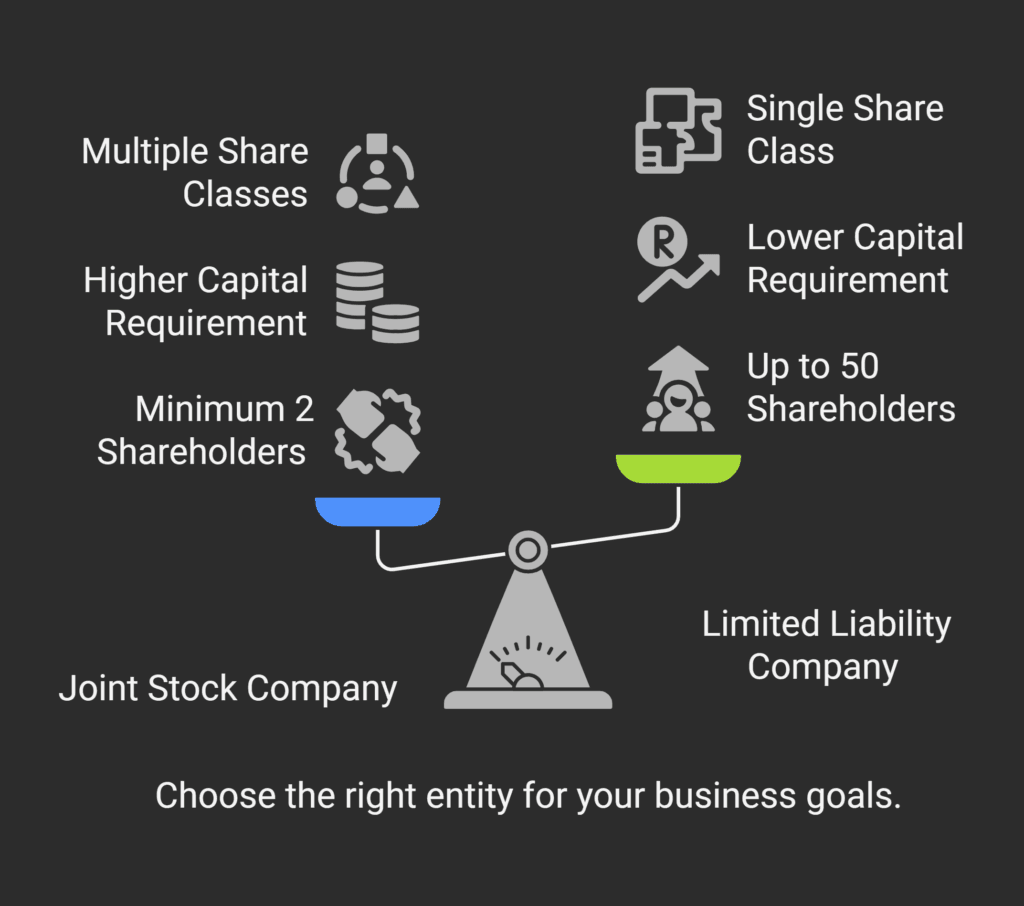
  1. Limited liability companies (SRL), which are often preferred by smaller businesses due to their simpler organizational structures.
  2. Joint-stock companies (SA), designed for larger enterprises and characterized by more complex governance procedures.

Ultimately, the selection between these legal structures will influence the company’s meeting and decision-making protocols.

Legal Entities and Their Responsibilities

As legal entities, Romanian companies bear specific responsibilities under Romanian law.

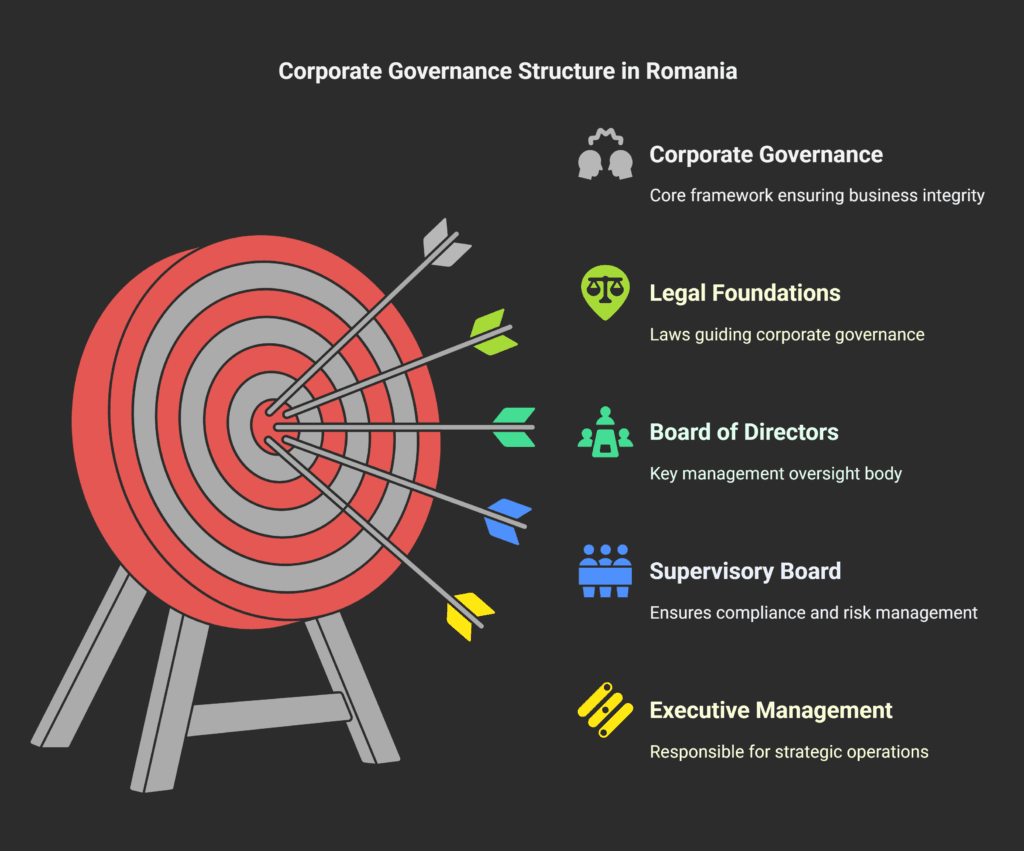
The board of directors, or the management board, plays a pivotal role in overseeing the company’s operations and ensuring compliance.

Members of the board are entrusted with representing the company, and their actions must align with both the law and the company’s articles of association.

The company is managed in accordance with the law, and the directors or the management board are responsible for preparing financial statements of the company and filing them with the Trade Registry.

Shareholder Meetings in Romania

A clock on the wall shows the time during the meeting.

Types of Shareholder Meetings

Under Romanian company law, various types of shareholder meetings serve distinct purposes.

These meetings are critical for the management of companies, ensuring transparency and shareholder involvement.

For example:

  1. The annual general meeting is a mandatory gathering where shareholders review the financial statements of the company and elect the board of directors or supervisory board.
  2. Extraordinary general meetings are convened to address specific, urgent issues such as amending the articles of association, increasing the share capital of the company, or approving significant transactions.

Convene Procedures for Shareholder Meetings

To convene a shareholder meeting, Romanian companies must adhere to specific procedures.

The board of directors, or in some cases, the supervisory board, must issue a notice to all shareholders, detailing the meeting’s agenda, date, time, and location.

This notice must be sent within the timeframe prescribed by Romanian company law and the company’s articles of association.

Failing to follow these procedures may invalidate the resolutions of the general meetings passed during the meeting, potentially leading to legal challenges.

Amending Resolutions in Shareholder Meetings

Shareholders can amend resolutions during the shareholder meeting under Romanian law, provided the proposed amendments are within the scope of the original agenda.

The process typically involves a motion to amend, followed by a vote among the shareholders.

For significant amendments, such as those affecting the articles of association, a supermajority vote may be required, and the amended resolution must be filed with the Trade registry.

Understanding these procedures is vital for effective corporate governance in Romanian companies.

The Role of the Board of Directors

A woman presenting a report on a screen in front of the board.

Composition of the Board of Directors

The composition of the board of directors is a critical element in the management of the company.

Under Romanian company law, the Articles of association of Romanian companies will specify the number of members of the board, their qualifications, and the process for their appointment.

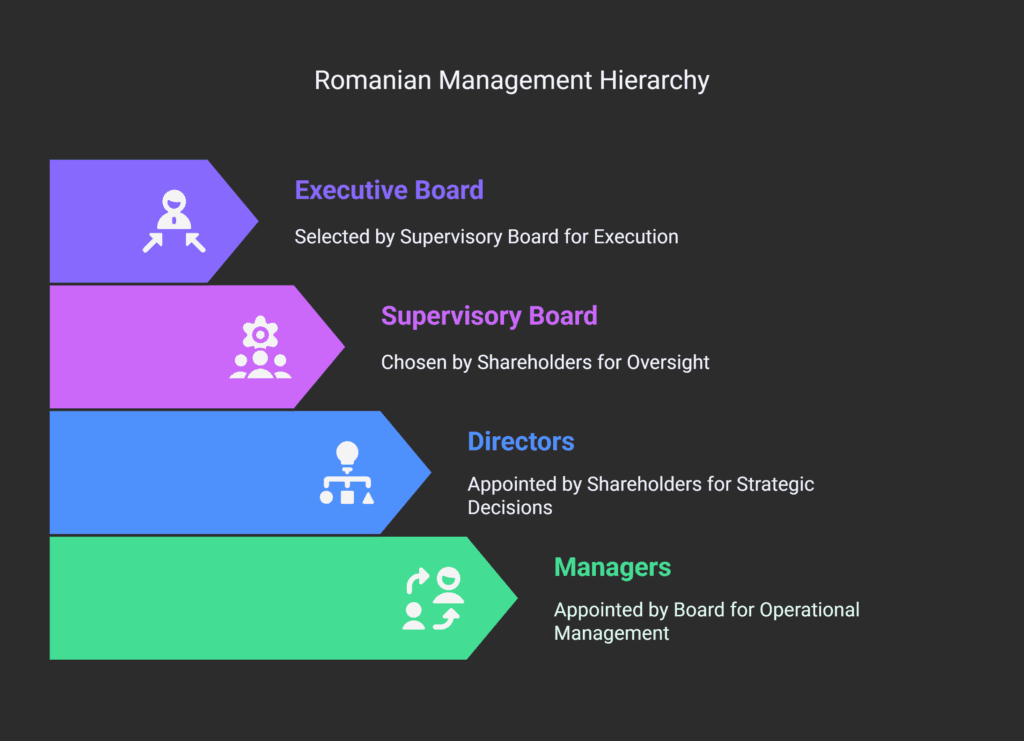
In joint stock companies, the shareholder structure dictates that some directors or the management board are appointed by the general meeting of shareholders, ensuring the shareholder interests are adequately represented.

This structure aims to balance expertise and shareholder oversight.

Duties and Responsibilities of Board Members

Members of the board have extensive duties and responsibilities under Romanian law.

They are entrusted with the strategic direction of the company in Romania, ensuring compliance with regulations, and safeguarding the interests of all shareholders.

The board of directors is responsible for overseeing the financial statements of the company, ensuring their accuracy and timely filing with the trade registry.

In joint stock companies, the board also manages risk, sets policy, and monitors the performance of the management board, upholding their fiduciary duty to the company.

Decision-Making Processes in Board Meetings

Effective decision-making in board meetings is crucial for the success of Romanian companies.

The process typically involves presenting agenda items, facilitating discussion, and voting on resolutions.

The Articles of association often prescribe specific voting thresholds for different types of decisions.

For significant matters, such as amending the Articles of Association or increasing the share capital of the company, a qualified majority or even unanimous consent may be required.

Proper documentation of these decisions in the meeting minutes is essential for transparency and accountability, and the minutes should be filed with the trade registry as appropriate.

General Meetings: Best Practices

Several individuals are engaged in discussion, with some taking notes.

Planning and Conducting General Meetings

Effective planning is essential for successful general meetings in Romanian companies.

The board of directors must meticulously plan the agenda, ensuring all relevant items are included and clearly defined.

Romanian company law mandates that the Articles of Association dictate the specific procedures for these meetings.

As an expert legal services provider, we emphasize that proper notice must be given to all shareholders, and the meeting should be convened in a manner that promotes transparency and active participation, whether for limited liability companies or joint stock companies.

We are dedicated to helping our clients navigate these processes smoothly.

Legal Requirements for General Meetings

Adherence to legal requirements is paramount for general meetings in Romania.

Romanian law stipulates specific rules for voting, quorum, and documentation of resolutions of the general meetings.

The board of directors must ensure that all procedures align with both Romanian company law and the articles of association.

Members of the board must understand that failure to comply can invalidate the meeting’s outcomes, potentially leading to legal challenges.

Our firm provides expert guidance to Romanian companies in navigating these complex legal obligations, ensuring compliance and protecting shareholder interests.

Best Practices for Effective Communication

Effective communication is a cornerstone of successful general meetings.

Members of the board should ensure that information is presented clearly and concisely, allowing all shareholders to understand the issues at hand.

In Romanian companies, this includes providing materials in Romanian and, potentially, other languages if international shareholders are involved.

Encouraging open dialogue and addressing shareholder concerns promotes trust and transparency.

As a client-focused firm, we emphasize the importance of proactive communication to facilitate productive and legally sound board meetings.

Recent Developments in Romanian Company Law

Documents and folders are neatly arranged on the table for review.

Changes Impacting Board Meetings

Recent changes in Romanian company law have significantly impacted board meetings.

Amendments related to corporate governance and shareholder rights necessitate that directors or the management board stay informed and adapt their practices accordingly.

These changes may affect procedures for votes, the handling of resolutions, and the overall management of the company.

As an expert team of Romanian lawyers, we closely monitor these developments and provide timely advice to our clients, ensuring their companies remain compliant and competitive.

These updates are particularly relevant for both limited liability companies and joint stock companies.

Emerging Trends in Corporate Governance

Emerging trends in corporate governance are reshaping how Romanian companies conduct board meetings.

There is a growing emphasis on transparency, accountability, and environmental, social, and governance (ESG) factors.

Companies are increasingly adopting digital solutions to streamline meeting processes and enhance shareholder engagement.

The articles of association of Romanian companies are evolving to reflect these trends, often requiring more detailed reporting and greater shareholder involvement.

We assist our clients in integrating these best practices to enhance their corporate governance frameworks and attract investment.

Case Studies of Successful Board Practices

Examining case studies of successful board practices provides valuable insights for Romanian companies.

Instances where board meetings effectively addressed critical challenges, implemented innovative strategies, or improved shareholder relations offer practical lessons.

These examples often highlight the importance of diverse members of the board, robust decision-making processes, and proactive risk management.

We leverage our experience and expertise to help clients implement similar strategies, fostering a culture of excellence and driving sustainable growth for Romanian companies across various sectors, including both limited liability and joint stock companies.

FAQ:

What are the requirements for conducting board meetings in Romania?

In Romania, board meetings must comply with the applicable legislation, which includes the requirements set forth by the Romanian legislation.

Companies are required to convene meetings in accordance with their articles of association, which dictate the procedures shareholders must follow.

Additionally, the meeting must be held at the registered office or another location specified in the convening notice.

How can shareholders participate and vote in general shareholder meetings?

Shareholders can participate and vote in general shareholder meetings either in person or through electronic means.

The recent legal framework removes the requirement for companies to include identification data in the meeting notice, making it easier for shareholders to engage in the voting process, including the use of electronic voting in general.

What is the role of the supervisory board in Romanian companies?

The supervisory board is responsible for overseeing the management of the company and may appoint one or more directors.

Members of the supervisory board are appointed either directly by shareholders or through the general shareholder meeting, which can delegate this authority.

Their role is crucial in ensuring that the company adheres to the current legal framework concerning operational and strategic decisions.

How does electronic communication impact board meetings in Romania?

Electronic communication has transformed the way board meetings are conducted in Romania.

Companies may now utilize electronic means to convene meetings, allowing for greater flexibility and accessibility.

This shift aligns with the needs of the business, enabling stakeholders to participate remotely while ensuring compliance with the legal requirements set forth in the recent amendments to Romanian law.

What happens if a company fails to comply with the legal framework during a board meeting?

If a company fails to comply with the legal framework concerning board meetings, it may face legal repercussions, including invalidation of decisions made during the meeting.

The current legal framework emphasizes the importance of adhering to the stipulated procedures, such as ensuring that the convening notice is published at least 30 days prior to the meeting and that all necessary documentation is submitted.

Can a company hold a general shareholder meeting without the presence of all shareholders?

A general shareholders’ meeting may proceed without the attendance of all shareholders, as long as the required quorum is met.

Shareholders representing the absolute majority of the share capital must be present, either in person or via electronic means, for decisions to be valid.

The company’s articles of association typically specify the exact quorum requirements.

What are the implications of the deadline of 6 December 2024 for Romanian companies?

The deadline of 6 December 2024 is significant as it marks the date by which companies must comply with the new legal framework concerning board meetings and shareholder communications.

Companies that fail to meet these requirements may face penalties or other legal consequences.

It is essential for companies to stay informed and adjust their procedures accordingly to ensure compliance with the amended legislation.

How do secondary offices relate to board meetings in Romania?

Board meetings are generally held at the registered office.

Secondary offices may play a role in the operations of a company, particularly for those with representative offices in different locations.

However, companies may also convene them at secondary offices, provided this is specified in the articles of association.

This allows for greater flexibility in operations and can help accommodate shareholders who may be located in various regions.


Remote Company Formation Romania

Remote Company Formation Romania: Digital Process 2025

Remote Company Formation Romania: Digital Process 2025

A person sits at a desk with a laptop and a cup of coffee, looking at a website about company formation.


Setting up a business in Romania has become increasingly streamlined, especially with advancements in digital processes.

This article serves as a comprehensive guide, focusing on several key aspects:

  1. Understanding remote company formation in Romania.
  2. Highlighting the nuances of Romanian law.
  3. Exploring the opportunities Romania offers for entrepreneurs seeking to register a company.

We aim to clarify the requirements and procedures for company registration in Romania, ensuring a smooth and efficient company formation process.


Understanding Company Formation in Romania

A person is video calling on a computer with a notepad in front of them.

Company formation in Romania involves navigating a specific legal and administrative landscape.

Understanding the nuances of the Romanian Trade Register and relevant legislation is crucial for seamless company registration.

Whether you are starting a company in Romania remotely or planning a physical presence, grasping the fundamentals will help you make informed decisions and ensure your business aligns with all legal requirements.

Many entrepreneurs find Romania offers a strategic location within the European Union, making understanding company formation in Romania paramount.


The Importance of Company Registration in Romania

Company registration is the cornerstone of legitimacy and operational capacity for any business in Romania.

By officially registering your company, you gain legal entity status, enabling you to enter into contracts, open a bank account in Romania, and conduct business activities within the Romanian legal framework.

Furthermore, proper company registration in Romania ensures compliance with Romanian tax regulations, including VAT and corporate tax, which is essential for sustainable growth and avoiding legal complications when starting a company in Romania.

Types of Romanian Companies

Romania offers several business structures for entrepreneurs, with the SRL (limited liability company) being the most popular.

Other options include the joint stock company (SA), suitable for larger ventures needing to raise capital through shares.

Each type has specific legal requirements, including minimum share capital and shareholder responsibilities.

Selecting the right structure is vital for aligning with your business goals and operational needs, especially if you’re looking at company formation Romania or even remote company formation.

Legal Framework Governing Company Registration

The legal framework governing company registration in Romania is primarily dictated by the Romanian Company Law No. 31/1990, alongside other relevant laws concerning business registration and trade.

This framework outlines the processes for registering a company, the necessary documentation, and the ongoing compliance requirements for Romanian companies.

Atrium Romanian Law Office possesses a deep understanding of the Romanian legal system and stays up-to-date on the latest legislative changes, ensuring clients receive accurate and effective guidance.

Navigating this framework is essential for anyone looking to set up a company in Romania.

Step-by-Step Guide to Registering a Company Remotely

A coffee cup next to a laptop, symbolizing a comfortable workspace.

Initial Considerations for Starting a Company in Romania

For international business owners aiming to expand or operate within Romania, certain initial considerations are crucial for successful company formation in Romania.

Understanding the Romanian market dynamics, including consumer behavior and competitive landscape, is essential.

Additionally, assessing the specific legal requirements and regulatory environment governing your industry in Romania will ensure compliance from the outset.

Addressing these initial aspects will lay a solid foundation for setting up a business and achieving long-term success as legal entities.

Document Requirements for Company Registration

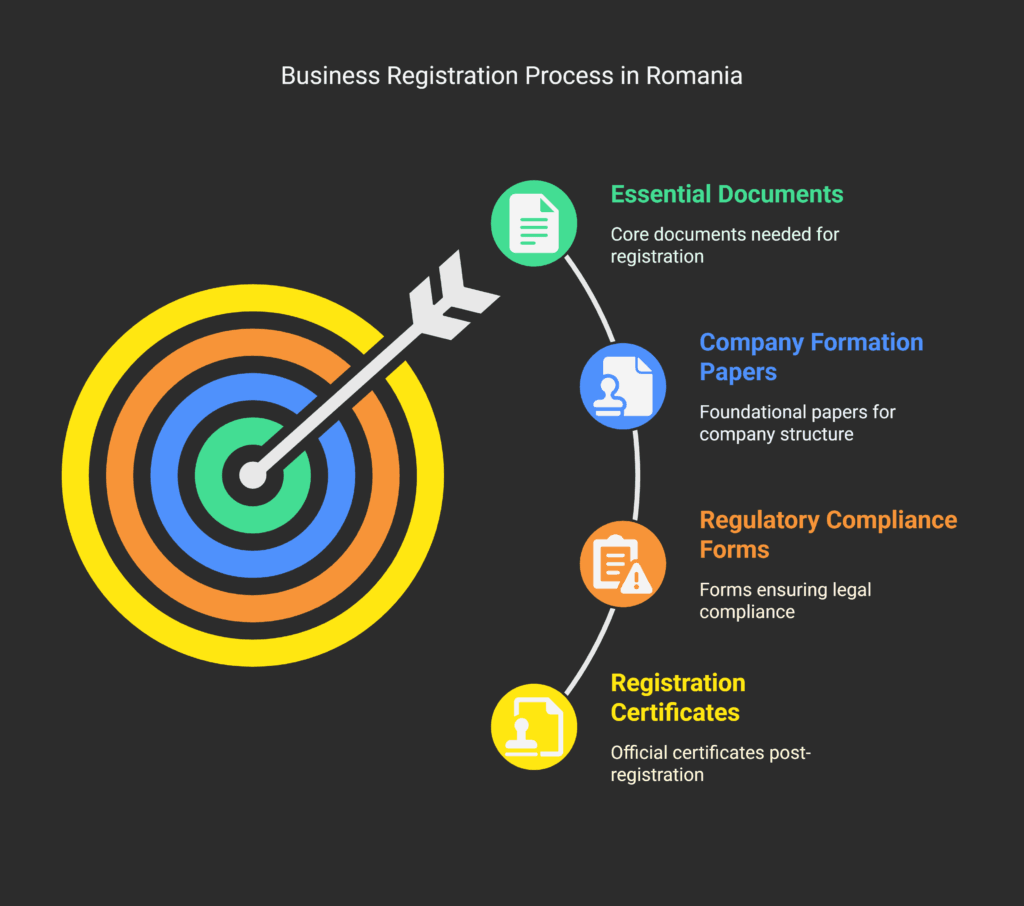
The document requirements for company registration in Romania are comprehensive and precise, ensuring transparency and legal compliance during the company formation process.

Typically, these include the articles of association, identification documents for shareholders and directors, and proof of registered office address.

If registering a company remotely, notarized copies and officially translated documents are often necessary, especially for international founders.

Atrium Romanian Law Office provides invaluable legal assistance in ensuring compliance with these matters, streamlining the registration process.

Choosing a Company Name and Legal Structure

Selecting an appropriate company name and business structure is a pivotal step when starting a company in Romania.

The company name must be unique and comply with Romanian Trade Register regulations.

The choice of legal structure, such as an SRL (limited liability company) or SA (joint stock company), impacts liability, tax rate, and administrative obligations.

Atrium aims to be the best in handling complex and challenging legal matters, providing expert guidance to ensure you select the optimal business structure that aligns with your business goals and legal requirements.

The Digital Process of Company Registration in Romania

Documents are neatly arranged on a table, symbolizing the paperwork needed for registration.

Online Platforms for Company Registration

The digitization of company registration in Romania has led to the emergence of several online platforms designed to streamline the process.

These platforms typically offer a user-friendly interface where entrepreneurs can submit required documents, track the progress of their application, and communicate with the Romanian Trade Register.

While the central Trade Register does not yet offer a fully integrated online portal, authorized service providers can assist with digital submissions, making the company formation process more efficient and accessible for those registering a company.

Steps for Online Company Registration

The steps for online company registration in Romania generally mirror the traditional process but leverage digital tools to expedite company formation.

This involves preparing and digitizing all required documents, submitting them through an authorized platform, and paying the necessary fees online.

Verification and processing times may vary, but the online approach often reduces administrative delays, making it an attractive option for entrepreneurs aiming to set up a company efficiently.

Atrium Romanian Law Office can assist with this step-by-step guide.

Engaging Notaries and Power of Attorney

While the digitalization of company registration is advancing, the involvement of a notary is still often required, especially when registering a company remotely.

A notary public is essential for authenticating certain documents and ensuring compliance with legal requirements.

If founders cannot travel to Romania, granting a power of attorney to a local representative is a viable solution.

Atrium Romanian Law Office can act as a power of attorney for setting up a business in Romania.

Banking and Financial Requirements for Romanian Companies

A person types on a laptop while surrounded by various financial reports.

Opening a Bank Account for Your Romanian Business

Opening a bank account is a critical step in the company setup process.

A Romanian bank account is essential for managing your company’s finances, processing transactions, and complying with local regulations.

The process typically involves submitting company registration documents, identifying shareholders and directors, and adhering to the bank’s due diligence procedures.

Having a bank account in Romania is necessary to manage transactions in EUR and for paying your corporate tax and VAT.

Understanding Share Capital Regulations

Share capital is a fundamental aspect of company formation in Romania, representing the investment made by shareholders in the company.

For an SRL (limited liability company), the minimum share capital is relatively low, making it accessible for small and medium-sized businesses.

Understanding these regulations is crucial for complying with Romanian company law and avoiding potential legal complications when starting a company.

Tax Registration and Compliance

These are vital for all Romanian companies.

After company registration, businesses must register for VAT (if applicable) and income tax.

The standard corporate tax rate in Romania is competitive within the EU, making it an attractive destination for investors.

Regular tax filings and adherence to Romanian tax laws are essential for maintaining good standing and avoiding penalties. Atrium Romanian Law Office provides expertise in Tax Law, ensuring compliance and optimizing tax strategies.

Challenges and Solutions in Remote Company Formation

A stack of documents is neatly arranged next to a coffee cup.

Common Hurdles in Company Setup

Undertaking company formation in Romania remotely presents unique challenges for international entrepreneurs.

A significant obstacle is lack of familiarity with complex Romanian laws and regulations, especially concerning business registration.

Potential language barriers can further complicate communication with local authorities and service providers.

The sheer complexity of setting up a business in a foreign country, including navigating administrative procedures and understanding legal requirements, can also be daunting.

However, these hurdles can be overcome with proper planning and expert guidance when starting a company.

Legal and Administrative Support for Foreign Entrepreneurs

Atrium Romanian Law Office provides comprehensive legal services in multiple languages, including English, French, and German, catering specifically to the needs of foreign entrepreneurs.

Our expertise covers all aspects of company formation in Romania, from initial consultation to final company registration. We offer tailored legal solutions, addressing the unique challenges faced by international businesses.

Atrium Romanian Law Office stands as a reliable partner, ensuring a smooth and compliant entry into the Romanian market when registering a company.

Resources for Navigating Company Formation

Our team of Romanian Lawyers emphasizes understanding the unique needs of each client and providing tailored legal solutions.

We offer a range of resources designed to assist entrepreneurs in navigating the company formation process.

These resources include detailed guides, personalized consultations, and ongoing support to ensure compliance with Romanian laws and regulations.

Our client-centric approach ensures that each business in Romania receives the individualized attention and legal guidance necessary for success, especially when registering a company.

Future Trends in Company Formation in Romania

A futuristic city skyline is visible through a window, symbolizing progress.

Impact of Technology on Business Registration

Technology is rapidly transforming business registration worldwide, and Romania is no exception.

The increasing use of online platforms, digital signatures, and automated processes is streamlining the company formation in Romania process.

This trend is making it easier and faster for entrepreneurs to register a company in Romania, reducing administrative burdens and promoting efficiency.

Embracing technological advancements is crucial for Romanian companies to remain competitive in the global market.

Emerging Trends in the Romanian Business Landscape

The Romanian business landscape is evolving, driven by factors such as increasing foreign investment, technological innovation, and a growing focus on sustainability.

Emerging trends include the rise of e-commerce, the adoption of digital technologies across various industries, and a greater emphasis on corporate social responsibility.

These trends present both opportunities and challenges for Romanian companies, requiring adaptability and strategic planning to thrive in the changing environment.

Atrium Romanian Law Office offers insightful legal guidance to navigate these trends and capitalize on new opportunities when starting a company.

Policy Changes Affecting Company Formation

Government policies and regulations play a significant role in shaping the company formation landscape in Romania.

Staying informed about these policy changes is essential for entrepreneurs and investors.

Atrium Romanian Law Office closely monitors legislative developments and provides timely updates and expert advice to help clients adapt to the evolving regulatory environment and ensure compliance when registering a company

FAQ:

What is the process for remote company formation in Romania?

The process for remote company formation in Romania involves several legal steps, including selecting a company name, establishing a legal address, and registering with the National Trade Register Office.

You can complete most of the requirements online, making Romania an ideal location for setting up a company remotely.

What types of companies can I establish in Romania?

You can establish various types of companies in Romania, including limited liability companies (SRL) and joint stock companies.

The choice depends on the type of business you want to run and the number of shareholders involved.

Each structure has its own legal requirements and implications.

How do I register my company in Romania?

To register your company in Romania, you need to submit the necessary documents to the National Trade Register Office.

This includes your company name, legal address, and proof of share capital.

The registration process can typically be completed online, streamlining the company setup.

What legal address do I need for a company in Romania?

Your company in Romania must have a legal address, which is where official correspondence will be sent.

This address can be a commercial space or an office, but it must be registered with the National Trade Register Office during the company registration process.

What are the tax obligations for companies in Romania?

Can I open a bank account in Romania as a foreigner?

Yes, foreigners can open a bank account in Romania.

You will need to provide identification and documents related to your registered company, such as your Articles of Association and proof of registration.

Many Romanian banks offer services tailored for foreign business owners.

What are the benefits of setting up a company in Bucharest?

Bucharest is the capital of Romania and offers numerous advantages for business formation, including a vibrant economy, access to a skilled workforce, and a central location within Europe.

Additionally, the Romanian government provides various support services for growing your business in Romania.

How long does it take to register a company in Romania?

The registration process for a company in Romania typically takes about 5 to 10 working days, depending on the completeness of your documents and the efficiency of the National Trade Register Office.

Utilizing online services can expedite the establishment of your company.

What are the accounting services required for a business in Romania?

All companies in Romania must maintain proper accounting records and submit annual financial statements.

It is advisable to hire local accounting services to ensure compliance with Romanian tax laws, including income tax and VAT obligations, as well as to facilitate smooth operations in Romania.


Tax residency Romania

Romanian Tax Residence: A Guide to Tax Residency in Romania

Romanian Tax Residence: A Guide to Tax Residency in Romania

A person sitting at a desk with a laptop and tax documents spread out.

Navigating the complexities of the Romanian tax system can be daunting, especially when determining your tax obligations as a resident or non-resident.

This guide provides a comprehensive overview of tax residence in Romania, covering key aspects such as defining tax residency, understanding the Romanian tax system, and fulfilling your tax responsibilities.

Understanding Tax Residency in Romania

A group of people discusses tax forms around a table.

Determining your tax residency status in Romania is crucial for understanding your tax obligations.

Whether you are an expat, a foreign investor, or a Romanian citizen living abroad, understanding the rules of Romanian tax residence is essential for compliance with Romanian law and avoiding potential tax liabilities.

Definition of Tax Residency

Tax residence in Romania dictates how the Romanian tax authorities will treat your income.

A tax resident in Romania is subject to taxation on his or her worldwide income.

Understanding this definition is the first step in navigating the Romanian tax system, particularly for those with income sources outside Romania.

Criteria for Establishing Tax Residency

The primary criterion for establishing tax residency in Romania is spending more than 183 days in Romania within any 12-month period.

However, other factors can also contribute to determining your tax residency status, such as having your vital interests centered in Romania, including personal and economic ties, playing a crucial role in determining if someone is considered a tax resident.

Differences Between Resident and Non-Resident Status

Tax residents are subject to taxation on their worldwide income, while non-residents are only taxed on income sourced from Romania.

This distinction is vital for understanding your tax liabilities and completing accurate tax returns in accordance with Romanian law.

The Romanian Tax System

A person is reviewing documents while sipping coffee.

The Romanian tax system is governed by a range of legislation and regulations, impacting both individuals and businesses.

A solid understanding of this system is crucial for anyone considered a tax resident in Romania, ensuring compliance and effective financial management.

Furthermore, being a tax resident in Romania demands that individuals understand how to fulfill their tax obligations.

Overview of Romanian Tax Authorities

The main tax authority in Romania is the National Agency for Fiscal Administration (ANAF).

ANAF is responsible for the collection of taxes and enforcing tax legislation across the country.

Dealing effectively with the Romanian tax authorities requires understanding their procedures and ensuring all submissions are compliant with Romanian law.

Types of Taxes Applicable to Residents

Romanian tax residents are subject to various taxes, including income tax, social security contributions, and local taxes.

The flat income tax rate is a key feature of the Romanian tax system.

Understanding these different types of taxes is essential for proper fiscal planning and compliance.

How Tax Obligations are Determined

Tax obligations in Romania are primarily determined by your tax residency status and the type of income you earn.

Salary income, for example, is subject to specific tax and social security contributions, which are typically handled by the Romanian employer.

Properly declaring all income and understanding applicable tax treaties is crucial for accurate tax payments.

Tax Returns and Filing Requirements

A calendar on the wall highlights important tax filing deadlines.

Annual Tax Return Responsibilities

As a tax resident in Romania, you have an annual obligation to declare your worldwide income.

Ensuring compliance with Romanian law requires a thorough understanding of the tax legislation and accurate record-keeping of all financial transactions throughout the fiscal year.

Failure to submit accurate annual tax returns can result in tax liabilities and penalties in accordance with the Romanian tax code.

How to Declare Worldwide Income

Declaring your worldwide income as a tax resident involves completing and submitting the appropriate tax return forms to the Romanian tax authorities, ANAF.

These forms require a detailed account of all income sources, including salary, investments, and other earnings, both inside and outside Romania.

It’s important to accurately report all income.

Seeking professional tax advice can aid in correctly declaring your worldwide income.

Deadlines and Procedures for Filing Tax Returns

Adhering to the deadlines and procedures for filing tax returns is crucial.

Understanding the filing procedures, including online submission and required documentation, is essential for avoiding penalties.

Keep in mind that failure to comply with these provisions can result in tax liabilities and legal repercussions under Romanian law.

Implications of Tax Residency for Expats

A calculator and a notepad are placed beside a cup of coffee.

Tax Residency Status for Foreign Workers

If expats spend more than 183 days in Romania within a 12-month period, they are generally considered tax residents.

Understanding this threshold is essential for expats to comply with Romanian tax obligations and avoid potential issues with the Romanian tax authorities, ANAF.

Double Taxation Agreements and Their Importance

Double taxation agreements (tax treaties) prevent individuals from being taxed twice on the same income.

Romania has several tax treaties with EU member states and other nations to alleviate double taxation.

These agreements typically provide provisions for determining which country has the primary right to tax certain types of income, thereby impacting the tax obligations of expats and other tax residents in Romania.

Relocating for Work: Tax Considerations

Relocating to Romania for employment necessitates careful consideration of various tax implications.

Before relocation, expats should familiarize themselves with Romanian tax legislation to understand their potential tax obligations.

Factors such as employment contracts, salary, and the intention to spend more than 183 days in Romania within a 12-month period all impact tax residency status.

Consulting with tax professionals can ensure a smooth transition and compliance with the Romanian tax system.

Fiscal Obligations of Romanian Tax Residents

A calendar marked with tax deadlines and reminders.

Understanding Personal Income Tax Rates

As a tax resident in Romania, it’s crucial to understand the applicable personal income tax rates.

Romania operates with a flat income tax rate, currently set at 10%.

Understanding how this flat rate impacts your overall tax liabilities is essential for effective fiscal planning and budgeting as a tax resident.

Tax Deductions and Credits Available

Romanian tax legislation provides several tax deductions and credits that tax residents can utilize to reduce their tax obligations.

Expert guidance can help maximize your eligible deductions, ensuring compliance with Romanian law.

Consequences of Non-Compliance with Tax Obligations

Failure to comply with Romanian tax obligations can result in significant penalties and legal repercussions.

Ensuring accurate and timely tax compliance is crucial to avoid these potential adverse consequences for all Romanian tax residents.

Conclusion and Key Takeaways

A group of diverse people discussing documents around a table.

Summary of Romanian Tax Residency Principles

Spending more than 183 days in Romania within a 12-month period typically establishes tax residency, subjecting individuals to taxation on their worldwide income.

Understanding the nuances of Romanian tax residence is vital for compliance with Romanian law and fulfilling tax obligations, particularly for expats and those with income sourced outside Romania.

Important Resources and Links for Further Information

To further navigate the intricacies of Romanian tax residency, several resources are available.

The website of the National Agency for Fiscal Administration (ANAF) provides comprehensive information on tax legislation, tax returns, and filing procedures.

Consulting with a tax advisor specializing in Romanian tax law can provide tailored advice based on your specific circumstances.

Staying informed through these channels ensures compliance and maximizes tax efficiency as a tax resident.

Final Thoughts on Tax Residency in Romania

Navigating tax residency in Romania requires careful attention to detail and a thorough understanding of the applicable legislation.

As a tax resident in Romania, being aware of your tax obligations, understanding the Romanian Fiscal Code, and seeking professional guidance when needed are crucial for maintaining compliance.

Proactive management of your tax affairs ensures financial well-being and peace of mind while operating within the Romanian legal framework.

What is fiscal residency in Romania?

Fiscal residency in Romania refers to the legal status of individuals who are considered residents for tax purposes.

To be deemed a fiscal resident, one must meet specific residence criteria, such as having a permanent home in Romania or residing in the country for 183 days within a calendar year or 12 consecutive months.

How can foreign nationals establish tax residency in Romania?

Foreign nationals can establish tax residency in Romania by ensuring they meet the necessary residence criteria.

This includes having a permanent home in Romania or staying in the country for the required duration.

Additionally, registering with the Romanian tax authorities and notifying them of your residency status is crucial.

What are the tax obligations for residents in Romania?

Residents in Romania are liable to pay taxes on their worldwide income, which includes income obtained from employment activities, investments, and other sources.

They must also comply with mandatory social contributions and any reporting obligations set by the Romanian fiscal code.

How long do I need to reside in Romania to be considered a tax resident?

To be considered a tax resident in Romania, you must reside in the country for at least 183 days within a calendar year or maintain a permanent home there.

If you meet these conditions, you will be subject to Romanian tax laws.

Do I need to register with the tax authorities if I stay in Romania for less than 30 days?

If you are in Romania for less than 30 days, you typically do not need to register with the tax authorities.

However, it is advisable to check if your specific situation requires any notification or registration, especially if you have income sourced from Romania.

What happens if I do not meet the residence criteria?

If you do not meet the residence criteria for fiscal residency, you will be classified as a non-resident in Romania.

Non-residents are generally taxed only on their Romanian-source income, which may involve different tax rates and obligations compared to residents.

What is the standard procedure for establishing tax residency in Romania?

The standard procedure for establishing tax residency in Romania involves meeting the residence criteria, registering with the tax authorities, and submitting the necessary documents, including a questionnaire.

Additionally, if you are a foreign national, your tax documents may need to be translated into Romanian.

Are there any tax agreements in place to avoid double taxation?

Yes, Romania has tax agreements with various countries to avoid double taxation.

These agreements allow individuals to determine which country has the primary taxing rights on their income, thereby preventing tax liabilities in both the source country and Romania.

What are the implications of having a job with a salary in Romania?

If you are employed and receive a salary in Romania, you will be subject to Romanian tax laws and must fulfill your tax obligations as a resident if you meet the residence criteria.

This includes paying taxes on your income and contributing to mandatory social contributions.

What should I do if my circumstances change and I no longer meet the conditions for tax residency?

If your circumstances change and you no longer meet the conditions for tax residency, you must notify the tax authorities and update your residency status.

It’s essential to ensure compliance with all reporting obligations to avoid any penalties or issues related to your tax situation.

Minority Shareholder Rights in Romanian Companies

Minority Shareholder Rights in Romanian Companies: Legal Protections and Limits

Minority Shareholder Rights in Romanian Companies: Legal Protections and Limits

Can minority shareholders in Romanian companies protect their investments against decisions by controlling shareholders?

This question is vital for thousands of investors who contribute capital and oversight but own less than fifty percent of shares.

Minority shareholder rights in Romanian companies are a delicate balance between business efficiency and investor protection.

The legal framework, including Law No. 31/1990 on Commercial Companies, the Civil Code, and court precedents, offers safeguards.

These protections are for investors without voting control but with essential capital and market credibility.

Minority Shareholder Rights in Romanian Companies

Shareholder protection laws in Romania acknowledge the unique vulnerabilities of minority investors.

Majority shareholders might pursue strategies that benefit them at the expense of smaller shareholders.

The legal system counters these risks with mandatory information rights, judicial remedies, and procedural safeguards for fair treatment within corporate structures.

EU standards significantly influence Romanian legislation on minority investor rights. European directives dictate how Romanian companies must treat all shareholders, regardless of ownership percentage.

These protections go beyond basic voting rights to include access to corporate information, dividend distributions, and legal recourse against decisions harming minority interests.

A Romanian law office specializing in corporate matters offers critical guidance for minority shareholders.

Professional assistance helps investors understand their rights, evaluate corporate actions, and pursue remedies when necessary.

For expert legal services combining Romanian expertise with international standards, contact office@theromanianlawyers.com.

Key Takeaways

  • Romanian law defines minority shareholders as those holding less than 50% of company shares with specific legal protections
  • Law No. 31/1990 on Commercial Companies provides the primary framework for shareholder rights and corporate governance,
  • Minority investors possess information rights, voting privileges, and access to judicial remedies against unfair treatment,
  • EU directives strengthen minority investor protections through enhanced transparency and governance standards
  • Professional legal counsel helps minority shareholders understand and exercise their rights effectively,
  • Romanian courts offer multiple remedies including resolution annulment, compensation, and forced company dissolution.

Understanding the Legal Framework for Minority Shareholders in Romania

The protection of minority shareholders in Romania is rooted in detailed business legislation.

This legislation sets out clear guidelines for corporate governance.

It ensures that even those with smaller stakes receive fair treatment and have a say in company decisions.

The level of protection depends on the company type and the percentage of shares held.

Law No. 31/1990 on Commercial Companies as the Primary Legislation

Law 31/1990 is the cornerstone of corporate law in Romania, covering all private companies and outlining fundamental shareholder rights.

This legislation, backed by the  Civil Code, strikes a balance in corporate governance.

It deals with essential topics like shareholder meetings, voting, access to information, and legal recourse for minority shareholders.

Romanian companies law framework

Distinction Between Limited Liability Companies (SRL) and Joint Stock Companies (SA)

Romanian companies law 31/1990 distinguishes between two main types of commercial entities.

Each has its own governance structure:

Company TypeMinimum CapitalShareholder RightsMeeting Requirements
SRL (Limited Liability)1 RONAll shareholders can propose agenda itemsSimple majority decisions
SA (Joint Stock)90,000 RON5% threshold for special rightsQualified majority for major decisions

Definition and Thresholds for Minority Shareholders

In Romania, minority shareholders are those with less than 50% of shares.

The law sets specific thresholds for enhanced rights.

In joint stock companies, those with at least 5% can call for a general meeting and suggest agenda items.

Even single-share owners in SRLs have significant rights, including the right to challenge unlawful decisions in court.

Fundamental Information Rights and Corporate Transparency

Information access is key to protecting shareholders in Romania.

The Romanian Company Law outlines detailed rights for shareholders.

These rights allow them to track company activities and make informed choices.

This ensures that even small investors can monitor their investments and hold management accountable.

Access to Financial Statements and Corporate Records

Romanian law ensures all shareholders can access critical company documents.

This includes annual financial statements, board meeting minutes, and corporate registers.

It’s vital for protecting minority shareholders to review balance sheets, profit and loss statements, and audit reports.

Companies must keep these records at their registered office and make them available during business hours.

minority shareholder protection documents

Rights to Request Explanations from Directors

Shareholders also have the right to ask directors for explanations.

They can pose questions about business operations, financial transactions, or strategic decisions.

Directors must respond clearly within 15 days.

This strengthens shareholder protection in Romania by ensuring management is accountable.

Notification Requirements for Shareholders’ Meetings

Meeting notification is another essential aspect of protecting minority shareholders in Romania.

Companies must announce general meetings at least 30 days in advance through official channels.

Notifications must include:

  • Complete meeting agenda,
  • Proposed resolutions text,
  • Voting procedures,
  • Documentation access details.

These rules prevent majority shareholders from making surprise decisions that could harm minority shareholders.

Courts actively enforce these rules, often annulling resolutions passed without proper notification.

Minority Shareholder Rights in Romanian Companies

Romanian corporate law offers vital mechanisms for minority shareholders to protect their interests.

These legal safeguards are key in preventing corporate abuse and ensuring fairness for all shareholders.

This fairness is not based on the size of their ownership stake.

Challenging Unlawful Resolutions Under Article 132

Article 132 of Law No. 31/1990 gives shareholders the power to challenge decisions that break the law or company statutes. This provision is a cornerstone in Romania’s fight against minority shareholder oppression.

Shareholders can seek court annulment of resolutions under these conditions:

  • Decisions breach Romanian commercial law
  • Articles of association are violated
  • Individual shareholder rights face infringement
  • Private interests override company welfare

Legal Standing and Time Limits for Court Actions

Any shareholder can challenge board decisions in Romanian courts.

The law sets a strict deadline—actions must be filed within 15 days from the date the resolution is published in the Monitorul Oficial al României, Part IV .

This tight timeframe demands constant vigilance and quick action against minority shareholder oppression.

shareholder remedies romania

Protection Against Abusive or Self-Interested Decisions

Romania’s corporate abuse protection goes beyond just procedural issues.

Courts also look at the substance of decisions affecting minority shareholders:

Type of AbuseExamplesAvailable Remedies
Financial OppressionWithholding dividends despite profitabilityCourt-ordered distributions
Dilution TacticsUnjustified share capital increasesResolution annulment
Exclusion PracticesBarring minorities from strategic decisionsGovernance reforms
Self-DealingUndisclosed related-party transactionsTransaction reversal

Romanian courts are active in reviewing cases of challenging majority decisions.

Judges determine if resolutions are for legitimate business reasons or just to benefit the majority at the expense of minorities.

Voting Rights and Meeting Participation

Protecting voting rights for minority shareholders is key in corporate governance in Romanian companies.

Romanian corporations must follow specific legal rules to ensure all shareholders, regardless of their share percentage, have a say in corporate decisions.

The law on voting rights in Romanian corporations sets clear thresholds.

This allows minority groups to influence major decisions.

Shareholders with at least 5% of shares can call for general meetings.

This ensures minority shareholders’ rights are protected, even without a majority.

voting rights shareholders romania

Voting rights in Romanian corporations vary between Limited Liability Companies (SRL) and Joint Stock Companies (SA).

In SRLs, every shareholder has more rights. They can:

  • Propose agenda items for general meetings,
  • Contest decisions deemed unlawful,
  • Exercise corporate voting rights Romania guarantees by statute.

Shareholders in Romania face some limitations.

Amendments to Law 31/1990 now allow electronic or correspondence voting, particularly in joint-stock companies (SAs)—especially when listed or when permitted under the articles of association.

For SRLs, remote voting remains subject to stricter interpretation and typically requires express provisions in the company statute.

Major corporate decisions need qualified majorities to protect minority shareholders’ rights.

Changes to company charters, liquidation, and major asset sales need at least three-quarters of voting shares approval.

Recent reforms have introduced cumulative voting.

Cumulative voting (permitting concentration of votes on a single board candidate) remains entirely optional, made possible only where provided in the articles of association.

While corporate governance codes for listed companies might encourage it, no legal mandate exists.

This strengthens minority shareholders’ voting power in board elections and improves their role in corporate governance.

Legal Remedies for Minority Oppression and Abuse

In Romanian companies, minority shareholders facing corporate minority oppression have legal recourse.

The courts aim to safeguard small investor rights from majority abuse.

This includes withholding dividends, excluding from decision-making, and unfair share dilution.

Remedies span from financial compensation to restructuring the company.

Financial Compensation and Annulment of Resolutions

Romanian courts can annul resolutions that harm minority investors.

Claims often stem from preferential treatment of directors through secret deals.

Shareholders receive financial compensation when corporate governance is breached.

oppression remedies romania

Company Dissolution and Enforced Exit Mechanisms

In severe cases, courts may dissolve the company.

They assess if operations are justified amidst ongoing conflicts.

Fair compensation is ensured in minority squeeze-out procedures, with judicial oversight.

Exit MechanismTrigger ConditionsCourt Requirements
Forced BuyoutSystematic exclusion from managementFair market valuation
Company DissolutionIrreparable deadlockNo viable alternatives
Squeeze-Out Rights95% ownership threshold (for listed companies) | Independent price assessment.
In unlisted companies, squeeze-out rights are not statutory and must be defined through shareholder agreements or pursued through court action in cases of abuse
Independent price assessment

Judicial Administrator Appointments in Governance Deadlocks

Courts appoint judicial administrators in governance deadlocks.

This addresses conflicts where squeeze-out procedures fail.

Administrators have temporary power to resolve issues, ensuring compliance with regulations.

Dividend Rights and Corporate Distribution Policies

Minority shareholder rights in Romanian companies are crucial for ensuring equitable treatment and protection against potential abuses by majority shareholders.

Under Romanian company law, minority shareholders often face challenges related to voting influence, dividend distribution, and participation in corporate governance.

The articles of association play a central role in defining the procedures for passing shareholder resolutions and transferring shares, which can significantly affect minority influence in the general meeting of shareholders.

In mergers, demergers, or corporate reorganizations, minority shareholders are entitled to receive fair treatment, including compensation where applicable, particularly if their shareholding is affected by structural changes or exit scenarios.

 Although share buybacks are legally permitted under strict conditions, they are not a typical tool for minority exits.

The Romanian courts have acknowledged the importance of safeguarding minority shareholder rights, and affected shareholders may bring legal actions to challenge unlawful decisions or seek remedies under Law No. 31/1990 on Companies.

The Trade Register (ONRC) ensures public access to essential information such as company capital, registered shareholders, and changes to governing documents, contributing to transparency for both limited liability companies (SRL) and joint stock companies (SA).

As Romania continues to align its corporate governance framework with EU directives and international standards, the development of more effective enforcement mechanisms remains key.

Ensuring meaningful participation and protection for minority shareholders is essential to building trust and accountability in the Romanian business environment.

Shareholder Agreements and Contractual Protections

Shareholders’ agreements in Romania offer vital protections beyond what’s mandated by law.

These agreements fortify minority positions with specific clauses addressing common issues in Romanian business structures.

Tag-Along Rights and Cumulative Voting Provisions

Tag-along rights safeguard minority investors during majority shareholder sales.

They ensure minority shareholders can sell at the same price and terms as the majority.

Cumulative voting rights, on the other hand, boost board representation by allowing concentrated voting on certain candidates.

Protection TypeKey BenefitsApplication in Romania
Tag-Along RightsEqual sale conditionsCommonly included in Romanian shareholder agreements—especially in joint ventures, private equity deals, or closely held companies—to protect minority investors during ownership changes
Cumulative VotingEnhanced board representationMandatory for listed companies
Drag-Along RightsFacilitates complete salesStandard in PE investments

Preemptive Rights in Share Transfers and Capital Increases

Preemptive rights in Romania safeguard shareholders from dilution.

These rights apply during capital increases and share transfers, ensuring ownership percentages remain proportional.

Exit Options for Minority Investors

Minority investors have exit options, including mandatory buyouts triggered by certain events.

Romanian agreements typically include valuation mechanisms for fair pricing.

Derivative Actions and Corporate Litigation Rights

Romanian law empowers minority shareholders to defend corporate interests through derivative actions.

These actions allow shareholders to sue on behalf of the company when directors act against its best interests.

This is a key part of resolving disputes in corporate settings, ensuring management is held accountable.

Derivative actions in Romania have strict rules.

Shareholders must prove that directors have not pursued rightful claims against wrongdoers.

The law allows for actions against directors for breaches of duty, conflicts of interest, and transactions that favor certain shareholders over the company.

Romanian courts assess both the process and fairness of minority shareholder lawsuits.

They check if claims are for the company’s benefit or personal gain.

This ensures only valid disputes are addressed, preventing frivolous lawsuits.

Type of ClaimLegal Standing RequirementsTime Limits
Breach of Fiduciary Duty5% ownership in SA, 10% in SRL3 years from discovery
Conflict of Interest TransactionsAny shareholder regardless of stake6 months from transaction
Corporate Asset Misappropriation5% ownership minimum5 years from occurrence

Despite its benefits, enforcing these rights in Romania is challenging.

Courts demand robust evidence and legal expertise in local commercial law.

Success in shareholder disputes hinges on grasping procedural details and presenting strong cases that clearly show corporate harm.

Evolution of Romanian Corporate Governance Standards

Corporate governance in Romania has seen major changes with the shift to a market economy.

The reopening of the Bucharest Stock Exchange in 1995 was a key moment.

It opened up the Romanian capital markets after a 50-year hiatus.

This event laid the groundwork for modern shareholder protection laws and opened doors for both local and international investors.

Impact of EU Directives on Shareholder Protection

Romania’s path toward European Union membership led to significant legislative improvements.

The Pistor index, a measure of investor protection, jumped from 13 points in 1996 to 17.75 between May 2002 and November 2006.

EU directives brought in essential protections for minority shareholders in Romanian joint stock companies:

  • Mandatory takeover bid thresholds protecting minority investors,
  • Independent share registries ensuring transparent ownership records,
  • Strict insider trading prohibitions,
  • Enhanced disclosure obligations for major transactions.

Bucharest Stock Exchange Requirements for Listed Companies

The exchange introduced a three-tier listing system with increasing strictness.

First-tier companies face the most demanding corporate governance standards.

These standards aim to boost transparency and accountability.

They also enhance minority protections through mandatory disclosure and regular financial reports.

Recent Legislative Developments and Reform Initiatives

Law No. 441/2006 brought significant changes to minority protections in Romanian Companies.

It reduced the quorum needed for certain decisions to one-quarter.

This change slightly lowered the protection index to 17.25.

Yet, recent reforms have tackled key areas like cumulative voting, compulsory takeover offers, and detailed transaction disclosure.

These steps reflect the growing demand for better governance from investors in Romania.

Conclusion

Romanian corporate law, as outlined in Law No. 31/1990, provides a robust framework for minority shareholder rights.

This legislation ensures that minority shareholders have access to corporate information and can participate in meetings.

They also have the right to challenge unfair resolutions and seek judicial remedies when their rights are violated.

These protections align with EU standards, solidifying Romania’s standing in the global business arena.

Despite these legal safeguards, minority shareholders face practical hurdles in Romanian corporate governance.

Companies often distribute minimal dividends, limiting returns for minority investors.

Share issuance restrictions also hinder market oversight, which could discipline management decisions.

Minority shareholders must remain vigilant, documenting governance failures and asserting their statutory rights.

The dynamic nature of shareholder protection laws in Romania necessitates ongoing monitoring of legislative changes and court interpretations.

Seeking professional legal representation is essential for minority shareholders facing complex corporate disputes.

A skilled Romanian lawyer is well-versed in both the statutory framework and practical strategies to protect minority interests.

Whether it’s pursuing annulment actions, seeking compensation, or negotiating exit arrangements, experienced counsel is vital.

For expert guidance on shareholder disputes and protection strategies, contact a reputable Romanian law office at office@theromanianlawyers.com.

The future of minority shareholder protection hinges on ongoing legislative refinement and judicial enforcement.

As Romania’s corporate landscape evolves, the balance between majority control and minority rights must be constantly adjusted.

Collaborating with knowledgeable lawyers in Romania ensures minority shareholders can effectively exercise their rights.

This contributes to enhanced corporate governance standards.

For tailored advice and protection strategies for your investments, contact experienced Romanian lawyers at office@theromanianlawyers.com.

FAQ

What percentage of shares qualifies someone as a minority shareholder under Romanian law?

Romanian corporate law defines minority shareholders as those owning less than 50% of shares.

This rule applies to both Limited Liability Companies (SRLs) and Joint Stock Companies (SAs).

Specific rights and thresholds can differ between these company types.

How long do minority shareholders have to challenge unlawful corporate resolutions in Romania?

Article 132 of Law No. 31/1990 states that minority shareholders must start legal actions within 15 days after a resolution is adopted.

This tight deadline is critical for shareholders to act quickly when they spot legal breaches or decisions that harm their rights.

What information rights do minority shareholders have in Romanian companies?

Romanian Company Law ensures minority shareholders can access corporate records like financial statements and meeting minutes.

They have the right to ask directors about company operations and must be informed about shareholders’ meetings and decisions.

Denying access to this information can lead to legal action.

Can minority shareholders in Romanian SRLs propose agenda items for general meetings?

Yes, in Limited Liability Companies (SRLs), any shareholder can suggest agenda items and challenge decisions, regardless of their shareholding percentage.

This gives them more participation rights than in Joint Stock Companies (SAs), where at least 5% is needed to request a general meeting.

What remedies exist for minority shareholders facing dividend withholding in profitable Romanian companies?

Romanian courts can order financial compensation or annul abusive resolutions.

In extreme cases, they might dissolve the company if majority shareholders consistently withhold dividends despite profitability.

Studies show companies with majority shareholders over 50% pay lower dividends, making judicial remedies key for minority protection.

How do tag-along rights protect minority shareholders in Romania?

Tag-along rights in shareholder agreements allow minority shareholders to sell their shares at the same price and conditions as majority stakeholders.

Can minority shareholders bring derivative actions against directors in Romanian companies?

Yes, Romanian law allows minority shareholders to take legal action on behalf of the company against directors who fail to pursue claims.

They can seek compensation for damages caused by directors’ breach of duties or conflicts of interest.

Courts assess both procedural and substantive fairness.

What voting threshold is required for fundamental corporate decisions affecting minority shareholders?

Romanian law demands a 3/4 qualified majority for key decisions like charter changes, liquidation, and major asset sales.

This supermajority ensures minority shareholders can block significant corporate changes that might harm their interests.

How has EU membership affected minority shareholder protections in Romania?

Romania’s EU accession boosted corporate governance standards, with the Pistor index increasing from 13 in 1996 to 17.25 in 2008.

EU directives introduced takeover bid thresholds, independent registries, insider trading bans, and enhanced disclosure, strengthening minority investor rights.

What are preemptive rights and how do they protect minority shareholders from dilution?

Preemptive rights prevent dilution by allowing minority shareholders to buy new shares proportional to their existing holdings during capital increases or share transfers.

Romanian courts uphold these rights, ensuring that minority positions are not unfairly diluted without participation opportunities.

What are the rights of minority shareholders in Romanian companies?

Minority shareholders in Romanian companies have several rights established by law that provide them protection in the company’s governance.

These rights include the ability to attend and vote in the general meetings of shareholders, access to the company’s financial information, and the right to propose resolutions.

Additionally, minority shareholders may request the court to intervene if their rights are violated or if they believe the company is not acting in its best interests.

How does the law protect minority shareholders during a merger?

The law provides specific protections for minority shareholders during a merger in Romania.

Minority shareholders have the right to fair compensation for their shares if they do not agree with the merger.

The company must publish the merger details in the official gazette and provide adequate information to all shareholders, ensuring transparency throughout the process.

Furthermore, minority shareholders may challenge the merger in court if they believe it violates legal provisions or the company’s articles of association.

Can minority shareholders influence decisions made at the general meeting of shareholders?

Yes, minority shareholders have the right to influence decisions made at the general meeting of shareholders.

They can vote on shareholder resolutions and may request to hold extraordinary general meetings if they hold at least a certain number of shares as established by the articles of association.

This ensures that even minority shareholders can contribute to significant decisions affecting the company, including changes in the share capital or the transfer of shares.

What is the significance of the trade registry for minority shareholders?

The trade registry plays a crucial role in protecting the rights of minority shareholders in Romanian companies.

It serves as the official record of the company’s structure, including the number of shareholders, their contributions to the share capital, and any changes to the company’s articles of association.

Minority shareholders can verify the company’s compliance with corporate governance rules and ensure that any resolutions or actions taken are legally binding and in their best interests.

What legal forms of companies exist that impact minority shareholder rights?

In Romania, there are two main types of companies that impact minority shareholder rights: joint-stock companies and limited liability companies.

Each legal form has specific regulations regarding shareholder rights, governance, and share capital.

For instance, in a joint-stock company, minority shareholders may have greater rights to information and participation in decision-making compared to a limited liability company.

Understanding these distinctions is essential for minority shareholders to navigate their rights effectively.

Crypto Romania 2025

What is a Beneficial Owner and How to Declare It in Romania

What is a Beneficial Owner and How to Declare It in Romania

A recent study found that many of Romanian companies don’t follow beneficial ownership rules.

Romania is working hard to fight money laundering and terrorist financing.

Knowing who the beneficial owner is and how to declare it is key for businesses there.

Beneficial Owner and How to Declare It in Romania

The beneficial owner, or ultimate beneficial owner (UBO), is the person who really owns or controls a company.

In Romania, Law No. 129/2019 requires companies to reveal their beneficial owners.

This is to boost corporate transparency and follow anti-money laundering (AML) rules.

If a company doesn’t declare its beneficial owner correctly, it could face big fines or even be shut down.

So, it’s vital for business leaders to grasp the rules about declaring beneficial owners in Romania.

They must follow these steps to stay in line.

Key Takeaways

  • Beneficial owner refers to the individual who ultimately owns or controls a company;
  • Romanian law requires companies to declare their beneficial owners for transparency;
  • Non-compliance with beneficial ownership declaration can lead to hefty fines and company dissolution;
  • Understanding the legal framework is key for businesses in Romania;
  • Proper declaration of beneficial owners ensures AML compliance and prevents sanctions.

Understanding Beneficial Ownership in Romania

Understanding beneficial ownership is key in fighting financial crimes and boosting corporate transparency.

Romania has joined many countries in making companies reveal who really owns them.

This part will explain what a beneficial owner is and why knowing who they are matters in Romania.

Definition of Beneficial Owner

A beneficial owner is the person who really controls a company, even if they don’t own it directly.

They might have a big share of the company or decide who runs it.

This person can hide behind complex structures like shell companies or trusts.

beneficial ownership registry

Importance of Beneficial Ownership Transparency

Knowing who owns a company is vital to stop crimes like money laundering and tax evasion.

By making companies reveal their owners, governments can keep an eye on money flows.

This also makes sure all businesses compete fairly.

Transparency is even more critical for offshore companies, where true owners are often hidden.

Romania’s goal is to create a registry that shows who really owns these companies.

This move aims to cut down on financial crimes and increase economic openness.

Legal Framework for Beneficial Ownership Declaration in Romania

Romania has a strong legal framework to fight money laundering and ensure transparency.

Law No. 129/2019 is the main law for this. It has been updated by Law No. 315/2021.

beneficial ownership declaration romania

Law No. 129/2019 on Preventing and Combating Money Laundering

Law No. 129/2019 is key for beneficial ownership in Romania.

It requires all legal entities to tell the Trade Register who owns them.

This includes anyone with more than 25% of the company’s shares or voting rights.

Companies must report their beneficial owners when they start and when ownership changes.

Not doing this can lead to big fines or even closing the company.

Amendments Introduced by Law No. 315/2021

In 2021, Romania updated its laws on beneficial ownership.

Law No. 315/2021 made these changes to meet EU standards.

Now, companies with shareholders from high-risk countries must report their beneficial owners every year.

This helps fight money laundering.

The new law also made it clear what information must be in the beneficial ownership report.

This includes names, dates of birth, and ID details.

These changes help authorities check who really owns a company.

Obligations for Legal Entities Registered with the Trade Register

Legal entities in Romania must follow rules to ensure financial transparency.

They need to declare who really owns them.

This is key for keeping accurate records and following “know your customer” rules.

beneficial ownership declaration obligations

Submitting the Beneficial Owner Statement upon Incorporation

When a new Romanian legal entity is formed, it must submit a beneficial owner statement.

This statement should have certain details:

  • Name, date of birth, and personal identification number of the beneficial owner(s);
  • Citizenship and country of residence of the beneficial owner(s);
  • Nature and extent of the beneficial interest held.

Or, this info can be in the entity’s founding documents.

Updating the Statement Whenever Changes Occur

Legal entities must update their beneficial owner statement within 15 days of any changes.

This keeps the ownership records up to date.

Changes that need an update include:

  • Transfer of shares or ownership interests;
  • Appointment or removal of beneficial owners;
  • Changes in the personal details of beneficial owners.

Annual Statement Requirements for Entities with Shareholders from Specific Jurisdictions

Entities with shareholders from high-risk areas must report annually.

This is even if there are no changes in the year.

This annual report helps keep things transparent.

It also helps fight financial crimes by tracking entities linked to risky places.

By meeting these requirements, legal entities in Romania help keep the beneficial ownership register strong.

This supports the country’s fight against financial crimes and boosts transparency.

Jurisdictions with Fiscal and Money Laundering Risks

When it comes to setting up a company in Romania, some places are seen as high-risk.

This is because they don’t cooperate well with tax laws or are linked to money laundering.

The Financial Action Task Force (FATF) watches these places closely.

They set rules to fight money laundering worldwide.

Companies with owners from these risky places have to report more under Romanian laws.

This is to make things clearer and stop bad uses of companies.

Trusts and other setups from these places also get checked more often.

This is to make sure they follow rules about who really owns them.

romanian company registration

The table below lists some of the jurisdictions that are currently considered high-risk from a fiscal or money laundering perspective:

JurisdictionRisk Category
PanamaTax haven, money laundering
British Virgin IslandsTax haven, money laundering
Cayman IslandsTax haven, money laundering
IranTerrorist financing
North KoreaMoney laundering, terrorist financing

Companies with owners from these places must follow stricter rules in Romania.

Not following these rules can lead to big fines and harm to their reputation.

Getting help from a lawyer in Romania  is a good idea to understand the rules about who owns a company.

Deadline for Submitting the Annual Beneficial Owner Statement

In Romania, companies must follow strict deadlines for their annual beneficial owner statements.

This is key for keeping corporate information transparent and following know your customer (KYC) rules.

If they miss these deadlines, the company could face big problems.

corporate ownership transparency register

By law, companies in Romania have to send in their annual beneficial owner statement after they approve their financial statements.

This keeps the transparency register current and shows who really owns the company.

15 Days after Approval of Annual Financial Statements

Companies have 15 days after their financial statements are approved to send in their beneficial owner statement.

This is a tight window, as they have to gather and verify information on who owns the company.

This short time frame highlights the need for accurate records of who owns the company.

This includes details on nominee shareholders and any offshore companies.

Companies need to have systems ready to collect and check this information quickly to avoid missing the deadline.

Consequences of Non-Compliance

If a company doesn’t send in its beneficial owner statement on time, it could face serious penalties.

Not following this rule is a big deal and can lead to big fines and other penalties.

OffenseFine RangeAdditional Penalties
Late submission of annual statement5,000 to 10,000 lei
Failure to submit annual statement10,000 to 20,000 leiPotential dissolution of the company
Providing false or incomplete information20,000 to 50,000 leiPotential criminal charges

The table shows that not following the rules can lead to big fines, from 5,000 to 50,000 lei.

In the worst cases, not following the rules can even mean the company gets shut down.

To avoid these problems, companies need to make sure they send in their annual statements on time.

They must keep detailed records of who owns the company, including any nominee shareholders or offshore companies.

They also need to keep up with any changes in who owns the company.

Penalties for Failing to Comply with Beneficial Owner Declaration

Not following the beneficial owner declaration rules in Romania can cause big problems for businesses.

Romanian companies that ignore these laws might get fined a lot or even shut down.

It’s very important for companies, including those offshore, to follow tax laws and protect their assets.

They must correctly state who owns them, as the law requires.

The penalties for not following the beneficial owner declaration rules are:

Fines Ranging from 5,000 to 10,000 Lei

Companies that don’t file or update their beneficial owner statement on time face fines.

These fines can be between 5,000 to 10,000 lei.

They are meant to make companies be more open and follow the law about who owns them.

Potential Dissolution of the Company

If a company keeps not following the rules, the Trade Register can shut it down.

This shows how serious it is to follow the beneficial owner declaration rules.

Shutting down a company affects its owners and everyone involved, showing why companies must take these rules seriously.

To avoid these problems and stay in good shape, companies should get help from legal experts.

They should know a lot about Romania’s company laws.

With the right advice, companies can deal with the beneficial owner declaration rules, reduce risks, and run smoothly in Romania.

Beneficial Owner and How to Declare It in Romania

Declaring who really owns a company is key in Romania.

This is to keep things transparent and follow the law.

Companies must give out a beneficial owner statement with certain details and follow specific steps to submit it.

The beneficial owner statement needs to have some important information for each owner:

  • Full name;
  • Date and place of birth;
  • Personal identification number;
  • Nationality;
  • Residential address.

The statement also has to say how each owner controls the company.

This could be through shares, voting rights, or other ways.

This info helps meet due diligence needs and lets authorities know who really owns the company.

Signing and Submission Options

Companies have a few ways to sign and send in the beneficial owner statement:

Signing MethodSubmission Channel
Private signatureTrade Register portal
In the presence of a notaryPostal mail
Certified by a lawyerCourier service

The choice of signing and sending method depends on what the company prefers and who can sign.

It’s important to make sure the statement is right, complete, and sent on time.

This avoids fines under Romanian law.

By properly declaring who owns a company and keeping records up to date, businesses show they are serious about being transparent.

This helps avoid money laundering and other financial crimes.

It also builds trust and makes doing business in Romania easier.

Importance of Compliance with Beneficial Ownership Regulations

Following beneficial ownership rules is key for companies in Romania.

It keeps things transparent and avoids penalties.

By following the law on beneficial ownership identification and sharing this info, businesses show they care about being responsible.

This also helps stop bad activities like money laundering.

It’s important for companies to check themselves often to stay in line with reporting obligations.

They need to watch for changes in who owns the company.

Then, they must tell the right people about these changes right away.

Not doing this can lead to big fines and harm to their reputation.

Preventing Sanctions and Ensuring Transparency

Companies in Romania can avoid big problems by following beneficial ownership disclosure rules.

Here are some sanctions they might face if they don’t:

SanctionDescription
FinesRanging from 5,000 to 10,000 lei for non-compliance
DissolutionPotential dissolution of the company in severe cases
Reputational damageNegative impact on the company’s image and credibility

Being open about who really controls a company is not just the law.

It’s also a way to gain trust from everyone involved.

By sharing who benefits from the company, businesses show they are honest and follow ethical rules.

Periodic Verification of Compliance

To keep up with Romanian corporate compliance, companies should check themselves often.

They might need help from experts sometimes.

This makes sure all info about who owns the company is correct and shared as needed.

By focusing on following beneficial ownership rules, companies in Romania can work with confidence.

They know they are doing the right thing and helping make business more open.

Getting help from legal and corporate experts can be very useful in dealing with these rules and staying compliant.

Legal Advisory and Corporate Consultancy Services for Beneficial Owner Declaration

Understanding beneficial owner identification and declaration in Romania can be tough.

Companies want to be clear about who owns them.

Legal advisors and corporate consultants can help a lot.

They make sure companies follow anti-money laundering rules in Romania.

Legal experts in Romania help companies find their ultimate beneficial owners.

This is key to meeting legal needs.

They help gather documents, check information, and make sure the beneficial owner statement is right and on time.

Legal advisors also help with ongoing compliance.

They watch for changes in ownership and update the registry as needed.

They offer advice on keeping company operations transparent.

Working with legal and corporate consultants shows a company’s commitment to transparency.

It helps avoid risks and supports a fair business environment in Romania.

Getting professional help gives companies peace of mind.

It lets them focus on their main work while following legal rules on beneficial ownership.

Conclusion

It’s very important for companies in Romania to follow beneficial ownership reporting rules.

By revealing who really owns them, businesses show they care about being open.

This helps fight money laundering too.

Law No. 129/2019 and its updates set out how to report beneficial owners.

Companies need to know their duties.

This includes filing statements when they start, update them when things change, and report yearly if needed.

If they don’t follow these rules, companies could face big fines or even shut down.

Getting help from legal experts and corporate consultants is a good idea.

They can help understand the rules, make sure statements are right, and keep up with changes.

This way, companies can stay safe, avoid trouble, and help make business more open in Romania.

FAQ

What is a beneficial owner?

A beneficial owner is someone who has a big share of a company’s shares or votes.
They might also control the company.

Why is it important to declare the beneficial owner in Romania?

Declaring the beneficial owner helps keep things clear.
It stops bad activities like money laundering.
It also helps watch over money moves.

What is the primary law governing beneficial ownership declaration in Romania?

The main law is Law No. 129/2019.
It makes sure beneficial owners are known in certain cases in Romania.

When must legal entities submit the beneficial owner statement?

Legal entities must give a beneficial owner statement when they start.
They can also put this info in their founding documents.
They need to update it within 15 days if the ownership changes.

What are the additional requirements for entities with shareholders from specific jurisdictions?

Companies with shareholders from certain places need to give an annual statement.
This is in addition to the first report and any updates.

What is the deadline for submitting the annual beneficial owner statement?

Companies that need to give an annual statement must do it within 15 days after they approve their yearly financial reports.

What are the penalties for non-compliance with beneficial owner declaration?

Not following the rules can lead to fines of 5,000 to 10,000 lei.
If a company keeps ignoring the rules, it might get shut down by the Trade Register.

What information must be included in the beneficial owner statement?

The statement needs to have the beneficial owner’s details.
This includes their name, birth info, ID number, nationality, where they live, and how they control the company.

How can legal entities ensure compliance with beneficial ownership regulations?

Legal entities should check if they follow the rules often.
They can also get help from experts to make sure they do everything right.

What services can assist with beneficial owner declaration?

Legal advice and corporate help can be very useful.
They can help find beneficial owners, prepare documents, and make sure everything is done correctly.

What is a beneficial owner in Romania?

A beneficial owner refers to any natural person who ultimately owns or controls a legal entity through direct or indirect ownership.

In Romania, according to Law no. 129/2019 on preventing and combating money laundering and terrorist financing, the ultimate beneficial owner (UBO) is the individual who ultimately owns or controls at least 25% of the shares or voting rights of a legal person, or who exercises control through other means.

If no such person can be identified based on ownership percentage, the beneficial owner is considered to be the person(s) holding the position of senior managing official.

Romanian legislation aligns with EU directives aimed at ensuring transparency of beneficial ownership structures and preventing financial crimes.

How do I declare a beneficial owner in Romania?

Declaring a beneficial owner in Romania involves submitting a declaration to the Trade Register Office.

This can be done either during company incorporation or through a separate filing for existing companies.

The declaration must be submitted by the legal representative of the company and must contain the identification data of the beneficial owner(s).

The declaration form can be obtained from the National Trade Register Office website or in person at any Trade Register Office.

The completed form, along with supporting documentation proving the beneficial ownership structure, must be submitted to the Trade Register Office.

After verification, the information will be entered into the Register of Beneficial Owners maintained by the National Trade Register.

What information is required when declaring an ultimate beneficial owner in Romania?

When declaring an ultimate beneficial owner in Romania, you must provide comprehensive data of the beneficial owner, including: full name, date and place of birth, Personal Numerical Code (CNP) for Romanian citizens or passport details for foreign nationals, citizenship, country of residence, complete residential address, the nature of the relationship that created the beneficial owner status, and the

Corporate Restructuring Options Under Romanian Law: Mergers, Divisions, and Transformations

Corporate Restructuring Options Under Romanian Law: Mergers, Divisions, and Transformations

Did you know that Romania has seen a big rise in corporate restructuring?

This includes more mergers and acquisitions in 2025.

These changes are key for companies to stay competitive and efficient in a fast-changing market.

It’s important to know how these restructuring processes work.

This knowledge helps companies follow Romanian laws well.

This article will dive deep into the restructuring options in Romania.

It will show how these options can help your business grow.

corporate restructuring options under romanian law

Key Takeaways

  • Corporate restructuring is increasingly vital for businesses in Romania.
  • Mergers, divisions, and transformations are the key options available for restructuring.
  • Compliance with Romanian corporate laws is essential for successful restructuring.
  • Understanding the legal framework can guide effective restructuring strategies.
  • The Romanian market experiences dynamic changes impacting restructuring processes.

Understanding Corporate Restructuring in Romania

Types of Corporate Restructuring Options Under Romanian Law

In Romania, corporate restructuring is key for companies facing challenges.

It helps solve financial issues and opens up growth chances.

By restructuring, companies can improve operations, cut debts, and boost their competitive edge.

Definition and Importance of Restructuring

Corporate restructuring means changing a company’s financial or operational setup to tackle challenges or seize new chances.

It’s vital for boosting efficiency, managing debts, and aligning resources with market needs.

Companies that restructure can cut their debt by about 40%, helping them through tough times.

Context Within Romanian Corporate Law

In Romania, the legal framework for restructuring is clear.

The law provides ways for companies to reorganize, like voluntary liquidations and preventive compositions.

It sets rules for businesses, ensuring creditors can start legal actions if needed.

On average, restructuring in Romania takes about 12 months due to its complexity.

Romanian Legal experts are key in guiding companies through this process.

They help reduce risks and ensure compliance with current corporate laws.

understanding corporate restructuring

Types of Corporate Restructuring Options Under Romanian Law

Businesses in Romania can improve their efficiency and competitiveness through various restructuring options.

Mergers, divisions, and transformations are key strategies.

Each has its own purpose and must be carefully considered under Romanian law.

A thorough approach helps companies adapt well to market changes and operational needs.

Mergers: Consolidating Business Operations

Mergers combine two or more companies to make operations smoother and boost market presence.

This method can lead to bigger market shares and shared resources.

Romanian law requires detailed planning and negotiations to follow merger and acquisition rules.

Divisions: Splitting Companies for Increased Efficiency

Divisions let companies split into separate entities for better focus and efficiency.

Assets can be fully or partially transferred to new or existing companies.

Romanian law demands a structured spin-off process, including a detailed plan for asset distribution.

This plan must be decided within three months by the companies involved.

types of corporate restructuring options

Transformations: Altering the Legal Structure

Transformations change a company’s legal structure to fit new strategies and market conditions.

This strategy is vital for adapting to regulatory changes and operational needs.

Whether it’s changing corporate form or adjusting governance, transformations can greatly affect a company’s future success.

Legal Framework for Corporate Restructuring in Romania

The legal framework for corporate restructuring in Romania is based on several laws.

These laws outline the processes and protections for companies going through big changes.

Knowing the key laws helps companies understand their changes better.

Key Romanian Legislation on Corporate Reorganization

The main laws for restructuring include the Romanian Company Law no. 31/1990 and insolvency rules.

These laws protect creditors and help businesses reorganize.

The Company Law sets the rules for mergers and divisions, including what’s needed for these steps.

It’s important for companies to follow these rules.

This ensures their restructuring is legal.

Regulations Affecting Restructuring Processes

There are more rules for restructuring in Romania.

The Romanian Trade Register requires companies to submit detailed documents, like changes to their articles of association.

Changes to the Fiscal Code can also impact a company’s financial plans during restructuring.

Legislation or RegulationKey Provisions
Romanian Company Law no. 31/1990Outlines processes for mergers and divisions, and protects shareholder rights.
Insolvency RegulationsOffers guidelines on restructuring processes, ensuring fair treatment of creditors.
Romanian Trade RegisterMandates documentation requirements for altering company structures.

Restructuring Strategies for Businesses in Romania

Understanding and using effective restructuring strategies is key for businesses in Romania.

Companies facing financial issues find that strategic planning helps.

It aligns goals with legal needs and boosts efficiency.

By making a detailed plan, businesses can tackle their financial challenges.

This plan helps them overcome unique obstacles.

Corporate Restructuring Romania

Strategic Planning for Effective Restructuring

Strategic planning is the core of restructuring.

Businesses need to create a plan that shows why restructuring is needed.

It should outline how to reach the desired outcomes.

This plan must include how to involve stakeholders, set a timeline, and allocate resources.

It’s vital to get approval from shareholders for any job changes.

Clear communication and alignment among stakeholders are key for success.

Addressing Financial Challenges and Optimizing Operations

Dealing with financial issues in Romania needs careful attention and flexibility.

Companies should review their operations to find ways to improve.

This helps make smart decisions about cutting jobs while following local laws.

If restructuring means laying off workers, companies must follow legal steps.

This includes giving enough notice and telling the labor authorities.

Knowing labor laws well and planning for layoffs helps avoid problems and keeps employees happy.

The Restructuring Process in Romania

The restructuring process in Romania involves several steps for businesses to follow.

A step-by-step guide to corporate restructuring is essential for firms looking to improve their operations.

Working with corporate restructuring specialists can offer valuable insights and expertise.

The Restructuring Process in Romania

Step-by-Step Guide to Corporate Restructuring

The first step is to assess your business’s current state.

This includes looking at its financial health, operational efficiency, and market position.

After identifying the need for restructuring, you can start the next steps.

  • Developing a detailed restructuring strategy;
  • Sharing the plan with all stakeholders;
  • Starting legal procedures, like submitting a restructuring agreement;
  • Proposing a reorganization plan to creditors within set timeframes;
  • Negotiating with creditors to get a fair agreement;
  • Putting the approved restructuring plan into action and tracking progress;

Engaging Corporate Restructuring Specialists

Corporate restructuring specialists play a key role in guiding businesses through the restructuring process in Romania.

Our team of Romanian Lawyers can help you:

  • Understand the legal rules for restructuring;
  • Prepare the necessary documents for filing;
  • Negotiate with creditors to avoid conflicts;
  • Make sure you follow all legal rules during restructuring;
  • Keep an eye on how well the restructuring plan is working.

Working with specialists can increase your chances of success.

It also helps you prepare for future challenges.

The right guidance can make the restructuring journey smoother.

Benefits of Corporate Restructuring Under Romanian Law

Benefits of Corporate Restructuring Under Romanian Law

Corporate restructuring is key for companies in Romania to tackle challenges.

It can help your business grow and stay ahead.

By restructuring, you can improve your finances and how you operate, making your company more adaptable to market changes.

Improving Financial Performance and Competitiveness

One big plus of restructuring in Romania is better finances.

Companies often struggle with money due to market shifts or poor management.

A good restructuring plan can help use resources better and make operations smoother.

This can lead to more money for your business and make you more competitive.

Enhancing Operational Efficiency

Another big benefit is making your operations more efficient.

Restructuring helps find and fix problems in how you work.

This makes your company stronger and encourages ongoing improvement.

Your business will be quicker to respond to new needs or rules.

Legal Implications of Corporate Restructuring in Romania

Understanding the legal side of corporate restructuring in Romania is key.

It involves looking at creditors’ rights and the liabilities that come with them.

Knowing this helps protect your interests and ensures a smooth transition during restructuring.

Dealing with Creditors’ Rights and Liabilities

In Romania, creditors’ rights are shaped by Law No 85/2014.

Any restructuring plan needs approval from creditors who hold at least 30% of the affected receivables.

Creditors can keep pursuing claims against co-debtors or guarantors, even if they agree to a plan.

This shows how important it is to keep in touch with creditors during this time.

Compliance with Corporate Insolvency Procedures

Following corporate insolvency procedures in Romania is vital to avoid legal issues.

The restructuring process needs careful planning and must follow strict rules.

For example, the temporary stay of enforcement actions can last from three to 12 months, giving time for negotiations.

Also, a creditor arrangement must offer prospects that allow creditors to get at least what they would in bankruptcy, based on a recent valuation report.

Not following these rules can lead to the court dismissing the restructuring or creditors not approving it, which could harm the restructuring efforts.

AspectDescription
Approval RequirementMinimum 30% of affected receivables must approve the restructuring agreement.
Rights of CreditorsCreditors can pursue claims against co-debtors and guarantors despite agreeing to restructuring.
Duration of Enforcement StayStay lasts from 3 to a maximum of 12 months.
Valuation ReportsMust be no older than 6 months for ensuring creditor agreements in reorganizational plans.
Non-compliance RisksCan lead to dismissal of proceedings or disapproval by creditors.

Best Practices for Corporate Restructuring in Romania

Effective corporate restructuring in Romania needs careful planning and following best practices.

Businesses should focus on strategies that reduce legal risks.

Working with experienced professionals is key to success.

Strategies to Minimize Legal Risks

To lower legal risks, conducting independent business reviews (IBRs) is essential.

These reviews check financial, operational, and strategic performance.

They help find the best ways forward.

Pre-lending reviews also help set financial limits.

This impacts overall strategies.

It shows the need for legal solutions that match business goals.

Collaborating with Legal and Financial Experts

Working with financial experts in Romania can improve restructuring.

Firms like Atrium Romanian Lawyers are great examples.

They offer a team approach to handle various issues.

This way, companies can deal with complex laws better.

They can also aim for better results.

Conclusion

Understanding corporate restructuring in Romania is key.

You have options like mergers, divisions, and transformations.

Each one has legal aspects that affect your business’s health.

Delaying these steps can harm your business.

It can lead to lower sales and more debt.

This article shows why businesses need to think about restructuring early.

Working with experts can help you understand Romanian law better.

This way, you can use your resources wisely and stay up-to-date with new laws.

Thinking about restructuring can help your business.

It can make your operations better and save jobs.

It’s a chance to get through tough times and come out stronger.

FAQ

What is corporate restructuring?

Corporate restructuring means a company changes how it works, its money setup, or its legal form.

This can be through mergers, divisions, or changes in legal status.

It aims to make the company more efficient, financially stable, and competitive.

What are the primary options for corporate restructuring in Romania?

In Romania, companies can choose from mergers, divisions, or transformations.

Mergers combine companies to simplify operations.

Divisions split companies to boost performance.

Transformations change a company’s legal form.

How do Romanian laws govern corporate restructuring?

Romanian laws, like the Companies Law and insolvency rules, guide corporate restructuring.

These laws set the rules for mergers, divisions, or transformations.

They protect everyone involved legally.

What are the benefits of corporate restructuring?

Restructuring can make a company’s finances better, more competitive, and efficient.

It helps companies adjust to market changes, cut costs, and get stronger in the market.

What are the legal implications of restructuring for creditors?

When restructuring, it’s key to think about creditors’ rights and duties.

Following insolvency rules helps avoid legal issues and ensures fairness for everyone.

Why is strategic planning important in corporate restructuring?

Strategic planning is vital.

It makes sure restructuring goals match legal needs.

This helps companies tackle financial issues and improve operations during restructuring.

How can businesses ensure compliance during restructuring?

Working with restructuring experts and lawyers is helpful.

They offer advice and detailed checks.

This ensures the restructuring follows Romanian laws and rules.

What are best practices for corporate restructuring in Romania?

Good practices include carefully checking what restructuring is needed.

Working with legal and financial experts is also key.

Using strategies that reduce legal risks helps achieve success while following the law.

What are the main types of restructuring and insolvency procedures in Romania?

In Romania, there are several key restructuring and insolvency procedures available:

1. Preventive composition: This is a restructuring procedure aimed at companies facing financial difficulties but not yet insolvent.

It involves negotiations with creditors to reach a restructuring agreement.

2. Ad-hoc mandate: A confidential procedure where a mandatary is appointed to negotiate with creditors to overcome financial distress.

3. Insolvency proceedings: This is the main procedure for companies unable to pay its debts.

It can lead to reorganization or liquidation.

4. Simplified insolvency proceedings: A faster procedure for certain categories of debtors, typically leading to liquidation.

5. Restructuring procedure: Introduced by the implementation of the restructuring directive, this procedure aims to help companies in financial difficulties or facing imminent insolvency.

Each of these procedures has specific requirements and outcomes under Romanian insolvency law.

How does the new restructuring procedure work in Romania?

The new restructuring procedure in Romania, introduced through the implementation of the restructuring directive, works as follows:

1. Eligibility: The debtor must be facing financial difficulties or imminent insolvency but still be viable.

2. Initiation: The debtor proposes a restructuring and applies to the court.

3. Restructuring practitioner: The court appoints a restructuring practitioner.

Corporate Documentation Requirements in Romania

Corporate Documentation Requirements in Romania

Corporate Documentation in Romania

Did you know Romania lets companies be fully owned by foreigners?

This shows how welcoming Romania is to businesses.

Knowing the legal documents and rules is key for any company wanting to start here.

Getting through Romania’s business laws needs careful focus.

The process includes setting up a company and following rules.

Your success relies on knowing all the details of doing business here.

Whether you’re new or already big, learning the law is vital.

Romania has great chances for those willing to learn its business rules.

Key Takeaways

  • Romania supports 100% foreign company ownership;
  • Company incorporation typically takes 5-10 working days;
  • Minimum share capital varies by company type;
  • All companies must have a registered Romanian office;
  • Comprehensive documentation is critical for legal compliance.

Understanding Legal Entity Types in Romania

In Romania, you’ll find two main types of legal entities for starting a business:

Joint Stock Companies (JSC) and Limited Liability Companies (LLC).

These options differ in how they handle corporate governance.

They also offer flexibility for those setting up businesses in Romania.

Legal Entity Types in Romania


Romania’s business scene is diverse, with JSCs and LLCs being the top choices for investors.

Knowing what each offers is key to choosing the right structure for your business.

Joint Stock Companies (JSC)

Joint Stock Companies are known for their strength and several important features:

  • Minimum of 2 shareholders with no maximum limit;
  • Limited personal liability for shareholders;
  • Fiscal registration through the Trade Registry;
  • Potential for public trading of shares.

Limited Liability Companies (LLC)

Limited Liability Companies are known for their simplicity and benefits:

  • Up to 50 shareholders possible;
  • Simplified management structure;
  • Lower minimum capital requirements;
  • Faster incorporation process.

Key Differences Between Entity Types

CharacteristicJoint Stock CompanyLimited Liability Company
Minimum Shareholders2 shareholders1 shareholder
Minimum CapitalRON 90,000RON 200
Maximum ShareholdersUnlimited50
Share ClassesMultiple possibleSingle class only

Choosing between a JSC and LLC depends on your business goals, available capital, and future plans.

Each type has its own advantages for managing documents and corporate governance in Romania.

Corporate Documentation Requirements Under Romanian Law

Corporate Documentation in Romania

Understanding corporate law in Romania is key.

You must know the legal rules to follow.

When  starting a business in Romania, you’ll need to gather important documents that follow Romanian laws.

The process of getting these documents involves several steps.

These steps make sure your company follows all the rules.

Romanian law has specific rules for different types of businesses.

It’s important to know these rules well.

  • Prepare detailed company formation documents;
  • Get the needed registration certificates;
  • Follow local legal rules;
  • Keep your corporate records up to date.

Foreign investors need to grasp legal rules in Romania.

The process includes at least six important documents.

These include articles of association and financial statements.

Each document must be carefully made to meet Romanian rules.

Key documentation needs change based on your business type and goals.

Here are some specific documents you’ll need:

  1. Company incorporation papers;
  2. Tax identification documents;
  3. VAT registration forms;
  4. Records of shareholder information.

The Law No. 265/2022 on the Trade Registry has brought changes.

From November 26, 2022, companies must follow new rules.

These include easier ways to start and updated business registration rules.

Essential Business Registration Documents

Starting a business in Romania is complex.

You need to know a lot about company formation paperwork and corporate rules.

You’ll have to prepare important documents to follow the law and start your business smoothly.

Registering your business means filling out several key documents.

These documents are the base of your company’s policies and structure.

Business Registration Documents Romania

Company Formation Papers

Here are the documents you’ll need for your business registration:

  • Articles of Incorporation;
  • Shareholder Agreement;
  • Proof of Initial Capital Deposit;
  • Company Bylaws.

Regulatory Compliance Forms

You’ll also need to fill out important compliance forms:

  1. Trade Registry Registration Form;
  2. Tax Registration Application;
  3. Social Security and Health Insurance Registration;
  4. Employment Documentation.

Registration Certificates

Once you’ve submitted your documents, you’ll get important certificates:

Certificate TypePurposeProcessing Time
Trade Registry CertificateOfficial Business Registration5-7 Business Days
Tax Identification NumberTax Authority Registration3-5 Business Days
VAT RegistrationEnable Legal Business Transactions2-4 Business Days

It’s important to keep these documents in order.

Getting help from a professional can make this process easier.

Management Structure Documentation

Starting a company in Romania means you need to know about management structure documents.

These are key for following the law and keeping your business in order.

Romanian company law is strict about how your business is set up.

Romanian Management Hierarchy Romania

Romanian companies usually have one of two main management systems:

  • One-Tier Management System;
  • Two-Tier Management System.

The one-tier system has one board that does everything.

This board is chosen by the shareholders.

They can also pass on some tasks to others.

One-Tier Management Structure Characteristics

ComponentAppointment MethodKey Responsibilities
DirectorsAppointed by ShareholdersStrategic Decision Making
ManagersAppointed by Board of DirectorsOperational Management

The two-tier system splits the work into two boards.

The supervisory board, chosen by shareholders, watches over the executive board.

This board is picked by the supervisory board.

It adds more control and balance in how the company is run.

Proper documentation of management structures is essential for ensuring Romanian corporate compliance and maintaining transparent business operations.

Your legal papers in Romania must clearly show who does what in each management level.

This is a big part of following the law and keeping your business clear.

Corporate Governance and Compliance Standards

Getting to know corporate governance in Romania means dealing with many rules and documents.

Companies here must follow strict standards.

These ensure their management is clear and works well.

The laws that guide corporate governance come from two main sources.

Companies Law No. 31/1990 and Trade Registry Law No. 26/1990 set the rules.

They cover what each business type needs and how they should be managed.

Corporate Governance & Compliance Structure in Romania

Board of Directors Requirements

Setting up a Board of Directors in Romania comes with important rules. Companies must follow these to stay legal:

  • Minimum board size varies depending on company type;
  • Joint-stock companies typically require at least three directors;
  • Independent board members are key for clear management;
  • Professional liability insurance is a must for board members.

Supervisory Board Documentation

The Supervisory Board is vital in a two-tier management system.

It needs to keep detailed records.

This includes:

  1. Detailed meeting minutes;
  2. Annual performance reports;
  3. Compliance verification documents;
  4. Risk management assessments.

Executive Management Papers

Executive management in Romania has its own set of rules.

You must keep detailed records.

These show you’re responsible and strategic.

By following these corporate governance rules, your Romanian business can stay legal.

It also keeps things transparent and has a strong management system.

Single Administrative Document (SAD) Requirements

Understanding the Single Administrative Document (SAD) is key for businesses in international trade.

The SAD is a standardized customs declaration form used in many places, including the European Union and some partner countries.

Your business needs to know how important the SAD is in legal and corporate law in Romania.

It’s vital for tracking and managing goods, mainly for deals outside the EU or with non-EU goods.

  • Covers multiple customs procedures including export and transit;
  • Consists of eight distinct copies with specific functions;
  • Used for trade with non-EU countries and movement of non-EU goods;
  • Essential for proving goods origin during customs clearance.

Business documentation laws demand careful filling out of the SAD.

The form needs to have all the details about the goods, their origin, and the customs procedure.

Being accurate is key for easy customs processing and following Romanian and EU rules.

Businesses bear ultimate responsibility for the accuracy and completeness of customs declarations submitted on their behalf.

There’s a move towards fully electronic customs declarations.

Your business must get used to new digital submission rules.

Knowing these changes helps keep your international trade smooth and legal.

Economic Operator Registration and Identification (EORI)

Understanding the Economic Operator Registration and Identification (EORI) system is key in Romania.

If your business wants to do customs work in the European Union, you need an EORI number.

It’s important for managing your corporate documents.

The EORI system started in Romania on July 1, 2009.

It helps identify economic operators in international trade.

Your business must follow these rules for easy customs dealings.

Application Process

To get your EORI number, follow these steps:

  • Register with your national customs authority;
  • Prepare necessary business documentation;
  • Submit your application electronically;
  • Receive your unique EORI identifier.

Required Supporting Documents

You’ll need these documents for legal compliance in Romania:

  1. Company registration certificate;
  2. VAT registration proof;
  3. Identification documents for company representatives;
  4. Proof of business address.

Registration Timeline

The EORI registration is quick.

Romanian customs usually process applications in two days.

And it’s free.

Your EORI number is good for 10 years for businesses, keeping you in line with EU customs rules.

Knowing and following EORI rules helps your business with international trade.

It reduces customs problems.

Record-Keeping and Documentation Maintenance

Keeping records well is key for businesses in Romania.

Your company needs to keep detailed records to follow the law and work smoothly.

The National Trade Register Office gives important rules for keeping business documents.

Record-Keeping and Documentation Maintenance in Romania

Romanian laws require keeping documents in order across many areas.

Your company’s rules should cover:

  • Financial records retention;
  • Meeting minutes documentation;
  • Employee file management;
  • Compliance documentation.

Digital storage is now vital in Romania.

The Ministry of Communications and Information Society says companies need special approvals for digital documents.

You must tell the authorities 30 days before starting digital archiving.

Your systems must also meet strict rules.

Proper documentation is not just a legal requirement, but a strategic asset for your business.

Important steps for good documentation include:

  1. Use safe digital storage systems;
  2. Make clear filing rules;
  3. Check and update records often;
  4. Train staff on document handling.

By focusing on keeping good records, you help your business avoid legal problems.

You also make your operations clear and efficient.

Conclusion

Mastering corporate record keeping in Romania is complex.

It requires a deep understanding of legal frameworks.

Your business’s success depends on following corporate compliance rules and keeping accurate records.

The Romanian business world needs strict paperwork management.

This must follow national legal standards.

Effective business paperwork in Romania does more than follow rules.

It protects your company, sets clear rules, and makes communication clear.

Getting help from legal experts can guide you through this complex area.

They ensure your business stays compliant and competitive.

Keeping up with Romanian business laws is key for growth.

Work with legal pros who know Romanian corporate rules well.

They can give you specific advice, explain complex laws, and reduce risks from mistakes.

For help with your corporate documents, contact Romanian legal experts.

They can help with creating, checking, and keeping your documents up to date.

Reach out to our Romanian Law Office to make sure your documents are top-notch and effective.

FAQ

What are the main legal entity types in Romania?

In Romania, there are two main types of legal entities.

Joint Stock Companies (JSC) are for bigger businesses with many shareholders.

Limited Liability Companies (LLC) are better for smaller businesses with fewer shareholders.

What essential documents are required for business registration in Romania?

You’ll need several important documents for business registration.

These include articles of incorporation and shareholder agreements.

You’ll also need a company registration certificate, tax number (CUI), and proof of a registered office.

Depending on your business type, you might need more documents.

How long must I retain corporate documents in Romania?

Romanian law says you must keep most corporate documents for at least 10 years.

This includes financial records and meeting minutes.

Keeping these documents well is key for audits and following the law.

What is the Single Administrative Document (SAD), and why is it important?

The SAD is a key document for international trade.

It’s used for customs declarations when moving goods in or out.

It gives detailed info about the goods, their value, and where they’re going.

This helps with smooth customs clearance in Romania and the EU.

What is an EORI number, and do I need one?

An EORI number is vital for EU customs operations.

If your business trades internationally, you’ll need one.

It helps with customs procedures and tracking your trade activities.

What are the management structure documentation requirements in Romania?

Romanian businesses must keep detailed records of their management structure.

This includes documents for directors and board members.

You’ll need meeting minutes and records of shareholder decisions for both one-tier and two-tier systems.

How difficult is it to set up a company in Romania?

Setting up a company in Romania is relatively easy but needs careful attention to legal details.

You’ll need to prepare incorporation documents and register with local authorities.

You’ll also need to get business permits and a tax ID.

What are the key compliance standards for corporate governance in Romania?

Romanian corporate governance requires detailed documentation.

This includes annual reports and meeting minutes.

Companies must show they follow local and EU rules through transparent records.

Are there specific documentation requirements for foreign investors?

Foreign investors need extra documents.

This includes translated and apostilled corporate documents and proof of registration in their home country.

It’s wise to work with a local legal expert to ensure you meet all requirements.

What penalties exist for non-compliance with documentation requirements?

Not following the rules can lead to big fines and even business suspension.

Penalties can be financial or more severe, like canceling your business registration for serious breaches.

What are the main documents required for incorporating a Romanian company (SRL)?

To incorporate a limited liability company (SRL) in Romania, you need to prepare and submit several documents required to the Trade Register.

The primary documents include:

1. Articles of Association

2. Proof of registered office;

3. Shareholder identification documents;

4. Criminal record certificates for company representatives;

5. Specimen signatures of company representatives;

6. Proof of share capital deposit;

7. Company name reservation certificate;

8. Declaration of honor from company representatives;

9. Power of attorney (if applicable);

10. Fiscal record certificate;

These necessary documents are crucial for setting up a company in Romania and ensuring compliance with Romanian law.

How do I prepare the Articles of Association for a Romanian company?

The Articles of Association is a fundamental document for company formation in Romania.

It should include:

1. Company name and type of company (SRL);

2. Registered address;

3. Object of activity (using NACE codes);

4. Share capital amount and distribution;

5. Shareholder information;

6. Administrator details and responsibilities;

7. Duration of the company (if not indefinite);

8. Profit distribution method;

9. General meeting of shareholders procedures;

The document must be submitted to the Trade Register Office and should be drafted according to the Romanian legislation.

It’s advisable to seek legal assistance to ensure all legal requirements are met.

Business Transfers in Romania: Fiscal and Legal Insights

Business Transfers in Romania: Fiscal and Legal Insights

business transfer in Romania

In Romania, only 14 Advance Pricing Agreements (APAs) were active by the end of 2020.

This shows how complex business transfers can be.

To navigate these, you need to understand the legal and fiscal rules well.

Thinking about buying a company in Romania?

You’ll face a complex set of rules.

Romania doesn’t have one law for all mergers and acquisitions.

Instead, it uses the civil code and many special laws.

To smoothly transfer ownership in Romania, you must know the local laws, taxes, and strategies.

Getting help from experts is key to understanding the complex world of Romanian business transfers.

Key Takeaways

  • Romanian business transfers require sophisticated legal and fiscal expertise;
  • No uniform M&A regulation exists in Romanian legislation;
  • Civil code serves as primary legal framework for transactions;
  • Complex tax and pricing documentation is mandatory;
  • Professional consultation is essential for successful transfers.

Understanding the Romanian M&A Landscape

M&A Romania


The Romanian mergers and acquisitions scene is growing fast.

It’s becoming a top spot for companies looking to change their structure.

The market is full of chances for growth and strategic moves.

In 2023, the Romanian M&A market showed it’s strong.

Key signs point to its bright future:

  • Total transaction value reached approximately 7 billion dollars;
  • 241 completed ownership transition transactions;
  • Ranked second in Central and Eastern European M&A activity.

Market Dynamics and Trends

Most deals in Romania are private. Small and medium-sized businesses lead the way.

About 67% of deals come from outside, showing investors’ keen interest.

Sectoral Breakdown

The top sectors for mergers and acquisitions in Romania are:

  1. Manufacturing;
  2. Information Technology;
  3. Real Estate;
  4. Construction;
  5. Financial Services.

Regional Positioning

Romania is a major player in Central and Eastern Europe’s M&A scene.

Its location, emerging digital ecosystem, and improving rules attract investors.

They see great chances for restructuring their businesses here.

Legal Framework Governing Business Transfers in Romania

Romanian Business Transfer Legal Framework

Understanding the legal side of business transfers in Romania is key.

The rules are based on both national laws and EU directives.

This makes the process for handing over a business in Romania quite detailed.

Important legal parts of business transfers in Romania include:

  • Directive (EU) 2017/1132 on company law aspects;
  • Directive (EU) 2019/2121 addressing cross-border conversions;
  • Romanian Companies Law (Law 31/1990);
  • Financial Services Authority Regulation No. 5/2018.

Your plan for transferring a business must follow certain rules.

The Romanian laws set important rules and steps for business deals:

  1. Controlling interest is defined as holding 50% plus one voting right;
  2. Public takeovers become mandatory when an investor holds over 33% voting rights;
  3. Shareholders with more than 5% ownership can propose valuation methods;
  4. Mandatory notifications are required at specific ownership thresholds.

When you plan to transfer a business, you must follow strict rules.

Filings related to business combinations must be submitted within 24 hours of triggering events.

Also, merger plans need to be published in the Official Gazette of Romania.

International investors should know about recent changes.

Government Emergency Ordinance No. 108/2023 has made rules for foreign direct investment clearer.

This adds more complexity to business transfers in Romania.

Types of Business Transfers and Acquisitions

When thinking about company ownership changes in Romania, it’s key to know the different ways to transfer businesses.

Business leaders face complex choices between mergers, acquisitions, and other transfer methods.

These choices can greatly affect their business strategies.

In Romania, business succession planning mainly focuses on two main types: share deals and asset deals.

Each type has its own legal, financial, and operational implications for corporate transfers.

Mergers and Their Characteristics

Mergers are a complex way to join two companies into one. In Romania, mergers often mean:

  • Combining corporate structures;
  • Shared leadership and strategy;
  • Benefits in taxes and operations.

Acquisition Structures

Acquiring a business in Romania can be complex, with many strategies for different goals.

The main acquisition types are:

  1. Buying the whole target company;
  2. Buying a part of it;
  3. Making a strategic minority investment.

Asset vs. Share Deals

CharacteristicAsset DealsShare Deals
Transferable ElementsSpecific assets and some liabilitiesWhole company ownership
Tax ImplicationsSeller pays taxes16% capital gains tax for locals
ComplexityMore complex due to asset-by-asset transfersSmaller complexity in ownership change

For commercial enterprise transfer in Romania, knowing these detailed strategies helps businesses pick the best one.

This choice should match their goals and the market situation.

Foreign Direct Investment Regulations

Romania is a great place for business ownership change.

It has a solid framework for foreign direct investment (FDI).

This framework helps attract international investors.

It also guides foreign buyers on how to start or grow their business here.

Here are some important points about Romania’s FDI rules:

  • Mandatory screening for investments over €2 million;
  • Comprehensive national security and public order checks;
  • Environmental protection compliance requirements;
  • Specific sector-specific investment scrutiny.

Foreign investors need to understand Romania’s detailed rules when considering a business transfer here.

The investment screening process makes sure investments fit with national interests.

At the same time, it keeps the country open to investors.

FDI Regulation HighlightsKey Details
Screening Fee€10,000 (refundable under certain conditions)
Maximum Review Duration135 days
Penalty for Unauthorized InvestmentsUp to 10% of worldwide turnover

The Romanian FDI regime strikes a good balance.

It attracts foreign investments while safeguarding national interests.

Investors need to look closely at sector-specific rules, like in energy, telecommunications, and critical infrastructure.

Foreign investors should know about the detailed screening process for ownership changes.

The rules ensure transparency and national security.

They don’t block international business investments.

Business Transfer in Romania: Process and Requirements

Starting a commercial enterprise succession in Romania needs careful planning.

The process involves many important steps.

These steps focus on legal and financial details.

Understanding the framework for business transfers in Romania is key.

The process aims for transparency, legal compliance, and a smooth transfer of ownership.

Pre-Transfer Assessment

The first step is a detailed pre-transfer evaluation.

This phase is critical and includes:

  • Comprehensive financial review;
  • Valuation of company assets;
  • Identification of legal risks;
  • Verification of contracts.

Documentation Requirements

Business transfers need careful documentation.

You’ll need:

  1. Detailed financial statements;
  2. Shareholder agreements;
  3. Corporate registration documents;
  4. Tax compliance certificates.
Document TypeLegal RequirementProcessing Time
Share Transfer Approval75% Share Capital Consent7-14 Days
Registration CertificateRomanian Companies Law10 Days
Tax ClearanceMandatory Verification5-7 Days

Legal Compliance Steps

Legal compliance is essential for a smooth transfer.

Key steps are:

  • Notifying authorities;
  • Getting Competition Council approvals;
  • Completing registration processes.

Seeking expert legal advice is recommended.

For professional help, call our recommended Romanian legal experts at +40765366887.

Due Diligence in Romanian Business Transfers

When buying a company in Romania, due diligence is key.

It helps lower risks and makes sure the transfer goes well.

This step checks the investment in many ways.

When planning mergers and acquisitions in Romania, focus on several important areas:

  • Financial review of historical performance;
  • Legal compliance verification;
  • Operational infrastructure assessment;
  • Commercial and market analysis.

Business sales in Romania need careful checking.

Investors should look closely at financial reports, legal papers, and any rules that might affect the business.

Due Diligence CategoryKey Focus AreasPotential Risks
FinancialRevenue streams, profit marginsHidden liabilities
LegalContractual obligationsPending litigation
OperationalTechnology infrastructureInefficient processes

Experts say using new tech and getting help from experts is smart.

Good planning can really cut down on risks.

With a thorough due diligence, you’ll have a better shot at making a successful deal in Romania’s fast-changing market.

Tax Implications and Fiscal Considerations

Understanding tax laws in Romania is key for corporate transactions.

When you’re handling ownership changes, you’ll face many financial issues.

These can greatly affect your business strategy.

Romanian tax laws are complex for financial transfers.

Knowing the main tax points is vital.

It helps avoid risks and get the best financial results from your deal.

Transfer Pricing Requirements

The Romanian Fiscal Code requires strict rules for deals between related parties.

There’s been a rise in tax audits on these issues.

  • Mandatory documentation for related-party transactions;
  • Comprehensive reporting requirements;
  • Potential penalties for non-compliance.

VAT Implications

VAT is a big deal in business transfers.

Romania has its own VAT rules that businesses must follow:

  1. Standard VAT rate: 19%
  2. Reduced VAT rates: 9% and 5% for specific supplies
  3. VAT registration threshold: RON 300,000 annually

Corporate Tax Aspects

Corporate tax strategies are important for business transfers.

You need to think about tax liabilities, exemptions, and new laws.

Tax planning is essential to optimize your financial position during ownership transitions in Romania.

Strategic Sectors and Special Regulations

When you’re doing commercial transfers in Romania, knowing about strategic sectors is key.

The Romanian government watches business deals in important areas closely.

These areas affect national security and public order.

Foreign investors face a tough approval process in sensitive sectors.

The Commission for the Examination of Foreign Direct Investments (CEISD) checks these deals carefully.

Key Strategic Sectors Requiring Special Approval

  • Energy infrastructure;
  • Transport systems;
  • IT and communication networks;
  • Financial and banking services;
  • Critical national infrastructure;
  • Security-related industries.

For sales of companies in these key sectors, investors need special approvals.

The rules require a close look at deals over 2 million euros.

Recently, laws have changed, like the updates to Emergency Ordinance 46/2022.

These changes help protect national interests but also keep the investment climate good.

Investment Approval Considerations

  1. Comprehensive security assessment;
  2. Evaluation of national security risks;
  3. Check on the investor’s background;
  4. Look at how the deal affects key sectors.

Knowing these rules is vital for smooth business transfers in Romania’s strategic sectors.

Investors should team up with local legal advisors to get through these complex steps.

Role of Regulatory Bodies and Authorities

When you transfer business ownership in Romania, knowing the role of key regulatory bodies is key.

Your journey in corporate restructuring will meet several important authorities.

They oversee and validate business transactions.

Romanian business transfers need several regulatory frameworks for transparency and compliance.

These key institutions are vital in monitoring and approving corporate changes.

Competition Council Oversight

The Competition Council is a key watchdog in firm handovers. It has main duties:

  • Preventing anti-competitive market practices;
  • Reviewing merger and acquisition impacts;
  • Evaluating economic concentration transactions;
  • Protecting fair market competition.

When you transfer business ownership in Romania, you must tell the Competition Council for certain transactions.

This keeps the market transparent and stops monopolies.

M&A Regulatory

Financial Supervisory Authority Functions

The Financial Supervisory Authority (ASF) is key in corporate restructuring in Romania, mainly for financial institutions and listed companies. Its main tasks are:

  1. Regulating financial market transactions;
  2. Protecting investor interests;
  3. Ensuring compliance with financial regulations;
  4. Monitoring corporate governance standards.

Your business transfer plan must meet these regulatory needs for smooth, legal transactions in various sectors.

Knowing these regulatory frameworks helps you confidently and strategically navigate Romanian business transfers.

Cross-Border Transaction Considerations

Foreign investors must grasp the complex world of corporate takeovers in Romania.

The country has a strong legal setup to help with ownership changes.

It also protects national interests.

Key points for cross-border deals include:

The Romanian government has rules to attract foreign investment safely.

Foreign buyers need to know a few important things:

  1. They must report investments in sensitive areas;
  2. There could be a 5-8 month wait for FDI approval;
  3. They need to show detailed ownership details.

Taxes are very important in cross-border deals. Non-resident investors should know about specific tax rules:

Transaction TypeWithholding Tax RateSpecial Conditions
Dividends8%0% for EU companies with 10%+ shareholding
Interest16%Potential exemptions under EU directives
Royalties16%Reduced rates for specific agreements

It’s vital to understand these detailed rules for successful deals in Romania.

You must look at legal, financial, and regulatory aspects.

This ensures a smooth change in ownership.

Cross Border Transaction Romania

Recent Legislative Changes and Future Outlook

Romania’s business world is changing a lot in 2024.

This brings new chances for selling businesses and changing how companies work.

The rules for buying and selling companies are getting clearer.

Important changes are making the Romanian business scene different.

These changes affect how businesses operate:

  • Government Decision 300/2024 makes it easier to invest;
  • Emergency Ordinance 32/2024 changes how money is handled;
  • New rules for foreign investments.

2024 Regulatory Updates

Romania wants to make it easier for investors to come in.

If you’re thinking about selling your business in Romania, you’ll find it easier to start a new one.

The rules are clearer now.

Anticipated Changes

Romania’s economy is looking good, with a 3% GDP growth forecast for 2024-2025.

The government plans to make things better for businesses by:

  1. Making it easier to transfer businesses;
  2. Following EU rules;
  3. Welcoming more foreign investments.

If you’re looking to buy a business in Romania, now is a great time.

The mix of EU money and economic changes makes it a good place to invest.

Conclusion

Business divestment in Romania is complex and needs careful planning and legal knowledge.

When looking at corporate acquisitions, you must understand the detailed rules for business ownership changes in Romania.

This process includes legal steps, financial checks, and making strategic choices.

Your success in Romanian business transfers depends on thorough preparation and expert advice.

With about 690,000 small and medium-sized enterprises possibly changing hands soon, knowing the legal details is key.

The rules, like Law no. 31/1990, require focus on things like share transfer agreements and shareholder approvals.

Getting professional legal help is vital for these complex deals.

Romanian corporate law asks for accurate documents, like share transfer agreements and updated Articles of Association.

Working with skilled corporate lawyers can help avoid risks and make sure your business moves smoothly and legally.

For expert help with your business transfer, call Romania business transfer expert at tel. +40765366887.

Your careful planning will be key to the success of your corporate deal or business sale in Romania’s fast-changing market.

FAQ

What are the main types of business transfers in Romania?

In Romania, you can transfer businesses through mergers, acquisitions, asset deals, or share deals.

Mergers combine two companies into one.

Acquisitions mean one company buys another.

Asset deals transfer specific business assets, and share deals change who owns the company.

What are the key regulatory bodies involved in business transfers in Romania?

Several key groups watch over business transfers in Romania.

The Competition Council stops unfair competition.

The Financial Supervisory Authority looks after financial sector deals.

The Commission for the Examination of Foreign Direct Investments (CEISD) checks foreign investments.

What additional requirements exist for foreign investors in Romanian business transfers?

Foreign investors face extra rules, like national security checks under Emergency Ordinance 46/2022.

They must get extra approvals in key areas like energy and IT.

The CEISD reviews these deals to protect Romania’s interests and welcome foreign money.

How important is due diligence in Romanian business transfers?

Due diligence is very important in Romanian business transfers.

It checks the target business’s finances, laws, operations, and sales.

A good due diligence helps avoid risks and makes the transfer smooth.

It’s best to get experts to do a detailed check.

What tax considerations are critical in Romanian business transfers?

Important tax issues include following the arm’s length principle, VAT, and corporate taxes.

With more audits on transfer pricing, it’s key to document and justify prices.

You should also think about tax breaks, delays, and new tax laws that might affect your deal.

What are the primary challenges in cross-border business transfers in Romania?

Dealing with international rules is a big challenge in cross-border transfers in Romania.

You face issues like currency, legal systems, security checks, and taxes.

Getting help from Romanian legal and financial experts  is vital for these complex deals.

How has the Romanian M&A landscape changed in recent years?

The Romanian M&A market has seen big changes, like the COVID-19 pandemic and global tensions.

Romania is a strong player in Central and Eastern Europe, with more interest in tech, green energy, and finance.

New laws aim to make it easier for foreign investors to come in.

What documentation is typically required for a business transfer in Romania?

You’ll need lots of documents for a business transfer in Romania.

These include financial statements, legal papers, shareholder agreements, and tax certificates.

Depending on the deal, you might also need environmental reports, security clearances, and more.


Navigating 2025 Tax Changes in Romania

Navigating 2025 Tax Changes in Romania

2025 Romanian Tax Reforms

Are you ready for big 2025 tax changes in Romania?

Emergency Ordinance no. 156/2024 brings major updates.

These changes will change how we handle money in 2025.

The 2025 tax news in Romania is key.

It affects everyone, from small businesses to big companies. You’ll need a good plan and expert advice.

Tax lawyers in Romania are getting ready to help.

Our team of Romanian Lawyers and tax consultants is making strategies for clients to deal with these new tax rules.

It’s important to know about these changes to stay in good financial shape.

Key Takeaways

  • Significant tax rate adjustments across multiple sectors;
  • New microenterprise income thresholds implemented;
  • Income tax exemptions eliminated for specific industries;
  • Mandatory contribution rates reset for employees;
  • Construction and dividend taxes experiencing notable changes.

Understanding Romania’s New Tax Landscape for 2025

Romania’s tax scene is changing a lot in 2025.

This brings both challenges and chances for businesses and people.

The new tax rules come from big changes in laws that need smart tax planning and good economic forecasts.

Romania Tax Landscape 2025

The Emergency Ordinance 156/2024 makes big changes.

These changes will change how the government budgets and taxes different areas.

It’s key to understand these changes for good financial planning.

Key Legislative Changes Under Emergency Ordinance 156/2024

  • Two main tax systems for businesses: turnover tax and profit tax;
  • Individual rental income tax is 8%;
  • Investment income tax is between 1% and 3%;
  • 10% tax on deposit interest.

Impact on Businesses and Individuals

Businesses will face big tax changes.

They need to adjust their money plans to follow new rules.

For individuals, tax rates on different incomes will change, so they must plan ahead.

Timeline of Implementation

  1. New tax rules start in January 2025;
  2. Full legal changes needed;
  3. Benefits for different sectors might change.

Dealing with these changes needs expert help and a deep understanding of Romania’s tax world.

Dividend Tax Increase: From 8% to 10%

Romanian Tax Reform Dividend Taxation

The Romanian tax system is changing a lot in 2025.

A big change is the dividend tax rate going up from 8% to 10%.

This is a 25% increase for investors and companies in Romania.

This tax reform Romania introduces will impact various taxpayers, including:

  • Corporate entities distributing dividends;
  • Individual investors;
  • Non-resident shareholders.

Key considerations for the new dividend tax regulation include:

  1. The new 10% rate becomes effective from January 1, 2025;
  2. To benefit from the existing 8% tax rate, dividends must be distributed by December 31, 2024;
  3. Health insurance calculations for dividends will reference the new minimum wage of 4,050 lei.
Tax Parameter2024 Rate2025 RateChange
Dividend Tax Rate8%10%+25%
Health Insurance Base3,300 lei4,050 lei+22.7%

Investors and businesses need to plan their dividend strategies carefully.

This is to make the most of the new tax rules in Romania.

Getting advice from a Romanian tax expert can help you deal with these changes well.

Changes in IT, Construction, and Agricultural Sector Tax Benefits

The Romanian fiscal landscape is changing a lot in 2025, mainly for key sectors.

Your tax planning in Romania needs to keep up with new rules for IT, construction, and agriculture.

The government is making big changes.

These will affect income tax updates and tax compliance in many sectors.

Elimination of Income Tax Exemptions

Starting January 2025, big changes will hit tax incentives in key sectors:

  • Software developers will pay 10% income tax.
  • Construction workers will also pay 10% income tax.
  • Agricultural workers will face the same 10% tax rate.

New Pension Insurance Contribution Rules

New rules for pension insurance contributions are coming:

Contribution TypeRateSector Impact
Pension Contribution25%IT, Construction, Agriculture
Health Insurance10%Targeted Sectors
Work Insurance2.25%Employer Contribution

Salary Thresholds and Implications

New salary rules are being set:

  • Construction workers need a minimum salary of 4,582 lei/month.
  • Agricultural workers need a minimum of 4,050 lei/month.
  • Those earning less than 4,300 lei get a 300 lei tax break each month.

Businesses need to check these changes.

They must stay compliant and plan their finances wisely in Romania’s changing tax scene.

2025 Tax News Romania: Major Reform Overview

Tax changes will affect how we handle personal finance and change economic forecasts.

The government is making big updates to the tax code to improve fiscal compliance and support the economy.

Some major changes include:

  • Dividend tax increase from 8% to 10%;
  • Micro-enterprise tax system restructuring;
  • Introduction of new construction sector taxation;
  • Sector-specific tax modifications.

For businesses and individuals, understanding these changes is key.

Tax lawyers in Romania are ready to help.

They will offer detailed advice on how to deal with the new rules.

Reform AreaKey ChangesImplementation Timeline
Corporate TaxationDividend tax increaseJanuary 1, 2025
Micro-Enterprise SystemNew turnover thresholdsJuly 1, 2025
Sector-Specific ReformsTax benefit adjustmentsPhased implementation

Romania wants to cut its budget deficit to 7% of GDP by 2025.

This goal matches what the European Commission suggests.

These changes are important for Romania’s economic growth and better fiscal management.

Micro-enterprise Tax System Overhaul

Romania’s tax reform for 2025 is making big changes to the micro-enterprise tax system.

These updates will change how small businesses handle their taxes and financial planning.

It’s important for entrepreneurs to understand these new rules to stay on top of their taxes.

The Romanian Government is making big changes to tax services for small businesses.

Businesses need to keep up with these new tax rules to stay financially healthy.

New Turnover Thresholds

One big change is the lower annual turnover thresholds:

  • Current threshold: EUR 500,000;
  • New threshold for 2025: EUR 250,000;
  • Projected threshold for 2026: EUR 100,000.

Changes in Qualification Criteria

The new rules make it harder for businesses to qualify as micro-enterprises.

They need to check if they meet the new criteria to stay compliant.

CriteriaPrevious RuleNew Rule
Annual Turnover LimitEUR 500,000EUR 250,000
Consultancy ServicesDisqualifying ConditionRemoved
Management ServicesDisqualifying ConditionRemoved

Small businesses need to quickly adjust to these changes.

Working with tax advisors can help you understand and plan for these changes.

Introduction of Construction Tax in 2025

Romania is introducing a big change for the construction sector in 2025.

A 1% construction tax will be applied to existing buildings on company balance sheets.

This tax is part of Romania’s fiscal policy for 2025.

It aims to bring in more money and make the tax system clearer.

Key aspects of the construction tax include:

  • Applies to all business entities with construction assets;
  • Tax rate set at 1% of the construction’s balance sheet value;
  • Impacts both domestic and foreign businesses with permanent establishments;
  • Implementation date: January 1, 2025.

This tax will affect many sectors, like real estate and construction.

Companies need to check their asset values.

They must also get ready for this new financial duty in Romania’s tax landscape for 2025.

Entity TypeTax ApplicabilityCalculation Basis
Local CompaniesFull Implementation1% of Balance Sheet Value
Foreign EnterprisesPermanent Establishment1% of Romanian Asset Value
Small and Medium EnterprisesProportional Application1% of Qualifying Assets

Businesses should talk to tax experts.

They need to understand these tax changes fully.

This will help them manage their new tax duties well.

VAT Changes and Future Considerations

There are big updates to the VAT system that will affect both businesses and consumers.

These changes in fiscal policy are very important and need to be watched closely.

New VAT rates and digital reporting rules are coming.

Businesses need to get ready for these changes.

They must make sure they follow the rules to avoid any financial problems.

Potential Rate Adjustments

There are talks about changing the VAT rates in Romania.

The exact changes are not clear yet.

But, experts think these changes could affect how businesses price their products.

  • Potential VAT rate increase under consideration;
  • Alignment with EU fiscal policy recommendations;
  • Possible impact on consumer spending.

E-invoicing Requirements

Romania is starting a new digital invoicing system called RO eVAT.

This change will make businesses use electronic invoices.

It will make things clearer and easier for everyone.

SAF-T Implementation

The Standard Audit File for Tax (SAF-T) will soon be a must for businesses.

This change will help Romania’s tax system work better.

It will make tax compliance easier and more transparent.

Digital Tax FeatureImplementation TimelineBusiness Impact
RO eVAT SystemJanuary 2025Mandatory Electronic Invoicing
SAF-T ReportingQ2 2025Enhanced Tax Transparency

Get your business ready for these changes.

Update your digital setup, train your team, and talk to tax experts.

This will help you deal with the new tax rules smoothly.

Minimum Wage Updates by Sector

The 2025 Romanian tax updates change minimum wages in different sectors.

The government has made new rules for construction, agriculture, and food industries.

These changes will affect workers and businesses.

Here are the main updates for each sector:

  • Construction sector: Minimum wage set at RON 4,582;
  • Food and agricultural industry: Minimum wage established at RON 4,050.

The government wants to help workers and support the economy.

These changes will likely change how companies pay their workers.

It might also change how they hire and what they pay.

SectorMinimum Wage (RON)Key Implications
Construction4,582Higher labor costs, possible better work
Agriculture/Food4,050More money for workers, better competition

The 2025 tax changes aim to grow the economy and pay workers fairly.

Companies in these sectors need to plan their budgets and paychecks.

They must follow the new wage rules and stay financially stable.

Businesses should do the following:

  1. Check their current pay scales;
  2. Update their budget plans;
  3. Make sure they meet the new wage rules;
  4. Look at how they pay their workers overall.

Tax Compliance and Reporting Requirements

The Romanian tax system is changing a lot in 2025.

This change will affect how businesses deal with taxes.

The government’s new tax rules will change how companies report their finances and follow the law.

Digital Transformation in Tax Administration

Your business needs to get ready for big changes in tax laws. The main updates include:

  • Mandatory B2B e-invoicing regime fully implemented;
  • Electronic invoice submissions through eFactura platform;
  • Simplified invoicing for small transactions;
  • SAF-T reporting requirements expanded.

Filing Deadlines and Procedures

The tax system in Romania is getting a big update.

Starting in January 2025, businesses will have to follow new rules for electronic reports.

The main changes are:

  1. Mandatory electronic submission of financial statements;
  2. Monthly trial balance preparations;
  3. Specific submission deadlines for different entity types.

Professional Tax Advisory Support

Understanding the new tax rules in Romania can be hard.

 Romanian Tax lawyers and tax consultants are very important.

They help you with digital reporting, e-invoicing, and avoiding fines.

Businesses in Romania need to get ready for these changes.

They should invest in good tax systems and get help from experts.

This will help them adapt well in 2025.

Impact on Foreign Businesses Operating in Romania

The future tax landscape in Romania is set to pose big challenges for foreign businesses.

They will face changes in tax laws in 2025.

It’s vital for them to stay updated on these changes to keep their operations smooth.

Foreign companies need to get ready for big changes in their financial plans.

The new tax rules in Romania will demand careful planning and expert advice.

  • VAT registration requirements have become more stringent;
  • Tax representative obligations are expanding;
  • Dividend tax increased from 8% to 10%;
  • New reporting and compliance mechanisms introduced.

To tackle these challenges, hiring a tax lawyer in Romania is key.

They can help you:

  1. Understand complex tax rules;
  2. Make sure you follow new laws;
  3. Reduce financial risks;
  4. Find the best tax strategies.
Business Impact AreaKey Changes in 2025Potential Risk Level
VAT RegistrationStricter Non-Resident RequirementsHigh
Dividend Taxation10% Tax RateMedium
Compliance ReportingEnhanced Digital ReportingHigh

Businesses that act early will use tax advisory services to deal with these changes.

By keeping up with Romania’s tax changes, foreign companies can stay competitive and financially stable.

Working with Tax Lawyers in Romania

Understanding Romanian tax laws is tough.

With big changes in 2025, knowing how to comply is key.

Businesses and individuals need tax lawyers to guide them.

Romanian law offices help clients deal with tax rules.

When picking a law firm, look for experts in local and global tax laws.

Legal Assistance for Tax Compliance

Tax lawyers in Romania offer vital help:

  • They explain complex tax laws;
  • They create tax-saving plans;
  • They help in tax disputes;
  • They make sure you follow the law.

Professional Tax Advisory Services

Romanian tax lawyers give strategic advice in many areas:

Service CategoryKey Focus Areas
Corporate Tax PlanningLowering tax bills, smart business deals
Individual Tax ConsultingOptimizing personal taxes, global tax rules
Regulatory ComplianceKeeping up with 2025 tax changes

Choose tax lawyers in Romania who are good at handling tax changes.

They should know Romanian tax laws well.

Conclusion

The 2025 tax news in Romania shows a complex fiscal scene.

It demands smart planning.

Tax reforms will affect businesses and people in many areas.

It’s important to be proactive and well-informed about these changes.

This way, you can handle them better.

Understanding these updates means analyzing new tax rates and rules.

The standard VAT rate is 19%, and company taxes vary from 1% to 3% on turnover.

Businesses need to adjust fast to these changes.

Getting help from tax advisors is key in this changing world.

Romania’s economy is expected to grow by 2.5% in 2025.

Knowing the rules can help you avoid financial risks and stay ahead in the market.

As taxes keep changing, being flexible and ready is essential.

Look for expert advice, keep up with new laws, and be open to changing your financial plans in Romania.

FAQ

What are the most significant tax changes in Romania for 2025?

The main changes include a higher dividend tax of 10% from 8%.

There’s also a new construction tax and rules for micro-enterprises.

These changes aim to update Romania’s tax system.

How will the dividend tax increase affect investors and businesses?

The tax hike on dividends will affect both local and foreign investors.

It might change how they invest and manage money.

Companies and investors will need to adjust their financial plans to the new tax rate.

What changes are happening to the micro-enterprise tax system?

The micro-enterprise tax system is changing a lot.

The turnover limits are dropping from EUR 500,000 to EUR 100,000 (in 2026).

Also, a rule about consultancy and management services income is gone, affecting how businesses are taxed.

Are there new VAT requirements for businesses in Romania?

Yes, Romania is introducing e-invoicing and SAF-T reporting.

Businesses must adapt to these digital systems.

They aim to make tax compliance easier and reduce paperwork.

How will the construction tax work in 2025?

A 1% tax will be applied to the value of existing constructions.

This tax will affect many entities, including foreign ones with permanent setups in Romania.

The rules and exemptions will vary based on the entity and construction type.

What changes are affecting foreign businesses operating in Romania?

Foreign businesses will face new VAT rules and changes to tax representative duties.

The dividend and construction taxes will also impact them.

These changes might force businesses to rethink their strategies in Romania.

Are there changes to minimum wage regulations in specific sectors?

Yes, minimum wages are increasing in construction, food, and agriculture.

These changes will affect labor costs.

They might influence how businesses compete and pay their employees.

How can businesses and individuals navigate these tax changes?

It’s wise to talk to a tax lawyer or advisor who knows Romanian tax law.

They can help with compliance, find tax-efficient ways, and explain the new rules.

When do these tax changes take effect?

The tax reforms from Emergency Ordinance 156/2024 will roll out in 2025.

Some changes start right away, while others will be phased in.

It’s important to know when each rule starts.

What is the purpose of these tax reforms?

The reforms aim to update Romania’s tax system.

They want to improve tax collection, follow EU standards, and make the fiscal environment better for businesses and investors.

Capital Gains Tax in Romania – Key Points to Know

Capital Gains Tax in Romania – Key Points to Know

Are you an investor in Romania?

Do you know how the country’s capital gains tax works?

It has different rates, rules, and special cases.

This guide will help you understand it better and make smart choices.

Capital Gains Tax in Romania

Key Takeaways

  • The flat capital gains tax rate in Romania is 10%, with lower rates for certain asset classes and holding periods.
  • Reporting of capital gains and losses is mandatory through the annual tax return, with a filing deadline of May 25th.
  • Romania’s Fiscal Code and recent legislative changes, such as Law no. 142/2022, govern the taxation of capital gains.
  • Specific rules and exemptions apply to different types of investments, including stocksbonds, real estate, and derivatives.
  • The role of tax treatment in capital gains tax. authorized intermediaries is crucial in the collection and reporting of capital gains tax.

Understanding Capital Gains Tax Fundamentals in Romania

If you invest or own assets in Romania, knowing about capital gains tax is key.

The tax rates range from 0% to 10%.

This depends on the asset type, how long you held it, and your income.

Basic Tax Rates and Thresholds

The tax on capital gains from the sale of shares and financial instruments through Romanian entities is changing.

It will drop from 10% to 1% or 3%.

This depends on how long you owned the assets.

If you held the assets over 365 days, you pay 1%.

For less than 365 days, it’s 3%.

Who Needs to Pay Capital Gains Tax?

People living in Romania for more than 183 days in a year must pay capital gains tax.

The tax is based on the profit from selling an asset.

If you live in Romania for more than 183 days in a 12-month period, you are generally considered a Romanian tax resident, which means you must pay tax on your worldwide income, including capital gains from selling assets.

However, ANAF also looks at other important criteria, such as whether you have a permanent home in Romania, your center of vital interests (family, job, business, bank accounts), or legal ties like a Romanian domicile, car registration, passport, or health insurance.

Taxable Events and Transactions

Capital gains tax applies to the sale of shares, bonds, real estate, and more in Romania.

Some sales, like inheriting within two years, are tax-free.

You must report your capital gains and income tax by February of the next year.

capital gains tax rates

It’s vital for investors and asset owners in Romania to grasp capital gains tax basics.

Knowing the rates, thresholds, and what triggers tax helps make smart financial plans.

This way, you can follow the rules and get the most from your investments.

Capital Gains Tax in Romania: Current Rates and Regulations

Romania’s capital gains tax rules are detailed in the Fiscal Code and updated by Law no. 142/2022.

It’s key for investors to know the current rates and rules.

This knowledge helps in managing investments and taxes.

The tax rate on capital gains in Romania depends on the asset and how long you hold it.

Securities held over 365 days are taxed at 1%. But, those held for less than 365 days face a 3% rate.

Other capital gains are taxed at 10%.

Also, Romanians must pay a 10% health insurance if their capital gains are over 6 minimum gross wages a year.

This rule helps ensure that those who earn more contribute to the country’s social security.

  • Capital gains tax on securities held for over 365 days: 1%
  • Capital gains tax on securities held less than 365 days: 3%
  • Capital gains tax on other types of assets: 10%
  • Health insurance contribution: 10% on annual capital gains exceeding 6 minimum gross wages

Understanding Romania’s capital gains tax rules is complex.

It requires keeping up with the Fiscal Code and new laws.

Staying informed and following the tax treatment rules is crucial to avoid fines and meet tax duties.

romanian capital gains tax

Securities and Investment Taxation

Capital gains tax in Romania affects securities and investment transactions a lot.

Knowing the details helps investors and traders understand taxes better.

Stock Market Transactions

Stock market deals in Romania face capital gains tax.

The tax rate changes based on how long you hold the stock.

Stocks held for under a year get taxed at 3%.

But, stocks held over a year get taxed at just 1%.

Bond Market Investments

Bond investments in Romania are taxed similarly to stocks.

Bonds held for under a year are taxed at 3%.

Bonds held over a year are taxed at 1%.

Investment Fund Taxation

Investment funds in Romania get a special tax break.

Open-end collective investment funds don’t pay capital gains tax.

This makes them attractive for diversifying and getting professional management.

It’s key to remember that taxes are handled by the people who do the transactions.

Investors should talk to their financial advisors to follow the rules.

Investment TypeTax Rate (HeldTax Rate (Held > 1 year)
Stocks3%1%
Bonds3%1%
Investment Funds0%0%

Knowing the tax rules for different investments in Romania helps investors plan better.

Keeping up with tax changes and getting advice from experts is important for a smooth investment journey.

Real Estate Capital Gains Taxation

In Romania, selling real estate is taxed on capital gains.

If a property sells for over RON 450,000, a 3% tax is applied.

But, there are some exceptions.

If you inherit a property and sell it within two years, no tax is due.

After two years, a 1% tax on the property’s value is charged.

Not all personal items sold are taxed.

There are specific rules for real estate sales.

Knowing about capital gains tax on real estate in Romaniareal estate gains tax Romania, and capital gains on property Romania is key for both buyers and sellers.

Transaction TypeCapital Gains Tax Rate
Sale of property valued over RON 450,0003%
Inherited property transferred within 2 years0%
Inherited property transferred after 2 years1%

Capital gains tax on real estate in Romania is a big deal for buyers and sellers.

Knowing the tax rates and exemptions helps make better choices in the real estate market.

Role of Intermediaries in Capital Gains Tax Collection

In Romania, certain groups help with capital gains tax.

These include investment managers, self-managed companies, and fund administrators.

They figure out gains and losses, report to the National Agency for Fiscal Administration (ANAF), and take taxes from their clients’ deals.

Types of Authorized Intermediaries

  • Investment management companies;
  • Self-managed investment companies;
  • Administrators of alternative investment funds.

Reporting Requirements and Deadlines

These groups must send reports to ANAF by May 25th of the next year.

Their reports show the gains and losses for each client, along with the taxes they’ve paid for tax purposes.

Transaction Documentation

They keep detailed records of each deal.

This includes info on buying and selling securities and other investments.

These records help prove the accuracy of the gains and losses reported.

Type of Intermediary for the transfer of securities.Responsibilities
Investment management companiesCalculating gains/losses, reporting to ANAF, and withholding taxes on income obtained.
Self-managed investment companiesCalculating gains/losses, reporting to ANAF, and withholding taxes
Administrators of alternative investment fundsCalculating gains/losses, reporting to ANAF, and withholding taxes

Tax Exemptions and Special Considerations

In Romania, there are tax breaks and special rules for capital gains.

Knowing these can help you save money and follow the law.

It’s key for good financial planning.

One big break is the 0% tax on gains from open-end funds.

This means profits from these investments are tax-free.

Also, gifts and interest from EU pension funds are not taxed in Romania.

  • 0% tax on capital gains from open-end collective investment funds;
  • Exemption for gifts and interest income earned by pension funds within the EU;
  • Employee stock option plans are not taxed when granted or exercised, but the sale of underlying shares is taxable;
  • Gifts of real estate may be exempt if received from relatives up to the third degree.

Employee stock options have special rules. Getting or using them doesn’t trigger taxes.

But selling the shares does.

This can help in planning and saving taxes for both sides.

Also, gifts of real estate might not be taxed if from close relatives.

This is good for family gifts or estate planning.

By knowing these capital gains tax exemptions in Romania, you can lower your taxes.

Talk to a tax experienced lawyer in Romania to use these tax exemptions and capital gains exemptions wisely in your plans.

Non-Resident Taxation and International Aspects

Romania’s capital gains tax affects people and companies from outside the country.

It’s important to understand how taxes work for those doing business across borders.

Double Taxation Treaties

Romania has made deals with over 80 countries to avoid double taxation.

These agreements help prevent too much tax on income earned in Romania.

They can help reduce the tax burden on earnings from abroad.

Cross-Border Transactions

Transactions in Romania can lead to capital gains tax for non-residents.

The tax depends on the type of transaction and the double taxation treaty.

It’s key to follow rules and report income correctly to avoid tax problems.

Key AspectsDetails
Non-Resident Tax Registration for tax purposes.
  • Obtaining a tax identification code
  • Registering in the taxpayers’ registry
  • Obtaining a tax registration certificate for non-resident individuals.
Applicable Tax Rates
Double Taxation Avoidance
  • Over 80 double tax treaties signed by Romania
  • Foreign tax credits available for taxes paid overseas

Understanding non-resident taxation and international rules helps individuals and companies with dividend income.

They can make the most of their business across borders and follow Romania’s tax laws.

Reporting and Compliance Requirements

In Romania, taxpayers must follow specific rules for capital gains tax.

They need to file an annual return by a certain deadline to report their dividend income.

This ensures they meet their tax duties.

People in Romania must submit the “Declaratia unica privind impozitul pe venit si contributiile sociale datorate de persoanele fizice” form by May 25th of the next year.

This form helps them figure out how much capital gains tax they owe.

It’s based on their investments and deals from the past year.

Not just individuals, but also brokers and investment firms have to report too.

They must give detailed info about the deals they handle for tax purposes.

This helps make sure the right amount of capital gains tax is paid to the Romanian government.

Key Compliance DeadlinesReporting Requirements
May 25thFiling of “Declaratia unica privind impozitul pe venit si contributiile sociale datorate de persoanele fizice” form
June 25thDeadline for submitting annual CIT returns and paying related CIT for taxpayers subject to OMF 1802/2014
OngoingIntermediaries must report details of transactions they manage

Not following these rules can lead to penalties and extra charges.

It’s important for everyone to know the rules and deadlines.

This way, they can avoid problems with the Romanian tax authorities.

Conclusion

Romania’s capital gains tax system is both competitive and nuanced.

It balances collecting revenue with incentives for investment, especially in the domestic market.

The tax rates for capital gains in Romania range from 0% to 10%.

Recent changes have made some securities transactions more favorable.

To make the most of Romania’s capital gains tax system, it’s important to understand the rules and exemptions.

Both residents and non-residents need to know about the reporting requirements.

This knowledge is key to leveraging the opportunities in the Romanian market.

Whether you live in Romania or invest from abroad, understanding the capital gains tax in Romania is crucial.

You need to pay close attention to the Romanian capital gains tax rates and regulations.

By staying informed and following the rules, you can plan your taxes better and manage your capital gains in Romania effectively.

The Romanian capital gains tax landscape is always changing.

It’s vital to keep up with the latest news and seek professional advice when needed.

This way, you can make sure your investment plans and transactions fit the current tax environment.

It helps you maximize your returns and reduce your tax liabilities in Romania.

FAQ

What are the capital gains tax rates in Romania?

In Romania, capital gains tax rates range from 0% to 10%.

This depends on the asset type and transaction.

Stocks have a tax rate of 1% to 3% on gains derived, based on how long you held them. For real estate, a 3% tax applies if sold for over RON 450,000.

Who is required to pay capital gains tax in Romania?

People living in Romania for more than 183 days in a year must pay capital gains tax.

This includes taxes on stocks, bonds, real estate, and other assets.

What types of capital gains transactions are taxable in Romania?

In Romania, selling stocks, bonds, real estate, and other assets is taxable.

The tax is based on the sale price minus the purchase price.

Are there any capital gains tax exemptions in Romania?

Yes, some transactions are tax-free.

This includes inheriting property within two years and gifts from relatives up to the third degree.

Also, open-end collective investment funds have a 0% tax rate.

How are stock and bond market transactions taxed in Romania?

Stock and bond market transactions are taxed at 1% or 3%, depending on the holding period.

Losses from these transactions can’t be used to offset future gains.

What are the reporting requirements for capital gains tax in Romania?

You must report capital gains annually to ANAF by May 25th of the next year.

Companies that manage investments are responsible for reporting and withholding taxes.

How does Romania’s capital gains tax system compare to other countries?

Romania’s system offers tax rates from 0% to 10%.

It recently changed to favor certain securities.

The system aims to balance tax collection with investment incentives, especially in the domestic market.

What are the special considerations for non-residents regarding capital gains tax in Romania?

Non-residents may face Romanian capital gains tax on some transactions.

They can claim tax credits for overseas taxes, up to the Romanian tax amount.

Cross-border deals have specific rules based on double taxation treaties.

What is the Capital Gains Tax in Romania?

The Capital Gains Tax in Romania refers to the tax imposed on the profits realized from the sale of assets, such as real estate or stocks.

This tax applies to both Romanian tax residents and foreign companies earning capital gains in the country.

The tax rate on capital gains is typically set at a fixed percentage, which may vary based on the type of asset sold and the duration of ownership.

How is the Capital Gains Tax calculated in Romania?

The tax is calculated by determining the difference between the sale price of the asset and its acquisition cost, adjusted for any allowable expenses related to the transaction.

The resulting amount is termed the taxable income.

The tax rate on capital gains is then applied to this taxable income to determine the final income tax due.

What are the current tax rates for capital gains in Romania?

The current tax rate for capital gains obtained from the sale of real estate in Romania is generally set at 3%, while gains from the sale of stocks are subject to a tax rate of 10%.

However, these rates may be subject to changes for tax purposes, so it is advisable to consult the. Romanian tax authorities for the most up-to-date information.

Do Romanian residents need to file a tax return for capital gains?

Yes, Romanian tax residents are required to report their capital gains in their annual return for dividend income. tax return.

This includes disclosing any income derived from the transfer of assets and ensuring that the correct income tax rate is applied.

Failure to do so may result in penalties or additional tax obligations.

Are there any exemptions on Capital Gains Tax in Romania?

In certain circumstances, exemptions may apply to the capital gains tax.

For instance, if a property has been held for more than 3 years, the gains from its sale may be exempt from taxation.

Additionally, Romanian tax authorities may provide specific exemptions for certain categories of income or for Romanian companies engaging in particular business activities.