AI Cybercrime 2025

AI Weaponization and Cybercrime Threat in 2025: What Every Organization Needs to Know

Play


AI Weaponization and Cybercrime Threat in 2025: What Every Organization Needs to Know

Direct Answer: Global cybercrime is projected to cost the world $10.5 trillion annually by 2025, which translates to approximately $19.9 million per minute in losses worldwide.

With AI-powered attacks occurring approximately every 39 seconds, organizations must urgently adopt AI-driven defensive strategies and implement robust governance frameworks to protect against hyper-personalized phishing, advanced malware, and deepfake fraud.

Legal and compliance teams should establish incident response protocols immediately.


Introduction: The AI-Powered Cybercrime Crisis

The cybersecurity landscape of 2025 is fundamentally transformed. Artificial Intelligence (AI) has become both the weapon and the shield in modern cyber warfare.

Malicious actors are weaponizing AI at an unprecedented scale, creating attacks that are more sophisticated, faster, and accessible to criminals with minimal technical expertise.

This shift demands immediate action from business leaders, compliance officers, and legal professionals.

The stakes have never been higher—and neither have the regulatory consequences for inadequate cybersecurity measures.


The Financial Impact of AI-Powered Cybercrime in 2025

AI threats

Understanding the Scale of Cyber Losses

Global cybercrime costs are projected to reach $10.5 trillion annually by 2025, according to Cybersecurity Ventures.

This represents an unprecedented transfer of economic wealth—greater than the GDP of most countries.

To put this in perspective: The world loses approximately $19.9 million per minute to cybercrime.

That’s $1.2 billion per hour, or $28.8 billion per day.

Why These Numbers Matter for Your Organization

Cybercrime isn’t just a technology problem—it’s a business crisis with legal implications.

For law firms and professional services organizations, a single data breach can result in average costs of $4.88 million. Beyond financial impact, a breach can result in:

  • Regulatory fines under GDPR, CCPA, and industry-specific regulations
  • Client trust erosion and reputational damage
  • Malpractice liability if client confidential information is compromised
  • Mandatory breach notifications with cascading legal consequences

Attack Velocity: The Speed of Modern Threats

In 2023, a cyberattack occurred approximately every 39 seconds globally, translating into over 2,200 cases per day.

This demonstrates the relentless and automated nature of modern threats.

The velocity of attacks continues to accelerate.

Organizations that rely on manual security monitoring are already behind the curve.


How AI Is Being Weaponized by Cybercriminals

AI-Powered Cybercrime in 2025

The Dual-Use Dilemma: When AI Turns Malicious

Artificial Intelligence presents a fundamental paradox.

The same technologies that drive innovation can be weaponized for criminal purposes.

AI has lowered the barrier to entry for sophisticated cybercrime, enabling individuals with minimal technical expertise to execute complex attacks.

Cybercriminals are embedding AI throughout their entire operations—from victim profiling and data analysis to creating false identities and automating large-scale attacks.

AI Jailbreaking: Bypassing Safety Guardrails

AI jailbreaking is the process of manipulating public AI systems (like ChatGPT, Gemini, and Claude) to bypass their ethical safety restrictions.

Threat actors use specialized prompt injections to force AI models to generate harmful content.

Key Statistics on Jailbreaking:

Common Jailbreaking Techniques:

  • Role-play prompts instructing AI to adopt specific personas (e.g., “act as a hacker”)
  • Social engineering techniques targeting AI safety systems
  • Prompt injection attacks designed to override safety protocols
  • Chained requests that gradually escalate harmful behavior

Organizations must educate employees on these risks.

Even well-intentioned staff can inadvertently expose sensitive information when using public AI tools without proper security awareness.

Dark AI Tools: The Underground Market for Malicious AI

social engineering attacks

Dark AI tools are uncensored, purpose-built AI systems designed explicitly for cybercrime, operating without ethical guardrails and facilitating illegal activities including phishing, malware generation, and fraud.

The Scale of the Dark AI Market:

Notable Dark AI Tools Threatening Organizations

WormGPT

WormGPT was promoted in underground forums beginning July 2023 as a “blackhat alternative” to commercial AI tools, based on the GPT-J language model and specialized for phishing and business email compromise (BEC) attacks.

  • Customized specifically for malicious activities
  • Focuses on crafting highly convincing phishing emails
  • Assists in BEC attacks targeting financial transactions
  • Reportedly used by 1,500+ cybercriminals as of 2023

FraudGPT

FraudGPT, circulating on the dark web and Telegram channels since July 2023, is advertised as an all-in-one solution for cyber-criminals with subscription fees ranging from $200 per month to $1,700 per year. FraudGPT provides:

  • Writing phishing emails and social engineering content
  • Creating exploits, malware, and hacking tools
  • Discovering vulnerabilities and compromised credentials
  • Providing hacking tutorials and cybercrime advice

Additional Dark AI Tools:


Five Key AI-Enhanced Cybercrime Attack Vectors

AI Jailbreaking

1. Hyper-Personalized Phishing and Social Engineering

Generative AI has revolutionized phishing attacks by enabling mass personalization at scale.

Cybercriminals now craft emails that precisely mimic executives’ writing styles, using publicly available data to increase authenticity.

How AI Enhances Phishing:

Real-World Example: The Ferrari CEO Deepfake Incident (July 2024)

In July 2024, an executive at Ferrari received WhatsApp messages that appeared to be from CEO Benedetto Vigna, with follow-up calls using AI voice cloning to mimic Vigna’s distinctive Southern Italian accent. The attack included requests for urgent financial transactions related to a confidential acquisition, but the executive detected the fraud by asking a personal question only the real CEO could answer.

Legal Implications:

Failing to implement anti-phishing controls can expose your firm to negligence claims if compromised client data results in loss or liability.

Courts increasingly expect organizations to deploy AI-driven email security.

2. Malware and Exploit Development

AI streamlines malware creation by automatically optimizing code for evasion and functionality.

Threat actors use AI tools to generate sophisticated malware that bypasses traditional antivirus and behavioral detection systems.

AI’s Role in Malware Development:

  • Automated payload optimization
  • Evasion technique generation
  • Ransomware code synthesis
  • Info-stealer refinement

Notable Examples:

3. Vulnerability Research and Network Exploitation

Cybercriminals leverage AI for automated reconnaissance, accelerating their ability to identify exploitable security gaps in target systems.

AI-Powered Vulnerability Exploitation:

  • Automated network scanning and analysis
  • Rapid vulnerability identification in software packages and libraries
  • Pattern recognition across security weaknesses
  • Potential exploitation planning

Nation-State Actors Using AI Tools:

Iranian-backed APT groups have used AI tools for vulnerability research on defense organizations.

Chinese and Russian threat actors similarly employ AI for reconnaissance and infrastructure analysis.

Compliance Alert: Your IT infrastructure must assume nation-state-level threats.
Legacy security systems are insufficient.

4. Identity Fraud and Financial Crimes

Generative AI enables sophisticated identity fraud through deepfakes that bypass Know Your Customer (KYC) and liveness verification systems used by banks and financial institutions.

Deepfake-Enabled Fraud Vectors:

  • Account opening fraud: Attackers create synthetic identities using deepfake images
  • Loan application fraud: AI-generated faces and documents bypass verification
  • Credit card fraud: Synthetic identity theft on an unprecedented scale
  • Wire transfer manipulation: Voice cloning for telephone-based fraud

Tools Used:

5. Automated Cyber Attacks (DDoS, Credential Stuffing, OSINT)

AI enables criminals to automate high-volume attacks that depend on scale and speed, making defenses that rely on human response obsolete.

AI-Optimized Attack Types:

  • DDoS Attacks: AI controls massive botnets, adapting attack vectors in real-time to evade filters
  • Credential Stuffing: Automated testing of breached credentials across platforms, with AI learning from failures
  • OSINT (Open-Source Intelligence): Automated reconnaissance and target profiling at scale

Example: The hacktivist group “Moroccan Soldiers” claimed to use AI-driven evasion techniques to launch more successful DDoS attacks while bypassing security controls.


Agentic AI: The Next Evolution of AI-Powered Attacks

Agentic AI Attacks

What Is Agentic AI?

Agentic AI represents a fundamental escalation in cybercriminal capabilities.

Unlike traditional AI tools that provide advice on attack methods, agentic AI systems autonomously execute complex, multi-stage cyberattacks with minimal human intervention.

These systems can:

  • Make tactical decisions during active attacks
  • Pursue open-ended goals like “infiltrate this system” or “compromise this network”
  • Chain prompts together to achieve complex objectives
  • Adapt strategies based on real-time feedback

Real-World Case: Autonomous Ransomware Operations

Security researchers documented a sophisticated cybercriminal using agentic AI to:

  • Automate reconnaissance of target networks
  • Harvest victims’ credentials automatically
  • Penetrate secured networks
  • Analyze exfiltrated financial data to determine appropriate ransom amounts
  • Generate psychologically targeted, visually alarming ransom notes

This represents a new threat paradigm where AI doesn’t just assist criminals—it orchestrates entire attack campaigns.

Nation-State Exploitation of AI Tools

Google’s Report on State-Sponsored AI Abuse:

Advanced Persistent Threat (APT) actors states are actively integrating AI tools into their cyber campaigns across multiple attack lifecycle phases:

  • Infrastructure research: Identifying and profiling target environments
  • Reconnaissance: Gathering intelligence on target organizations
  • Vulnerability research: Discovering exploitable security gaps
  • Payload development: Creating malware and exploit code

Iranian-Backed APTs: Identified as the heaviest users of AI tools for defense organization research and phishing content creation.

Legal Consequence: Organizations handling sensitive government contracts or defense-related work must assume they are targets of nation-state AI-powered attacks.

The Critical Vulnerability of AI Supply Chains
AI Supply Chains

What Is an AI Supply Chain?

The AI supply chain encompasses every stage of AI system development: data sourcing, model training, deployment, maintenance, and continuous learning. Each phase introduces potential vulnerabilities.

Key AI Supply Chain Risks

Data Poisoning: Malicious data introduced during training causes AI models to learn faulty, unsafe behaviors. A compromised training dataset can produce unreliable models deployed across an organization.

Model Theft: Proprietary AI models represent significant intellectual property. Threat actors can steal models directly or through supply chain compromise, then repurpose them for malicious activities.

Adversarial Attacks: Carefully crafted inputs trick AI models into producing harmful outputs or exposing sensitive information.

Third-Party Component Compromise: Organizations often rely on pre-trained models and open-source libraries. A compromised component can propagate vulnerabilities across multiple systems enterprise-wide.

Model Drift: Continuous learning mechanisms can introduce unintended behavioral changes, creating security vulnerabilities over time.

Strategic Importance

Securing the AI supply chain is now a strategic, economic, and national security priority—particularly as AI becomes integrated into safety-critical systems in healthcare, defense, and financial services.


Fighting AI with AI: Essential Defensive Strategies

The New Reality: AI-Driven Defense Is Non-Negotiable

Traditional, reactive cybersecurity is obsolete. Organizations must deploy advanced AI systems for real-time threat detection, predictive analysis, and autonomous response.

The Mandate for AI-Powered Defense:

  • Threat detection speed increases from hours to minutes
  • Response automation eliminates human delay
  • Pattern recognition identifies novel attack types
  • Behavioral analysis spots anomalies traditional tools miss

How AI Strengthens Defenses

AI-Powered Threat Detection: Advanced AI systems analyze email patterns, tone, structure, and sender behavior to identify red flags that traditional tools miss.

These systems can quarantine threats and alert users instantly.

Behavioral Analysis: Move beyond static signature-based detection to monitor actions like:

  • Attempts to encrypt files
  • Efforts to disable security controls
  • Unusual network traffic patterns
  • Anomalous user behavior (login location, timing, device)

Adaptive Authentication: AI flags risky logins based on geographic location inconsistencies, access timing anomalies, device fingerprinting changes, and frequency patterns.

DDoS Mitigation: AI manages traffic flow in real-time, recognizing abnormal patterns and dynamically scaling defenses before systems crash.

Strategic Framework: Secure AI Supply Chain Architecture

Organizations should adopt a multi-layered security framework integrating three key defensive concepts:

1. Blockchain for Data Provenance

Blockchain creates an immutable ledger tracking data origins and integrity throughout the AI lifecycle.

Benefits:

  • Verifies dataset authenticity and integrity
  • Prevents undetected poisoning attacks
  • Enables end-to-end traceability
  • Ensures regulatory compliance for sensitive industries

2. Federated Learning

Federated learning allows AI models to learn from distributed data sources without centralizing raw data, significantly reducing exposure to attacks.

Advantages:

  • Reduces centralized data breach risk
  • Prevents large-scale poisoning attacks
  • Protects individual data privacy
  • Maintains model effectiveness

3. Zero-Trust Architecture (ZTA)

Zero-Trust principles (“never trust, always verify”) secure deployment by enforcing continuous authentication at every system level, micro-segmentation isolating compromised components, behavior-based anomaly detection, and rapid isolation protocols for suspicious activity.


Implementing Proactive Mitigation Strategies

Generative AI

1. Testing and Evaluation Solutions

Action Items:

  • Evaluate security and reliability of all GenAI applications against prompt injection attacks
  • Conduct continuous assessment of your AI environment against adversarial attacks
  • Deploy automated, intelligence-led red teaming platforms
  • Document findings and remediation timelines

Compliance Note: Regulatory bodies increasingly expect documented AI security testing. Failure to test creates liability exposure.

2. Employee Education and Training Procedures

Training Components:

  • Educate staff on fraud recognition and phishing scenarios
  • Conduct simulations exposing employees to realistic deepfake threats
  • Train teams on emotional manipulation techniques used by attackers
  • Emphasize the importance of pausing before acting on unusual requests

Best Practice: Quarterly security awareness training, with mandatory deepfake vulnerability simulations.

3. Adopt AI Cyber Solutions

Implementation:

  • Integrate AI-based cybersecurity solutions for real-time threat detection
  • Deploy advanced LLM agents for autonomous threat response
  • Establish 24/7 monitoring with AI-powered security operations centers
  • Implement automated response protocols for common attack types

4. Active Defense Monitoring

Essential Protocols:

  • Monitor evolving cybercriminal tactics and AI tool exploitation techniques
  • Maintain offline backups of critical data (ransomware protection)
  • Implement rigorous system update and patching procedures
  • Track threat intelligence from credible security agencies

Critical Point: Unpatched software represents your organization’s largest vulnerability. Establish a zero-tolerance patching policy.

5. Organizational Defense Review

Assessment Areas:

  • Review account permissions and role privileges to limit lateral movement
  • Deploy email filtering and multi-factor authentication (MFA)
  • Establish role-based access control (RBAC) principles
  • Conduct quarterly access reviews

Legal and Compliance AI

Legal and Compliance Implications for Organizations

Regulatory Expectations for Cybersecurity

Regulatory bodies—from the SEC to GDPR enforcers—now expect organizations to document AI security measures taken to protect sensitive data. Requirements include:

  • Implement reasonable security controls appropriate to the threat level
  • Maintain incident response protocols with defined escalation procedures
  • Conduct regular security audits and penetration testing

Failure to meet these expectations can result in:

Incident Response: What Your Organization Should Have in Place

Your organization should establish a documented incident response plan including:

  • Identification procedures: How threats are detected and confirmed
  • Containment protocols: Immediate steps to limit damage
  • Eradication processes: Removing threat actors from systems
  • Recovery procedures: Restoring normal operations
  • Communication plans: Notifying affected parties, regulators, and law enforcement

Legal Recommendation: Have your incident response plan reviewed by legal counsel to ensure compliance with notification requirements in your jurisdictions.


Local Business and Professional Services Considerations

Local Business and Professional Services Romania

Why Location Matters in Cybersecurity

For professional services firms operating across multiple jurisdictions, cybersecurity compliance requirements vary significantly.

European operations face GDPR requirements, while U.S. operations must comply with state-specific breach notification laws and industry regulations.

Multi-Jurisdiction Compliance Framework

Establish protocols for:

Recommendation: Consult with legal counsel in each jurisdiction where you operate to establish compliant data handling procedures. 


Conclusion: The Urgency of Action

The weaponization of AI has ushered in a new chapter of cybersecurity challenges marked by unprecedented attack velocity, complexity, and accessibility.

Cybercriminals are leveraging tools like WormGPT and sophisticated jailbreaking techniques to automate every stage of their operations—from reconnaissance to fraud execution.

Organizations can no longer rely on traditional, reactive defenses.

The imperative is clear: Fight AI with AI.

By adopting robust, multi-layered security architectures—including blockchain for data integrity, federated learning for decentralized protection, and Zero-Trust principles for deployment—organizations can achieve superior detection rates and reduce response times from hours to minutes.

Strategic investment in AI-driven defenses, combined with continuous employee awareness training and documented incident response procedures, are not optional best practices.

They are critical components for:

Your organization’s cybersecurity posture today determines your resilience tomorrow.

Schedule Your  Consultation


Frequently Asked Questions (FAQ)

Q1: What is the projected financial impact of cybercrime globally in 2025?

A: Global cybercrime costs are projected to reach $10.5 trillion annually by 2025, representing a 10% year-over-year increase.

This translates to approximately $19.9 million per minute in losses worldwide. For context, this is larger than the GDP of most countries and represents an unprecedented transfer of economic wealth.

Q3: What is “AI jailbreaking” and why is it a significant threat?

A: AI jailbreaking involves bypassing ethical safety restrictions programmed into public AI systems through specialized prompt injections.

This allows malicious actors to circumvent guardrails and generate harmful content.

Discussions about jailbreaking methods increased 52% on cybercrime forums in 2024, reflecting the growing sophistication and accessibility of these techniques to lower-skilled attackers.

Q4: What are “Dark AI tools” and what are specific examples?

A: Dark AI tools are uncensored, purpose-built AI systems released without safety guardrails, designed specifically for cybercrime.

Key examples include WormGPT (specialized for phishing and business email compromise), FraudGPT (designed for financial fraud), and EvilAI (trained on malware scripts). Mentions of malicious AI tools increased 200% in 2024, reflecting a growing underground market.

Q5: How is AI lowering the barrier to entry for sophisticated cybercrime?

A: AI has dramatically reduced technical skill requirements for complex operations, with criminals with minimal expertise now able to develop ransomware and execute fraud schemes using automated tools.

The subscription model (often $60-$700/month) makes advanced capabilities affordable for novice cybercriminals, democratizing access to previously elite attack capabilities.

Q7: What defensive strategy is necessary to counter AI-powered attacks?

A: Organizations must adopt the principle of “Fight AI with AI.”

This involves deploying advanced AI systems for real-time threat detection, predictive analysis, and autonomous response mechanisms to neutralize threats before escalation.

AI-driven defenses reduce response times from hours to minutes, enabling organizations to match the speed and sophistication of attacker capabilities.

Q8: What are the primary risks associated with AI supply chains themselves?

A: AI supply chain vulnerabilities include data poisoning (manipulating training data), model theft (stealing proprietary models), adversarial attacks (crafting deceptive inputs), and third-party component compromise (corrupted pre-trained models or open-source libraries).

Compromised components can propagate vulnerabilities across multiple systems enterprise-wide, creating widespread damage.

Q9: What components should be integrated into a secure AI supply chain framework?

A: A robust framework should integrate: (1) Blockchain for data provenance (tracking and verifying data origins), (2) Federated learning (distributed training without centralizing raw data), and (3) Zero-Trust Architecture (continuous authentication and micro-segmentation).

This multi-layered approach significantly reduces exposure to supply chain attacks while maintaining regulatory compliance.

Q10: How quickly can modern AI-driven defense frameworks respond compared to traditional systems?

A: Traditional systems typically require 3-7 hours for threat response due to manual inspection and delayed flagging, while modern multi-layered frameworks integrating blockchain and real-time anomaly detection can respond to threats within 1-2 minutes, representing a 100-400x improvement in response speed.

This dramatic acceleration is critical given that attacks now occur every 39 seconds.


Debt recovery in Romania through payment order, court action and enforcement

Debt Recovery in Romania: 3 Legal Routes

Debt recovery in Romania is not a choice between three interchangeable remedies. The right route depends on what the creditor can prove, how the debtor responds and whether an enforceable title already exists.

Documents and calculator illustrating commercial debt recovery in Romania
Commercial debt recovery in Romania: documents, calculations and the route from claim to enforcement.

A clear invoice supported by a contract and proof of delivery may fit the payment-order procedure. A claim involving defective performance, disputed quantities, damages or set-off may require ordinary litigation. A judgment or another enforceable instrument moves the matter into enforcement, where the decisive question becomes whether the debtor has reachable assets.

This guide focuses on commercial money claims involving Romanian debtors or Romanian proceedings. It should be read together with the rules on late-payment interest and recovery costs in Romania.

Play
Video overview of the practical debt-recovery routes discussed in this guide.

Which debt recovery route should a creditor use in Romania?

Use a payment order for a documented contractual debt that is certain, liquid and due. Use ordinary court proceedings when the dispute needs broader evidence or a full examination of liability. Start enforcement only when an enforceable title already exists.
Route selector
Match the claim to the legal route

Choose the description that best matches the file. The result is a starting point, not a substitute for reviewing the documents and possible defences.

Consider the payment-order procedure

Where a contractual money claim is certain, liquid and due and the essential facts can be established from documents, Articles 1014 to 1025 of the Code of Civil Procedure provide a focused recovery route.

Route matrixChoose by claim profile
RouteBest suited toWhat the creditor needsPrincipal limitation
Negotiated paymentCommercially viable debtor who accepts the debtReconciled amount, written acknowledgment, realistic schedule and default consequencesA weak settlement can merely delay action and may not provide an enforceable title
Payment orderCertain, liquid and due contractual money claimWritten contractual basis, proof of performance, due date, calculation and Article 1015 summonsUnsuitable where the defence requires evidence beyond the summary documentary framework
Ordinary court actionDisputed liability, performance, amount, damages or set-offComplete factual and evidential case, jurisdiction analysis and properly quantified reliefUsually slower and subject to a value-based court fee
Small-claims procedureEligible claims not exceeding RON 50,000 at filingClaim within the statutory scope and a file suitable for the mainly written procedureExclusions apply and the procedure may not fit evidence-heavy disputes
EnforcementCreditor already holding an enforceable titleValid title, enforceable amount and timely application to a competent judicial executorA title does not create assets; recovery depends on what can lawfully be traced and attached

What should be checked before any recovery action?

The first legal question is whether the claimed amount is actually due. The invoice is important, but it rarely proves the entire case by itself. The underlying agreement, order, delivery or service records, acceptance documents, correspondence, account statements and payment history should be read together.

The creditor should also confirm the correct debtor, corporate identity, contractual notice method, governing law, jurisdiction or arbitration clause, due date, interest basis, limitation position and any security or guarantee. A focused review of the underlying Romanian contract can expose a jurisdiction clause, acceptance mechanism or liability provision that changes the recovery strategy.

Evidence map
What makes a commercial debt file stronger?

Select an evidence category to see what it should establish.

Prove the source of the obligation

The signed agreement, accepted order, framework contract and incorporated terms should identify the parties, the promised performance, the price and the payment mechanism.

Evidence fileWhat each document must prove
Document or factWhat it should proveTypical weakness to address
Contract, order and termsIdentity, scope, price, payment date, notices, law and forumUnsigned annexes, inconsistent entities or terms incorporated without proof
Invoice and calculationPrincipal amount, currency, VAT treatment, due date and credit notesInvoice differs from the contractual price or omits agreed milestones
Delivery or performance evidenceGoods delivered or services performed in the agreed mannerNo signed receipt, acceptance document or contemporaneous service record
Debtor correspondenceAcceptance, objections, promises, acknowledgment or proposed instalmentsCommercial discussions are treated as an admission when they remain conditional
Payments and reconciliationOutstanding balance after partial payments, credits and set-offClaim does not reflect payments or reciprocal amounts
Guarantees and securityAdditional debtor, collateral, promissory note or other recovery sourceFormalities, expiry, scope or enforcement conditions were not checked

Is a formal payment demand required before filing?

A documented demand is advisable in almost every commercial file. For the Romanian payment-order procedure, Article 1015 requires a specific summons giving the debtor 15 days to pay and served through a judicial executor or by registered letter with declared contents and acknowledgment of receipt.

The Article 1015 summons is not the same as an informal reminder. It should identify the agreement, principal, accessories, due date and payment account clearly. Proof of compliant service belongs in the court file. The statutory summons also has consequences for limitation under the payment-order rules.

A contract may impose an additional notice mechanism, address or cure period. The creditor should satisfy both the statutory requirement and any relevant contractual provision rather than assume one automatically replaces the other.

Response map
What does the debtor’s response change?

Choose the response received after the demand.

Test both procedure and recoverability

Silence may support moving forward, but it does not prove that the debtor has assets or that no defence will appear after filing. Review the documents and financial warning signs before choosing the route.

When is the Romanian payment-order procedure appropriate?

The payment-order procedure under Articles 1014 to 1025 of the Romanian Code of Civil Procedure applies to certain, liquid and due claims for payment of money arising from a civil contract and established through the documentary framework required by law. Commercial invoice claims commonly fit this structure when the underlying performance and amount are not genuinely in dispute.

“Certain” concerns the existence of the debt, “liquid” means the amount is determined or determinable, and “due” means the payment date has passed. These conditions must be established, not merely asserted. A debtor may contest the contractual basis, authority, delivery, acceptance, price, due date, payment, set-off or limitation.

What happens if the debtor raises a defence?

The existence of a defence does not automatically defeat the application. The court examines the documents and the parties’ explanations. It may reject the request if the debtor’s defence is well founded or if resolving the defence requires evidence that is admissible in ordinary proceedings but falls outside the payment-order framework. If the claim is established, the court may issue the payment order for the full amount or only for the part proved within the special procedure.

Rejection on either ground regulated by Article 1021 does not prevent the creditor from bringing an ordinary claim. If the court issues a payment order for only part of the claim, the creditor may use ordinary proceedings for the remainder. The Code also sets a procedural objective of issuing the order within 45 days from filing, but periods needed for service and delays attributable to the creditor are excluded. Actual duration depends on service, court workload, objections and the individual file.

Can the payment order be challenged?

The debtor may file an application for annulment within 10 days from communication of the payment order. Article 1024(2) also gives the creditor a narrowly defined annulment application against the rejection orders referred to in Article 1021(1)-(2) and against a payment order admitting only part of the claim. This limited remedy should be distinguished from the creditor’s separate right to bring ordinary proceedings after rejection or for the remainder not granted. The annulment application is not a general substitute for a full ordinary claim. The payment order remains enforceable while an annulment application is pending, although the debtor may request suspension subject to the statutory conditions and security.

When is an ordinary court action the better route?

Ordinary proceedings are usually the safer choice when the court must determine contested performance, contractual interpretation, defects, damages, causation, set-off or another issue requiring broader evidence.

Unlike the payment-order procedure, ordinary litigation can accommodate a fuller evidential process, including documents, witness evidence, party examination and expert evidence where admissible and relevant. This makes it better suited to construction, technology, professional services and supply disputes in which the unpaid invoice is only one part of a wider conflict. For broader procedural context, see our overview of the Romanian litigation process and court proceedings.

The claim should identify the legal basis and quantify principal, interest, contractual penalties and recoverable costs separately. Material jurisdiction is determined under the procedural law applicable when the proceedings are commenced. Claim value is only one criterion: the nature of the dispute, the relief sought and any special jurisdiction rules may displace the general allocation between district courts and tribunals. The competent court should therefore be verified against the claim as framed and the law applicable when the claim is registered with the court. Contractual arbitration clauses must also be checked before filing in a state court.

Ordinary court fees are normally calculated by reference to claim value under Government Emergency Ordinance no. 80/2013. The payment-order application has a fixed RON 200 court fee. Additional costs may include translations, experts, service, lawyer fees and enforcement advances. Recoverability of costs depends on the outcome, proof and the court’s assessment.

Can the small-claims procedure be used instead?

For eligible claims not exceeding RON 50,000 at the date of filing, the claimant may consider the Romanian small-claims procedure under Articles 1026 to 1033 of the Code of Civil Procedure. The threshold was increased to RON 50,000 by Law no. 57/2025. Interest, costs and other accessories are excluded when calculating the threshold.

The procedure is mainly written and uses standard forms, but statutory exclusions apply. It should not be treated as a smaller version of the payment order. A small claim may be disputed and still fit the procedure, while a payment-order claim is assessed against the special requirements for a certain, liquid and due contractual debt.

When can a creditor start enforcement in Romania?

Enforcement begins only when the creditor holds an enforceable title and the obligation is enforceable. The creditor applies to a competent judicial executor, who seeks court approval and uses the lawful method suited to the debtor’s assets.

An invoice, demand or favourable legal opinion is not by itself an enforceable title. A payment order, final or otherwise enforceable judgment, arbitral award, notarised instrument or another document given enforceable force by law may support enforcement, subject to its terms and any applicable formalities.

Possible methods include garnishment of bank accounts and third-party receivables, seizure and sale of movable property, enforcement against real estate and measures against security or guarantors where the title permits. The creditor should coordinate the title, outstanding calculation and asset information with the judicial executor. The European e-Justice Portal guidance on enforcing a court decision in Romania provides an official procedural overview.

Asset map
Where can enforcement produce value?

Select an asset category to review the practical control.

Garnishment may reach current and future funds

Bank-account garnishment can target the available credit balance and, subject to legal limits and exceptions, future incoming amounts. Speed matters where several creditors are competing.

Deadline radarTrigger, period and review point
IssueGeneral ruleWhy individual review matters
Article 1015 summonsGive the debtor 15 days to pay before filing the payment-order applicationService method and proof must meet the statutory requirements
Payment-order targetThe Code provides a 45-day target, excluding service time and creditor-caused delayIt is not a guaranteed completion date
Annulment applicationGenerally 10 days from communication in the situations regulated by Article 1024The party, decision and communication date must be checked
Limitation of the underlying claimOften three years from when the right of action aroseSpecial periods, suspension, interruption and contractual facts may change the analysis
Enforcement limitationGenerally three years from when the right to obtain enforcement arose; for judgments and arbitral awards, from finalitySpecial ten-year treatment applies to titles concerning rights in rem, and interruption rules matter
Enforcement challengeOften 15 days from the statutory triggering eventDifferent acts and grounds can produce different starting points
Creditor’s petition to open insolvency proceedings against the debtorClaim generally must exceed RON 50,000 and be unpaid for more than 60 daysInsolvency is a collective remedy and requires proof of the statutory conditions

Can the debtor challenge enforcement?

Yes. A debtor or another interested person may file an enforcement challenge on the grounds permitted by the Code. The ordinary period is often 15 days, but its start depends on the act challenged, knowledge of enforcement and the procedural situation. A challenge does not automatically mean the underlying debt never existed; it may concern the title, limitation, amounts, service, court approval or a specific enforcement act.

The general limitation period for obtaining enforcement is three years under Article 706 of the Code of Civil Procedure, unless the law provides otherwise. For court judgments and arbitral awards, it normally runs from finality. Acts of enforcement and other statutory events can interrupt the period.

What changes if the Romanian debtor is insolvent?

When insolvency proceedings open, Article 75 of Law no. 85/2014 generally suspends individual judicial, extrajudicial and enforcement measures for recovering claims against the debtor’s estate. The creditor must usually pursue the claim within the collective insolvency procedure and observe the deadline for filing its proof of debt. This general stay is subject to statutory exceptions, including certain proceedings against co-debtors or third-party guarantors, claims arising after the opening of insolvency and specific rules concerning secured funds or amounts already affected by enforcement. The position of secured creditors, including priority, distributions and any available relief from the stay, requires separate analysis under the insolvency legislation.

A creditor may apply to open insolvency if its claim satisfies the statutory requirements, including the RON 50,000 threshold and the presumption associated with a debt unpaid for more than 60 days. Insolvency should not be used merely as pressure where the debt is genuinely disputed or the statutory conditions are absent. It changes the recovery forum and priority structure rather than guaranteeing payment.

Security interests, guarantees, co-debtors and transactions concluded before insolvency require separate analysis. The opening of insolvency against the principal debtor does not necessarily eliminate every route against a guarantor or co-debtor. Our guide on Romanian company director liability explains why corporate debt and personal liability must not be treated as the same claim.

What interest and recovery costs can be claimed?

The creditor should distinguish principal, contractual penalty, statutory penalty interest, the EUR 40 minimum compensation and documented additional recovery costs. For qualifying B2B transactions, Law no. 72/2013 and Government Ordinance no. 13/2011 regulate statutory late-payment interest. Where Law no. 72/2013 applies and the parties have not agreed the level of late-payment interest, the legal penalty rate is the National Bank of Romania reference rate plus eight percentage points.

The EUR 40 minimum compensation under Law no. 72/2013 becomes due when the statutory conditions for late-payment interest are met. Additional recovery expenses must be substantiated. Contractual penalties require separate review under the Civil Code, including the court’s statutory power to reduce a manifestly excessive penalty in the circumstances allowed by law.

Recovery economicsAmounts, treatment and control
ItemHow it is treatedPractical control
PrincipalClaimed under the contract or other legal basisReconcile invoices, credits, partial payments and set-off before filing
Contractual penaltyDepends on valid contractual wording and Civil Code rulesCalculate transparently and test reduction risk
Statutory B2B interestReference rate plus eight percentage points where the statutory regime appliesUse the correct rate for each relevant semester
EUR 40 compensationMinimum additional compensation under Law no. 72/2013 when its conditions are metClaim separately and avoid presenting it as a substitute for all other costs
Court feeRON 200 for a payment-order request; ordinary claims are generally value-basedConfirm current fee and relief before filing
Lawyer, expert and translation costsMay be requested as litigation costs subject to proof and judicial assessmentKeep invoices, payment evidence and proportionality in view
Enforcement costsAdvanced through the enforcement process and allocated under the applicable rulesCompare expected asset value with the recovery budget

How do cross-border creditors recover Romanian debts?

A foreign creditor should first determine jurisdiction, governing law, service method and the place where assets are located. A Romanian proceeding may be appropriate when the debtor or assets are in Romania, but a valid jurisdiction or arbitration clause can change the route.

For qualifying uncontested cross-border pecuniary claims within the EU, Regulation (EC) no. 1896/2006 establishing a European order for payment may provide an alternative to the national payment-order procedure. Regulation (EU) no. 655/2014 may assist with a European Account Preservation Order in qualifying cross-border cases. Neither instrument replaces the need to establish jurisdiction, service and substantive entitlement.

Recognition and enforcement of judgments also depend on the country of origin and the applicable treaty or EU regulation. Our guide to the recognition and enforcement of foreign judgments in Romania explains that separate stage, while the guide to cross-border debt collection in Romania provides additional procedural context. The specific instrument should always be verified against the current parties and claim.

Common mistakes that weaken debt recovery

  • Treating the invoice as the complete case. The creditor still needs the legal basis, performance evidence, maturity and a correct calculation.
  • Using the payment order for an evidence-heavy dispute. A summary procedure cannot replace full litigation merely because the creditor wants speed.
  • Ignoring the contract’s forum and notice clauses. Filing in the wrong court or serving the wrong address can cause delay and cost.
  • Allowing limitation to drift. Commercial discussions do not always suspend or interrupt time. Each acknowledgment, notice and procedural step must be analysed legally.
  • Accepting informal instalments without protection. A settlement should state the admitted amount, schedule, interest, default consequences, security and costs.
  • Waiting until assets disappear. Litigation strategy should be coordinated with recoverability and lawful protective measures.
  • Confusing company debt with director liability. A director is not automatically personally liable for every unpaid company invoice.
  • Continuing individual enforcement after insolvency opens. The creditor may need to file in the insolvency proceedings instead.

A practical creditor checklist

  1. Identify the exact debtor, contractual basis, currency and outstanding balance.
  2. Collect the contract, orders, invoices, delivery records, acceptance evidence and correspondence.
  3. Check governing law, jurisdiction, arbitration, notice and limitation.
  4. Calculate principal, interest, penalties, EUR 40 compensation and documented costs separately.
  5. Review debtor objections, payments, set-off and any counterclaim.
  6. Assess assets, security, guarantors and insolvency indicators.
  7. Serve the correct commercial and statutory demand.
  8. Choose payment order, ordinary claim, small claims, settlement or insolvency participation deliberately.
  9. Prepare for enforcement before judgment rather than after assets have disappeared.
  10. Maintain one chronological file with originals, service records and calculations.

The Bottom Line

Debt recovery in Romania works best when procedure follows evidence. A payment order can be effective for a clear contractual money claim, but it is not a shortcut around a genuine dispute. Ordinary court proceedings provide the broader evidential framework required for contested cases. Enforcement comes after title and depends on identifiable assets, while insolvency can redirect the entire claim into a collective process.

For Romanian companies managing receivables, the earlier unpaid invoices guide for Romanian SRLs explains the operational starting point. Businesses can also reduce future disputes by strengthening the payment, acceptance, security and dispute clauses in their commercial contracts governed by Romanian law.

Frequently Asked Questions

What is the fastest procedure for debt recovery in Romania?

The payment-order procedure can be faster for a certain, liquid and due contractual money claim supported by documents. It is not automatically the best route when liability, performance or amount is genuinely disputed. The statutory timetable also excludes service time and delays attributable to the creditor.

Is an unpaid invoice enough to obtain a Romanian payment order?

Not necessarily. The creditor should prove the contractual basis, its own performance, the due date and the amount. A signed contract, accepted order, delivery record, acceptance document, account reconciliation and debtor correspondence may be important. The invoice should be read as part of the whole transaction file.

Must the creditor send a 15-day notice before applying for a payment order?

Yes. Article 1015 of the Code of Civil Procedure requires a summons giving the debtor 15 days to pay, served through a judicial executor or by registered letter with declared contents and acknowledgment of receipt. The creditor should retain compliant proof of service.

Can a Romanian payment order be enforced while it is challenged?

The payment order is enforceable even if an application for annulment is filed. The debtor may request suspension under the statutory conditions, which include the security required by law. The exact order and procedural status should be reviewed before enforcement begins.

How long is the limitation period for a commercial debt in Romania?

The general limitation period is often three years from the date on which the right of action arose, but special periods and rules on commencement, suspension and interruption may apply. The separate right to obtain enforcement is also generally subject to a three-year period under Article 706, calculated according to the type of title.

Can a creditor claim interest and the EUR 40 recovery compensation?

For transactions falling within Law no. 72/2013, the creditor may claim the applicable late-payment interest and the minimum EUR 40 compensation when the statutory conditions are met. Documented additional recovery costs may also be claimed. Contractual penalties and statutory interest require a careful calculation to avoid duplication or overstatement.

What happens to enforcement if the debtor enters insolvency?

Once insolvency proceedings open, individual judicial, extrajudicial and enforcement measures for recovering claims against the debtor’s estate are generally suspended under Article 75 of Law no. 85/2014. The creditor normally needs to file its claim in the insolvency proceedings within the applicable deadline.

Need to recover or defend a commercial debt in Romania?

Atrium Romanian Lawyers assists creditors and debtors with claim analysis, payment demands, payment-order proceedings, commercial litigation, settlement, insolvency-related claims and enforcement coordination.

AI Notice: AI-assisted content, reviewed and approved by a qualified Romanian lawyer.

Romanian business professional reviewing GDPR compliance checklist on laptop in Bucharest office

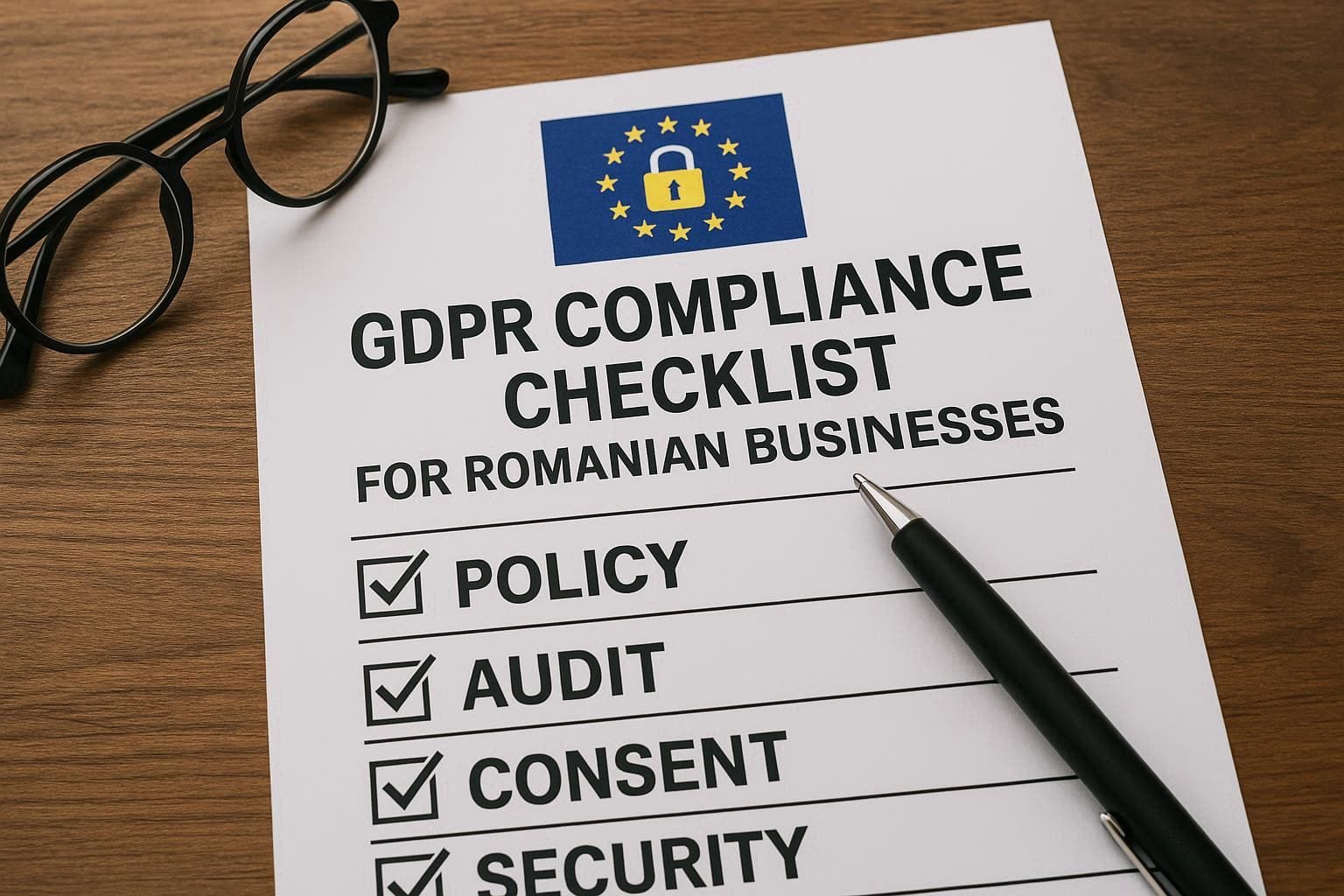
GDPR Compliance Checklist for Romanian Companies 2025

Play

GDPR Compliance Checklist for Romanian Companies

What crucial step could protect your business from devastating fines while building customer trust?

Many organizations underestimate how Europe’s strict data protection laws apply to their operations.

While GDPR penalties can reach €20 million or 4% of global revenue, Romanian enforcement authorities have imposed fines ranging from €3,000 to €130,000 for violations, demonstrating that penalties scale with the severity of breaches and organizational size.

GDPR compliance checklist for Romanian companies

Romania’s evolving digital economy demands proactive measures to align with rigorous privacy standards.

Legal experts emphasize that proper adherence involves more than basic policy updates—it requires systematic data governance.

Companies must address consent protocols, breach response plans, and cross-border data flows to avoid regulatory scrutiny.

Specialized legal guidance helps businesses transform compliance into strategic advantages.

Firms adopting privacy-first approaches often see improved client relationships and operational resilience.

Those delaying action risk not only financial consequences but also long-term reputational damage in competitive markets.

For tailored strategies meeting international standards, contact our data protection lawyers in Bucharest.

Our team of legal professionals provide actionable frameworks to navigate complex requirements while prioritizing business growth.

Key Takeaways

  • Data protection laws apply regardless of a company’s physical location if EU resident information is processed,
  • Penalties can reach €20 million or 4% of global revenue, emphasizing the need for preventive measures,
  • Building customer trust through transparent data practices creates market differentiation,
  • Legal experts offer customized solutions to align business operations with regulatory demands,
  • Compliance involves continuous monitoring, not just one-time adjustments.

Understanding GDPR and Its Impact on Romanian Businesses

How can organizations in Romania turn regulatory demands into strategic opportunities?

The General Data Protection Regulation (GDPR) reshapes how businesses manage information, particularly for entities handling EU residents’ data.

Its extraterritorial scope means even non-EU-based firms must adhere to strict standards when processing personal details of European citizens.

Core Regulatory Foundations

The regulation establishes six foundational principles for data handling, plus an overarching accountability principle.

These mandate that organizations:

  • Process information lawfully and transparently,
  • Collect only necessary data for specific purposes,
  • Maintain accuracy and limit storage durations.

Such requirements demand technical safeguards like encryption and operational protocols for accountability.

Privacy-by-design methodologies ensure protections are embedded in all systems.

Strategic Advantages for Local Entities

Adhering to these standards transforms obligations into opportunities.

Firms prioritizing data protection report:

  • Enhanced client confidence through transparent practices,
  • Reduced breach-related costs and operational disruptions,
  • Differentiation in markets where privacy concerns influence decisions.

For tailored strategies aligning Romanian operations with these regulations, consult our team of Romanian Lawyers.

Proactive adaptation not only mitigates risks but positions businesses as trustworthy data stewards.

Exploring Key GDPR Roles and Terminology

Who holds ultimate accountability in data governance frameworks?

Clarifying responsibilities under privacy regulations helps organizations establish clear operational boundaries.

Three critical roles form the foundation of proper data management practices.

data protection officer

Data Controllers, Processors, and Data Subjects

Data controllers determine why and how personal information is handled.

They bear legal responsibility for compliance across all processing activities.

Third-party processors execute tasks under controller directives but must independently meet security standards.

Individuals whose data is collected, known as data subjects, retain rights to access or delete their information.

Organizations must implement systems to honor these requests efficiently.

The Essential Role of the Data Protection Officer (DPO)

A data protection officer oversees compliance strategies and acts as the regulatory liaison.

This role is mandatory for entities processing sensitive data or conducting large-scale monitoring.

Under Romanian Law 190/2018, organizations processing national identification numbers (CNP) based on legitimate interest must also appoint a DPO, even if they don’t meet the standard GDPR thresholds.

This additional requirement reflects Romania’s enhanced protection for sensitive national identifiers.

Romanian businesses uncertain about role allocations should consult office@theromanianlawyers.com.

Proper classification prevents overlapping liabilities and ensures alignment with cross-border standards.

Conducting a Comprehensive Data Audit and Mapping

Organizations handling personal information must first establish clarity in their data ecosystems.

A systematic audit reveals how data flows through operations, exposing vulnerabilities while ensuring alignment with legal obligations.

This foundational step transforms raw information into actionable insights for risk management.

data audit and mapping

Identifying What Personal Data You Collect

Begin by cataloging every category of personal data your organization processes.

Common examples include:

  • Contact details (names, email addresses).
  • Digital identifiers (IP addresses, device information).
  • Sensitive records (financial data, health information).

Document each data point’s purpose, collection method, and retention timeline.

Assess whether processing activities rely on valid legal grounds like contractual necessity or explicit consent.

Storage locations demand equal scrutiny—identify physical servers, cloud platforms, and third-party repositories holding sensitive materials.

Access controls form another critical audit component.

Map which employees or systems interact with personal data and verify authorization protocols.

This process highlights potential exposure points while streamlining responses to information requests.

Romanian entities seeking structured frameworks for these assessments may contact our data protection legal specialists.

Expert guidance ensures audits meet regulatory expectations while supporting operational efficiency.

GDPR Compliance Checklist for Romanian Companies

Businesses handling EU data face operational complexity when aligning processes with privacy standards.

Structured frameworks simplify adherence while minimizing risks of non-conformance.

Effective strategies combine procedural clarity with technological safeguards to meet evolving requirements.

data protection checklist steps

Actionable Protocols for Information Security

Organizations should prioritize these critical measures:

Action ItemResponsible PartyDeadline
Complete data flow mappingIT & Legal Teams30 Days
Implement encryption protocolsSecurity Department45 Days
Update third-party contractsCompliance Officer60 Days

Consent Management Best Practices

Valid authorization requires unticked checkboxes and separate permissions for distinct processing purposes.

Confirmation emails enhance verification, while centralized logging systems track user agreements with timestamps and purpose details.

Organizations must honor withdrawal requests without undue delay and provide confirmation within one month, as required by GDPR Article 12(3).

Automated systems should flag outdated records immediately upon withdrawal, ensuring ongoing alignment with transparency obligations and ceasing processing activities promptly.

Regular audits verify adherence to storage limitation principles and access controls.

Local enterprises seeking customized frameworks may contact office@theromanianlawyers.com.

Specialized guidance helps establish resilient processes that satisfy regulatory expectations while supporting operational scalability.

Ensuring Website Security and Transparent Privacy Policies

How do modern businesses balance robust security with user transparency?

Websites storing personal information require layered defenses against cyber threats.

Organizations must adopt technical safeguards while clearly communicating data handling practices to users.

website security and privacy policies

Implementing SSL, Strong Passwords, and Anti-Virus Measures

HTTPS encryption via SSL certificates forms the first line of defense.

Multi-factor authentication and complex passwords prevent unauthorized account access.

Regular vulnerability scans and firewall updates address emerging threats.

Advanced protections include:

  • Content Delivery Networks (CDNs) to mitigate DDoS attacks,
  • Intrusion detection systems monitoring server activity,
  • Automated backups stored in geographically separate locations.

Designing Clear and Accessible Privacy Notices

Privacy policies must explain data collection purposes in plain language.

Every page should feature a visible link to these documents. Essential disclosures include:

  • Types of information gathered (contact details, device data)
  • Legal basis for processing activities
  • Third-party data sharing arrangements

Entities developing their online platforms should consult office@theromanianlawyers.com for policy reviews.

Proper alignment with privacy standards builds credibility while reducing legal exposure.

Managing Third-Party Vendors and International Data Transfers

How can businesses ensure their partners meet strict data protection standards?

Organizations relying on external vendors must verify their adherence to privacy regulations.

This requires thorough evaluations and contractual safeguards to maintain accountability across supply chains.

Evaluating Vendor Requirements and Contracts

Entities handling personal information must catalog all service providers processing data.

This includes cloud platforms, payment systems, and marketing tools.

Assessments should examine vendors’ security certifications, breach response plans, and documentation of regulatory alignment.

Legally binding agreements define responsibilities between controllers and processors.

These contracts specify permitted activities, retention timelines, and security protocols.

Subcontractor arrangements require explicit approval to maintain oversight.

RequirementActionMechanism
Vendor AccountabilityReview security auditsAnnual assessments
Data TransfersImplement SCCsContractual clauses
Risk MitigationConduct impact analysesTransfer evaluations

Cross-border data flows demand additional precautions.

Companies must confirm whether recipient countries have EU adequacy status.

For other regions, standardized contractual clauses or binding corporate rules become mandatory safeguards.

Romanian enterprises navigating these complexities should seek specialized Romanian Lawyer.

Proactive vendor management frameworks prevent regulatory violations while fostering trust with European partners.

Contact office@theromanianlawyers.com for tailored strategies addressing cross-border operational challenges.

Preparing for Data Breaches and Facilitating Data Subject Rights

What separates resilient organizations from vulnerable ones when cyber threats strike?

Proactive preparation for security incidents and efficient handling of individual rights form the backbone of modern data governance.

Organizations must balance rapid response capabilities with systematic processes to address user inquiries.

Developing a Robust Breach Response Plan

Effective incident management requires predefined protocols.

Immediate detection mechanisms trigger containment procedures within one hour of identifying unauthorized data access.

Forensic teams analyze breach scope while legal advisors determine notification obligations to authorities within 72 hours.

Regular simulation exercises test communication channels between IT, legal, and PR departments.

Documentation templates for breach reports ensure regulatory requirements are met without delays.

Continuous monitoring systems flag unusual activity patterns to prevent escalation.

Streamlining Data Subject Access Requests

Individuals increasingly exercise their right to review or delete personal information.

Centralized portals allow users to submit requests through secure authentication methods.

Automated workflows verify identities and route inquiries to appropriate teams within 24 hours.

Response templates maintain consistency while adhering to legal timelines.

Secure delivery channels protect sensitive information during transmission.

Audit trails demonstrate compliance with access rights obligations during regulatory inspections.

Entities requiring customized frameworks for incident management or user rights processes should contact office@theromanianlawyers.com.

Structured approaches transform regulatory demands into operational strengths while maintaining stakeholder trust.

FAQ

When must Romanian businesses appoint a data protection officer?

Organizations must designate a data protection officer if they systematically monitor individuals on a large scale or process sensitive categories like health records.

Public authorities in Romania also require this role regardless of data volume.

How long can companies retain customer information under EU regulations?

Storage periods must align with the original purpose for collection.

For example, transaction records may be kept for tax compliance periods specified by ANAF (Romania’s tax authority), while marketing contact lists require periodic reviews for relevance.

What technical safeguards are mandatory for website security?

Essential measures include SSL encryption, multi-factor authentication, regular penetration testing, and documented patch management processes.

Organizations should implement security measures proportionate to the risk level of data processing, following GDPR Article 32 requirements for appropriate technical and organizational measures.

Are international cloud providers like AWS or Microsoft Azure GDPR-compliant for Romanian data?

Providers operating under EU-approved mechanisms like Standard Contractual Clauses (SCCs) or binding corporate rules generally meet requirements.

However, companies must verify current certifications and update Data Processing Agreements (DPAs) annually.

What penalties apply for violating data subject rights in Romania?

The National Supervisory Authority for Personal Data Processing (ANSPDCP) can impose fines up to €20 million or 4% of global turnover.

Recent enforcement actions targeted improper consent practices and delayed breach notifications.

How should organizations handle data access requests from employees?

Businesses must respond within 30 days, providing free electronic copies of records.

Implement automated DSAR workflows in platforms like Microsoft 365 or specialized tools such as OneTrust to track and fulfill requests efficiently.

Foreigners’ Fiscal Registration: NIF Code in Romania 2026

Romanian fiscal registration • 2026

NIF code in Romania: the practical guide for foreign individuals

A Romanian NIF is a tax identification number assigned to a natural person who does not hold a Romanian CNP and must be identified in the Romanian tax system. The correct registration route depends on the person, the transaction and the reason Romanian fiscal identification is required.

Romanian NIF fiscal registration ecosystemAn animated visual showing identity, tax reason, Form 030 and ANAF registration around a Romanian NIF. ROMANIAN TAX ID • 2026 NIFROMANIA Identityperson without CNPTax reasontransaction or obligationForm 030correct registration routeANAFregistration certificate
A NIF connects a person without a Romanian CNP to a defined Romanian fiscal reason and ANAF record.

Short answer: the NIF, or număr de identificare fiscală, is the Romanian fiscal identifier used for a natural person who does not have a Romanian personal numerical code (CNP). It is obtained only when a Romanian tax or registration reason exists. A NIF does not itself create tax residence, immigration status, employment rights or a Romanian company.

What is a NIF code in Romania?

Under the Romanian fiscal-registration framework, a natural person who does not hold a CNP may be identified through a fiscal identification number assigned by the tax authority. In practice, this number is commonly called a Romanian NIF or Romanian tax identification number.

The governing framework includes Law no. 207/2015 on the Fiscal Procedure Code and the ANAF orders governing fiscal-registration forms. The NIF should be treated as an identifier within the tax administration system, not as a general identity document.

The decisive distinction is whether the person has a CNPThe current Form 030 is for natural persons who do not hold a Romanian CNP, except individuals carrying on independent economic activities or liberal professions, for whom a different registration route may apply. It is not a form reserved for non-EU citizens.

NIF, CNP, CIF and VAT number: what is the difference?

IdentifierWho or what it identifiesWhat it does not prove
NIFA natural person without a CNP who must be identified for Romanian fiscal purposes.It does not prove Romanian citizenship, residence, work authorisation or tax residence.
CNPA natural person to whom a Romanian personal numerical code has been assigned under the applicable civil or immigration framework.It does not automatically determine the person’s tax residence in a cross-border case.
CIF/CUIA company, organisation or another registered taxpayer or entity, depending on the legal context.It is not the personal NIF of a foreign shareholder or director.
VAT numberA person or entity registered for Romanian VAT under the applicable rules.A NIF does not automatically confer VAT registration.

Foreign founders should also distinguish their personal fiscal identification from the registration number of the Romanian company. The incorporation process is explained separately in our guides to company formation in Romania and starting a Romanian SRL in 2026.

Video guide: Romanian NIF code

A concise introduction to the Romanian tax identification number for foreign individuals and expats.

Who may need a Romanian NIF?

A foreign individual does not need a NIF merely because they visit Romania or communicate with a Romanian business. A concrete Romanian fiscal or registration relationship must be identified first. Depending on the facts, a NIF may be required or requested in connection with:

Romanian-source income

The person receives income that must be reported or administered in Romania and does not already have a CNP.

Property transaction

A non-resident becomes a party to a Romanian property transaction requiring fiscal identification.

Property ownership

The owner must be identified for Romanian tax records, local obligations or a later disposal.

Corporate involvement

A transaction, filing or tax record involving a foreign shareholder, director or beneficiary requires personal fiscal identification.

Bank or payer process

A Romanian credit institution or income payer is legally involved in the fiscal-registration route.

Other tax obligation

A specific Romanian tax rule requires the individual to be registered with ANAF.

These are categories for preliminary assessment, not automatic rules. For example, owning shares in a Romanian company and personally receiving Romanian-source income are different legal events. The relevant transaction and reporting obligation should be identified before a Form 030 file is prepared.

Avoid obtaining a number without defining its purposeA generic request may be delayed if the competent authority, registration reason, supporting documents or representative are not correctly identified. The starting question is not simply “Does a foreigner need a NIF?” but “Which Romanian legal or fiscal event requires this person to be registered?”

When is Form 030 used?

The current ANAF catalogue describes Form 030 as the fiscal-registration, amendment or deregistration declaration for natural persons who do not hold a CNP, other than persons carrying on independent economic activities or liberal professions. The form is governed by ANAF Order no. 2034/2022.

Before filing, use the official ANAF forms catalogue to confirm that the form and instructions have not been replaced. The official Form 030 PDF and instructions should be used rather than an older copy from an unofficial website.

Form 030 has three different functionsIt may be used for initial fiscal registration, for amendments to information already declared, or for deregistration after a CNP is assigned. The appropriate box and supporting information depend on the actual purpose of the filing.

Which documents are normally prepared?

The exact file depends on the applicant, the fiscal reason and who submits the declaration. A practical document review commonly considers:

  • the current Form 030, completed consistently with the supporting documents;
  • a valid passport, identity card or other accepted identity document;
  • the individual’s complete foreign domicile or address information;
  • the tax identification number in the state of residence, if one exists and is relevant to the form;
  • a document showing why Romanian fiscal identification is needed, where requested or useful for establishing the registration basis;
  • the power of attorney or other authority for the person or institution submitting the file;
  • Romanian translations and, where applicable, authentication, legalisation or apostille formalities; and
  • contact details and any additional information requested by the competent tax office.

A Romanian address is not universally required. A person applying under Form 030 may retain a foreign domicile, and the appropriate address evidence depends on the individual file and the tax office’s review. The document supporting the registration reason may be a transaction document, an income-related record or another document appropriate to the case.

How does the Romanian NIF registration process work?

Registration route

From the Romanian fiscal reason to the ANAF record

Romanian NIF registration routeA five-stage case file journey from the Romanian tax reason to the ANAF registration result. NIF REGISTRATION • CASE FILE JOURNEY ROMANIA • 2026 STEP 01Tax reasonDefine the Romanianregistration trigger STEP 02Correct routeCNP status • formcompetent authority STEP 03DocumentsIdentity • reasonauthority • translation STEP 04SubmissionRepresentative • payerbank • notarial route STEP 05ANAF resultFiscal record • NIFcertificate or query A defined fiscal reason leads to the correct filing route and a verified ANAF record.
Stage 01
Tax reason

Define the Romanian income, asset, transaction or obligation that creates the registration need.

The correct route begins with the fiscal reason, not with a generic request for a number. Select a stage to view its role in the file.
Confirm the registration triggerIdentify the income, asset, transaction, corporate event or statutory obligation that requires Romanian fiscal identification.
Check existing identifiersConfirm whether the individual already has a Romanian CNP or NIF and whether Form 030 is the appropriate route.
Identify the competent office and filerDetermine which ANAF office is competent and whether filing is made through an authorised representative, income payer, credit institution or another legally permitted route.
Prepare Form 030 and supporting recordsAlign names, addresses, identity data, foreign tax number, registration reason and authority documents.
Submit and answer queriesKeep proof of submission and respond if ANAF requests clarification, correction or additional documents.
Use and update the record correctlyUse the NIF for the relevant Romanian fiscal matters and submit amendments or deregistration when the legal conditions arise.

Can a lawyer or another representative obtain the NIF?

The Form 030 instructions contemplate filing through an authorised representative or other listed filer rather than treating the application as an unrestricted walk-in request by any person. The authority document and the representative’s capacity must therefore be checked carefully.

A Romanian lawyer may assist with identifying the correct route, preparing the form, reviewing foreign documents, arranging translations and communicating with the competent authority under an appropriate mandate. The scope of the mandate should match the required acts and document formalities.

For clients obtaining a NIF in connection with a company or investment, the fiscal-registration analysis may need to be coordinated with foreign-founder documentation, a Romanian business bank account or the relevant transaction documents.

Can a Romanian notary request fiscal registration?

Yes, in the circumstances covered by the specific procedure approved in 2025. The ANAF procedure for registration requested by public notaries applies where the notary needs the fiscal registration of a non-resident person who does not already have the required Romanian fiscal identifier.

Under that procedure, the notary transmits the required identity, address, foreign tax-number and transaction-reason information through the dedicated system. The competent tax authority checks whether the person is already registered and, if not, assigns the identifier and issues the registration certificate. The stated maximum of five working days applies to requests transmitted under this notarial procedure; it should not be presented as a universal deadline for every NIF application.

Property buyers should coordinate earlyIf a foreign buyer needs a NIF for a Romanian transaction, the lawyer, notary and tax-registration documents should be coordinated before the contractual deadline. Review our Romanian real estate due-diligence checklist and 2026 guide to buying property in Romania.

How long does it take to obtain a NIF?

There is no reliable universal promise of “a few days” for every application. Timing can depend on the filing route, competent office, completeness of the form, identity matching, translations, representative documents and whether ANAF requests clarification.

The special notarial procedure mentioned above provides a maximum five-working-day period for the tax authority to resolve the notary’s transmitted request. A conventional Form 030 file should be planned with a reasonable buffer rather than assuming that the same special deadline automatically applies.

Does a NIF make someone tax resident in Romania?

No. A NIF is an identification number. Romanian tax residence is a separate legal analysis based on the applicable domestic rules, facts and, where relevant, a double-taxation treaty. The number alone neither creates nor prevents Romanian tax residence.

A person who spends time in Romania, moves their centre of vital interests, earns Romanian-source income or maintains connections with several states may require a separate residence review. See our guide to Romanian tax residence and the ANAF materials on double-taxation conventions.

A NIF does not eliminate double taxationTreaty protection depends on residence, source, the type of income, beneficial ownership where relevant, supporting certificates and compliance with the applicable procedure. Merely holding a Romanian NIF does not resolve a treaty claim.

What happens if the person later receives a CNP?

Form 030 also covers deregistration following the assignment of a CNP. The tax record should be aligned so that the same person is not treated inconsistently under separate identifiers. The appropriate amendment or deregistration filing should be made with reference to the new CNP and the existing NIF record.

Changes to declared identity, domicile or contact information may also require an amendment. The correct response depends on the field that changed, the supporting document and the person’s current Romanian registration status.

Which NIF application mistakes cause delays?

  • using Form 030 solely because the applicant is foreign, without checking whether the person already has a CNP;
  • describing citizenship rather than the actual Romanian fiscal-registration reason;
  • using an outdated form or instructions copied from an unofficial source;
  • inconsistent spelling, name order, birth data or addresses across the passport, form and power of attorney;
  • omitting the foreign tax identifier when the form and facts require it;
  • assuming a general or informal authorisation is sufficient for representation;
  • submitting untranslated documents where Romanian translations are required;
  • confusing a NIF with tax residence, VAT registration, immigration status or company registration; and
  • assuming the five-day notarial timeline applies to every registration route.
Use the current official formANAF may update forms and administrative practice. Check the official form catalogue immediately before submission and confirm the competent authority and supporting documents for the particular case.

Need assistance with a Romanian NIF application?

Atrium Romanian Lawyers assists foreign individuals, investors and founders with Romanian fiscal-registration matters connected to property, companies, income and cross-border transactions. We can review the reason for registration, identify the appropriate route, prepare the documentation and coordinate the filing under an agreed legal mandate.

Frequently asked questions about the NIF code in Romania

Is the Romanian NIF only for non-EU citizens?

No. Form 030 is organised around whether a natural person has a Romanian CNP, not whether the person is an EU or non-EU citizen. The applicant must also have a Romanian fiscal-registration reason.

Can I apply for a NIF without travelling to Romania?

Remote handling may be possible through an authorised representative or another legally permitted filing route. The power of attorney, identity documents, translations and submission method must be checked for the specific case.

Does a Romanian NIF allow me to live or work in Romania?

No. A NIF is a fiscal identifier. Visas, residence permits and work authorisation follow separate immigration and employment rules.

Do I automatically need a NIF to own shares in a Romanian SRL?

Not every corporate role creates the same registration requirement. The incorporation, ownership, payment and reporting events should be reviewed to determine whether and when personal fiscal identification is needed.

Can a notary obtain the NIF for a property transaction?

A special procedure allows a Romanian public notary to request fiscal registration for a non-resident who lacks a Romanian fiscal identifier when this is required for the notarial matter. The transaction should be coordinated with the notary in advance.

Is Form 030 used if I already have a CNP?

Generally, Form 030 is intended for natural persons without a CNP. ANAF lists Form 020 for Romanian and foreign natural persons who hold a CNP, subject to the scope and exceptions stated in its instructions.

Does obtaining a NIF make me Romanian tax resident?

No. Tax residence depends on separate legal criteria and any applicable tax treaty. A fiscal identification number is not a tax-residence determination.

What should I do if I later receive a CNP?

The existing fiscal record should be aligned with the CNP. Form 030 includes a deregistration function following assignment of a CNP, but the correct filing and supporting documents should be confirmed for the individual record.

Legal information notice: This article provides general information about Romanian fiscal identification. The correct form, competent authority, documents and tax treatment depend on the person and transaction. Confirm the current ANAF requirements before filing.
AI Notice: AI-assisted content, reviewed and approved by a qualified Romanian lawyer.
+
Essential Documents for Foreign Founders Starting a Business in Romania

Essential Documents for Foreign Founders Starting a Business in Romania

Company formation in Romania

Essential Documents for Foreign Founders Starting a Business in Romania

Starting a business in Romania requires more than choosing a company name. The incorporation file must connect the founders, ownership structure, registered office, activities, management and beneficial-owner information in a form accepted by the Trade Register.

This guide explains the documents commonly required for foreign founders and why the correct route depends on the founder’s country, legal form, activity and filing method.

Play
Documents and practical steps for foreign founders entering the Romanian market.

Short answer: the core file usually includes founder and administrator identification, company-name information, proof of the registered office, articles of association, beneficial-owner information and the forms required by the ONRC. Foreign corporate shareholders may need additional registry, authority, translation and legalisation documents.

What Documents Are Needed?

The exact list is not identical for every applicant. An individual founder, a foreign company acting as shareholder, an EU citizen, a non-EU national and a representative acting under a power of attorney may face different document and signing requirements.

Individual founder

Usually needs a valid identity document, personal details, ownership and management information, beneficial-owner information and the declarations required for the application.

Foreign corporate shareholder

Usually needs a current registry extract or equivalent, evidence of legal existence, a corporate approval to invest and appoint representatives, and proof of the signatory’s authority.

Authorised representative

Needs a power of attorney or other authority in the form required for the filing. The document may need authentication, apostille or legalisation and an authorised Romanian translation.

Essential incorporation documents for foreign founders in Romania
Incorporation documents should be checked as one coordinated file.

Core Documents for a Romanian Company Formation File

Identity documents

Passports or identity documents for shareholders, administrators and other relevant persons. The required copy, format and translation depend on the filing route and the document’s origin.

Company name

Prepare several compliant name options and obtain the current ONRC proof or reservation document required for the incorporation route.

Registered office

Provide evidence of the right to use the Romanian premises, such as a lease, ownership document or another legally acceptable document. The arrangement should be checked for the intended activity.

Articles of association

The constitutional document should address the legal form, shareholders, capital, activities, management, representation and decision-making rules required by Romanian company law.

Beneficial-owner information

The ownership and control chain must be identified and reflected in the information or declaration required for the company-formation file.

ONRC forms and declarations

The application, declarations and supporting forms must be completed using the current ONRC requirements. The exact forms depend on the legal form and the requested registrations.

Additional Documents for Foreign Corporate Shareholders

When the shareholder is a company incorporated outside Romania, the Trade Register file normally needs evidence that the shareholder exists and that the persons signing or approving the investment have authority to do so.

Registry evidence

A recent extract or equivalent official document may be needed to show the foreign company’s legal existence, registered office, directors and ownership information.

Corporate resolution

The foreign shareholder may need a resolution approving the Romanian investment, the participation in the Romanian company and the appointment of the relevant representative.

Authority to sign

The file should show who may sign the articles of association, power of attorney and other documents on behalf of the foreign company.

Formalities abroad

Depending on the issuing country and document type, authentication, apostille or legalisation may be required before the document can be used in Romania.

There is no universal rule that every foreign document must be notarised or apostilled. The correct form depends on the issuing state, applicable international instruments, the document and the ONRC filing requirements at the time of submission.

Romanian Translations and Document Formalities

Documents submitted to Romanian authorities generally need to be usable in Romanian. A foreign-language document may require an authorised Romanian translation, and the translation may need to follow the form required for that document and filing route.

Before ordering translations or legalisation, check the complete document chain. A translation cannot cure a missing corporate resolution, an expired registry extract or a signatory who lacks authority.

Choosing the Legal Structure and Current Capital Rules

The documents depend on whether the founder chooses an SRL, an SA, a branch or a representative office. An SRL is often suitable for a privately held operating business, but the right structure depends on ownership, funding, governance, activity and the relationship with any foreign parent.

SRL

For a newly incorporated SRL, the minimum share capital is RON 500 under the current rules introduced by Law No. 239/2025. An existing SRL whose reported net turnover exceeds RON 400,000 may face a separate capital-increase obligation under the applicable timing rules.

SA

An SA has different capital, governance and incorporation requirements. The file should be prepared against the rules applicable to the proposed share structure and offering model.

Branch or representative office

These are not interchangeable with a Romanian subsidiary. The foreign parent’s constitutional documents, registry evidence and authority documents become central to the filing.

The current minimum-capital rules should be checked at the time of filing, especially where the founder is incorporating an SRL or modifying an existing Romanian company. The ONRC identifies Law No. 239/2025 as the source of the current SRL capital changes.

Registered Office and Activity Documents

The registered office requires evidence of the right to use the premises. A domiciliation or virtual-office arrangement may be possible in appropriate circumstances, but the document, provider and intended activity must be checked rather than assumed to be interchangeable with an operating location.

Activity codes should be selected under the current CAEN classification. Regulated activities may require additional approvals, professional qualifications or operating authorisations. Company registration alone does not automatically authorise every activity listed in the articles of association.

How the Documentation Process Works

1

Map the founders and structure

Identify shareholders, administrators, beneficial owners, the legal form and whether a foreign company is involved.

2

Check the activities and office

Confirm the CAEN activities, any special authorisations and the document supporting the Romanian registered office.

3

Collect foreign documents

Obtain current registry evidence, corporate resolutions, signatory authority and any required powers of attorney.

4

Complete formalities

Arrange translations and, where necessary, authentication, apostille or legalisation before the filing is submitted.

5

File and respond

Submit the complete application through an available ONRC route and address any request for correction or additional documents.

Can Foreign Founders Complete the Process Remotely?

Often, yes, but remote handling is document-dependent. A founder may act through an authorised representative where the authority document and filing route meet the applicable requirements. Online submission also depends on the current ONRC platform, signature and document-format rules.

Company formation, bank onboarding, tax registration, immigration status and permission to conduct regulated activities are separate questions. Incorporating a company does not automatically give a founder the right to live or work in Romania.

Tax and VAT: Keep These Questions Separate

The incorporation file and the company’s tax position are related but not identical. Microenterprise eligibility, profit tax, VAT registration, dividend taxation, e-Factura and sector-specific tax rules depend on the company’s facts and the law applicable at the relevant time.

For that reason, this documents guide does not state fixed tax rates or turnover thresholds as permanent formation rules. Those matters should be reviewed separately with the company’s Romanian tax adviser.

How Atrium Romanian Lawyers Can Help

Document mapping

We identify the documents required for the founder, foreign shareholder, administrator, registered office and intended activity.

Cross-border formalities

We help coordinate corporate resolutions, powers of attorney, translations and document-form requirements for foreign founders.

ONRC filing strategy

We prepare the formation route around the ownership structure, governance, activities, capital and post-registration needs.

Frequently Asked Questions

What documents does a foreigner need to start a company in Romania?

The core file commonly includes identity documents, company-name information, registered-office evidence, articles of association, beneficial-owner information, declarations and the current ONRC forms. The exact list depends on the founder and legal structure.

What extra documents are needed if the shareholder is a foreign company?

The file may require a current registry extract or equivalent, a corporate resolution, proof of signatory authority and documents concerning the foreign company’s ownership or control. Translation and legalisation requirements depend on the issuing jurisdiction and document.

Do foreign documents always need an apostille?

No. The requirement depends on the issuing country, applicable treaties or legal rules, the document and the filing route. The document chain should be checked before translation and submission.

Do documents need to be translated into Romanian?

Foreign-language documents used in the Romanian filing generally need to be made available in Romanian in the form accepted for that document and procedure. The required translation and certification should be confirmed case by case.

Can I incorporate a Romanian company without visiting Romania?

Often, yes, through an authorised representative or an eligible online route. Whether this is possible depends on the documents, signatures, powers of attorney, identity checks, banking and any sector-specific requirements.

What is the minimum share capital for a new SRL in 2026?

Under the current rules identified by the ONRC, a newly incorporated SRL has a minimum share capital of RON 500. Existing companies may be subject to separate obligations linked to net turnover and the transition rules in Law No. 239/2025.

Does company registration automatically give me a residence permit?

No. Company ownership or incorporation and the right to enter, reside or work in Romania are separate legal questions. Immigration eligibility should be assessed independently.

Does company registration authorise every activity listed in the articles?

No. Some activities require additional authorisations, professional qualifications, licences or operating conditions. The intended activity should be checked before the articles and filing are finalised.

Related Company Formation Resources

Official reference: Current forms, filing routes and procedural information should be checked on the ONRC website and its online portal. The ONRC lists Law No. 31/1990, Law No. 265/2022 and Law No. 239/2025 among the relevant national legislation. The exact document requirements may vary with the founder, jurisdiction, legal form and proposed activity.

Disclaimer: This page provides general information only and does not constitute legal advice, a legal opinion or the creation of a lawyer-client relationship. Legal solutions depend on the specific facts and documents involved.

AI Notice: AI-assisted content, reviewed by a qualified Romanian lawyer.

cadastral documentation Romania

Cadastral Documentation: Why It’s Required in Romania

Play

Cadastral Documentation: Why It’s Required in Romania

What if the key to securing your property rights in Romania isn’t just about owning land—but proving it in a way the law recognizes?

For buyers, sellers, and investors, this question underscores a critical reality: formalized records are the backbone of legally binding transactions.

A person is examining a detailed map of land parcels.

Romania’s integrated framework merges technical and legal processes to ensure accuracy in ownership details.

Every parcel undergoes rigorous verification before entering the national registry.

This system prevents disputes by creating an immutable record that shields owners from unauthorized claims.

The process involves collaboration between cadastral offices and real estate departments.

Technical surveys and legal validations occur simultaneously, streamlining approvals.

Delays in documentation can derail sales or financing, making compliance non-negotiable for smooth transactions.

For tailored guidance, contact office@theromanianlawyers.com.

Our team navigates these requirements daily, ensuring clients meet all obligations efficiently.

Key Takeaways

  • Romania’s property system requires precise technical and legal alignment for valid ownership,
  • Integrated workflows prevent errors and accelerate registration timelines,
  • Third-party claims lose validity without proper cadastral verification,
  • Delays in documentation expose owners to financial and legal risks,
  • Professional support minimizes hurdles in complex cases.

Understanding Cadastral Documentation in Romania

Romania’s property system relies on a structured framework where technical precision meets legal validity.

This foundation ensures every land registry entry reflects accurate ownership details and physical characteristics.

A map showing property boundaries and land divisions.

Definition and Key Components

Cadastral files combine technical surveys with legal descriptions.

They include boundary markers, exact surface measurements, and unique identification numbers assigned during registration.

These documents also contain geospatial plans that map the estate’s layout.

Authorized surveyors and legal experts collaborate to verify each detail.

Errors in boundary data or ownership records can invalidate transactions.

Professionals ensure compliance with national legislation to prevent disputes.

Historical Context and Evolution

Romania’s modern cadastral system has evolved through various historical influences, with significant development occurring during different administrative periods.

The current integrated system represents decades of modernization efforts to align with European Union standards.

Contemporary reforms integrated digital mapping with established processes.

Today’s estate records blend historical archives with real-time updates.

This evolution maintains continuity while addressing modern ownership complexities.

Cadastral Documentation and Why is It Required in Romania

A group of people discussing over a table filled with paperwork and charts.

Romanian legislation mandates strict protocols for validating property boundaries and ownership transfers.

These protocols serve as the foundation for all real estate transactions, ensuring every modification aligns with national standards.

Key Legal Requirements and Registration Effects

Under Romanian law, formalizing land divisions or mergers requires comprehensive technical verification.

This process applies during initial registrations and subsequent changes like boundary adjustments.

Authorized surveyors must validate measurement accuracy and confirm the credentials of involved professionals.

Each submission undergoes a multi-step review.

Inspectors cross-reference graphic databases to locate the site and ensure surface calculations match physical dimensions.

Discrepancies between descriptive details and visual representations trigger immediate revisions.

Upon approval, properties receive unique identifiers that lock their status in the national system.

These codes become critical references for future transactions or legal disputes.

Properly executed registrations grant owners enforceable rights against third-party claims.

They also activate the property’s eligibility for entries in Romania’s land book—a decisive factor in securing financing or completing sales.

Non-compliant submissions face rejection, requiring costly resubmissions.

Errors in surface data or boundary markers can delay land development projects significantly, emphasizing the need for precision from the outset.

Integration of Cadaster and Land Registry Systems

Romania’s property governance model eliminates bureaucratic silos through a cohesive institutional design.

The Romanain land registry and cadaster operate under one administrative umbrella, merging technical precision with legal validation.

This structural integration accelerates decision-making while maintaining rigorous standards.

Several colorful folders are neatly organized on a shelf labeled with different property names.

Unified Workflow in Land Book Registrations

Applications for property registration follow a synchronized process.

Technical surveys and legal validations are processed within the same department, removing redundant steps.

A single documentation file combines geospatial maps, boundary certifications, and ownership proofs.

The system routes files between cadastral inspectors and real estate publicity teams automatically.

Technical specialists verify measurement accuracy, while legal experts confirm compliance with ownership transfer rules.

Approved data flows directly into Part A of the land book, ensuring alignment between physical boundaries and registered rights.

Key advantages of this approach include:

  • Reduced processing times through parallel technical-legal reviews,
  • Eliminated discrepancies between registry entries and physical sites,
  • Centralized access to updated property information.

This integration minimizes errors that traditionally arise when separate institutions handle cadastral and registry tasks.

Real estate professionals benefit from predictable timelines, while owners gain enforceable rights backed by unified records.

Process and Legal Considerations for Cadastral Documentation

Navigating Romania’s property registration framework demands strict adherence to sequential technical and legal phases.

This structured approach protects ownership rights while maintaining alignment with national standards.

A close-up of a stamp on a completed application form.

Steps from Technical Verification to Legal Registration

The procedure unfolds through six critical stages:

  1. Preparer validation: Confirm credentials of professionals who drafted the documents,
  2. Database cross-check: Locate property in the national graphics system using coordinates,
  3. Surface verification: Audit mathematical accuracy of land measurements,
  4. Attribute correlation: Match written descriptions with graphical representations,
  5. Number assignment: Issue unique identifiers for unregistered properties,
  6. Final review: Cadastral inspector approves or flags discrepancies.

Ensuring Compliance with Romanian Law

Authorities reject submissions failing these legal benchmarks:

RequirementComplete DocumentationIncomplete Cases
Technical ActsPrecision-matched dataSurface calculation errors
Legal StandardsOwnership chain verifiedMissing notarized signatures
Time ImpactProcessing varies by complexityExtended delays and resubmissions

Non-compliant cases trigger detailed deficiency reports.

These outline exact corrections needed for resubmission.

Proper execution prevents third-party claims and ensures enforceable rights under Romanian statutes.

Implications for Real Estate and Property Transactions

Romania’s real estate market operates on a simple principle: no valid registration equals no enforceable rights.

The land registry acts as the ultimate authority for verifying ownership before any transaction closes.

This system protects buyers from inheriting unresolved disputes or hidden claims.

A computer screen displaying a digital cadastral map with highlighted properties.

Impact on Land Sale and Ownership Proof

Without registry entries, sellers cannot legally prove they own the property.

Notaries refuse to authenticate sales contracts for unregistered parcels, blocking transfers entirely.

Banks similarly reject mortgage applications tied to undocumented estates.

Common scenarios demonstrate these consequences:

ScenarioWith Proper DocumentsMissing Documents
Residential SaleProcessing within standard timeframesContract voided
Land DevelopmentFinancing approvedBank refusal
Inheritance TransferSmooth ownership changeExtended court proceedings

Proper registration creates a public record accessible to buyers, lenders, and authorities.

This transparency accelerates due diligence and reduces fraud risks.

Updated entries also increase property values by confirming marketability.

Maintaining current records helps avoid transaction delays and ensures compliance as boundaries or zoning laws change.

Legal Solutions and Alternative Approaches

When traditional property registration isn’t an option, Romanian law offers alternative pathways to secure ownership rights.

These mechanisms address complex scenarios where standard documentation remains unavailable or incomplete.


Noting Possession and Alternative Procedures

Individuals using land without formal ownership documents can request a notation of possession.

This legal step initiates a period during which third parties may contest the claim.

If no disputes arise, property rights may be formally registered through court proceedings.

Usucapion and Property Acquisition

Romanian law recognizes usucapion (adverse possession) as a method of acquiring property rights through prolonged possession.

Under current legislation, individuals who can demonstrate continuous, uninterrupted, and public possession for specified periods may acquire ownership rights.

The Civil Code establishes that those who possessed property for 10 years may become owners through adverse possession (extratabulară).

For situations involving longer periods, 30-year usucapion (acquisitive prescription) may apply depending on specific circumstances and legal requirements.

Resolving Complex Ownership Scenarios

Successful usucapion requires proving public, peaceful, and uninterrupted control of the land.

Authorized companies handle complex procedures for cases involving partial deeds or indirect evidence.

This process often becomes critical during inheritance disputes involving properties with unclear documentation.

Multiple heir situations demand specialized strategies to prevent prolonged litigation.

Legal professionals help owners navigate these complexities while protecting against future obstacles in mortgage or sale processes.

Consulting experienced attorneys ensures compliance with evolving registration standards.

Their guidance minimizes risks in both standard and alternative ownership validation processes.

Expert Insights and Best Practices in Cadastral Documentation

Navigating property records demands precision only specialists can deliver.

Romania’s framework assigns distinct roles to owners, professionals, and regulators to maintain system integrity.

O persoană arătând cu degetul la un teren pe un document.

Expert Guidance and the Role of Authorized Professionals

Licensed surveyors and legal practitioners handle technical evaluations under the National Agency for Cadaster and Land Registration.

These experts:

  • Verify boundary markers using GPS technology,
  • Cross-reference historical maps with current site conditions,
  • Certify that legal descriptions match physical characteristics.

Property owners must identify and preserve their boundaries.

Professionals bear responsibility for measurement accuracy, while inspectors validate data before issuing registration numbers.

Ensuring Data Accuracy and Timely Updates

Regular updates prevent conflicts during sales or inheritance transfers.

Key maintenance practices include:

ActionFrequencyResponsible Party
Boundary checksEvery 5 yearsOwner
Record auditsPost-constructionAuthorized surveyor
System updatesReal-timeCadastral office

Disputed cases require immediate legal intervention.

For complex scenarios like overlapping estate claims, contact office@theromanianlawyers.com.

Professional legal teams specialize in resolving boundary disputes efficiently.

Proactive monitoring of zoning changes safeguards rights.

Specialists recommend digital alerts for land registration amendments affecting your assets.

Conclusion

Securing property rights in Romania hinges on meticulous adherence to legal frameworks governing land records.

The integrated system combining technical precision with legal validation ensures transparent transactions while preventing ownership disputes.

From standard registrations to resolving complex cases, compliance protects all involved parties.

Authorized professionals play a critical role in verifying boundaries and maintaining error-free documentation.

Their expertise streamlines the process, whether handling routine updates or alternative acquisition methods.

Proactive management of real estate records remains essential for financing eligibility and conflict prevention.

Regular audits and immediate corrections uphold the integrity of Romania’s land registry framework.

For tailored guidance on navigating these requirements, contact office@theromanianlawyers.com.

Professional legal teams provide comprehensive support to ensure your assets remain protected under national law.

FAQ

What legal effects does land registration have in Romania?

Registration in the Land Book grants enforceable rights against third parties and validates ownership transfers.

It serves as the primary proof of legal title under Romanian law, ensuring transparency in transactions like sales or mortgages.

How does the cadaster system integrate with property registration?

Romania’s unified system combines cadastral data (physical boundaries, area) with the Land Registry’s legal records.

This integration streamlines workflows, reduces errors, and ensures accurate verification during transactions.

What steps are involved in obtaining cadastral documentation?

The process includes technical verification by licensed surveyors, boundary confirmation with neighbors, submission to the Cadaster Office, and final Land Book registration.

Compliance with zoning laws and notarization of legal acts is mandatory.

Why is cadastral documentation critical for real estate sales?

It confirms lawful ownership, clarifies boundaries, and identifies encumbrances like mortgages.

Buyers require this data to assess risks, secure financing, and complete transactions recognized by Romanian authorities.

Can property rights be established without full registration?

Temporary possession claims may be noted in the Land Book, but usucapion (adverse possession) or specialized procedures are required for full rights.

These alternatives involve court validation and strict evidence standards.

How do professionals ensure cadastral data accuracy?

Authorized surveyors, notaries, and lawyers cross-check records, resolve boundary disputes, and update entries for new constructions or subdivisions.

Regular audits by the National Agency for Cadaster prevent discrepancies.

What happens if a property has unresolved boundary issues?

Transactions may be delayed until disputes are settled via mediation or court rulings.

The Cadaster Office flags such cases, requiring updated technical plans and neighbor agreements before registration.

 
Romanian Company Capital Increase 2025

Romanian Company Capital Increase: Streamlined Processes 2025

Play

Romanian Company Capital Increase: Streamlined Processes 2025

Recent draft reforms on Romanian company capital increase 2025 have reshaped foundational requirements for Romanian companies, requiring both entrepreneurs and established firms to act quickly to stay compliant and maintain operational continuity.

capital increase procedures Romanian Company

Recent proposed changes in corporate legislation will require soon a minimum financial commitment, times higher than before, significantly impacting how companies, especially limited liability companies, operate.

Proposed changes are still in draft form and have not been enacted.

The current minimum capital requirement is 1 RON, and the proposal would increase it to variable amounts (500-90,000 RON).

The draft of law links financial obligations to company size, establishing specific compliance tiers across industries.

These changes will come with tight deadlines, enhanced reporting for banking activities, and stricter registry submissions.

Non-compliance could lead to severe penalties like operational suspension or dissolution.

Seeking professional advice is important, particularly for Romanian company formation or making structural adjustments.

Key Takeaways

  • Romania’s draft of corporate laws will enforce significantly higher minimum financial commitments,
  • Three-tier compliance system will align obligations with business size and revenue,
  • Mandatory banking protocols will affect entity registration and reporting,
  • Legal expertise ensures adherence to strict deadlines and documentation requirements,
  • Non-compliance may result in operational restrictions or business dissolution.

Navigating Romanian Corporate Regulations

The recent legislative draft introduces structured financial benchmarks for commercial entities.

These changes will create clear financial parameters tied to operational scale, ensuring alignment between resources and business activities.

bank account setup requirements

Updated Financial Benchmarks for Businesses

The revised draft establishes three financial tiers based on annual revenue.

Microenterprises with earnings below 395,000 RON must maintain 500 RON in reserves.

Mid-sized organizations generating up to 7 million RON require 5,000 RON.

Larger enterprises surpassing this threshold need 90,000 RON in available funds.

Business SizeRevenue RangeFinancial Reserve
MicroUnder 395k RON500 RON
Medium395k – 7M RON5,000 RON
LargeOver 7M RON90,000 RON

Banking Compliance Essentials

Under recent reforms in Romanian company law, newly incorporated businesses will be required to open and maintain a bank account within 30 days of registration, with banks permitted to refuse only on grounds related to anti-money laundering compliance under Law 129/2019.

Companies that fail to comply risk being declared fiscally inactive by ANAF, a status that suspends tax rights and may trigger fines of up to RON 10,000 for related non-compliance.

In parallel, the draft law increases the minimum share capital for limited liability companies (SRL) in Romania to RON 8,000, obliging existing SRLs to align either at the first amendment of their articles of association or within two years of the law’s entry into force.

Legal specialists recommend that entrepreneurs and investors prepare early to ensure smooth company formation, compliance, and business continuity in Romania.

Step-by-Step: capital increase procedures Romanian Company

Strategic documentation preparation forms the foundation of successful compliance.

Organizations must balance legal precision with operational agility when modifying foundational documents to meet revised standards.

trade register documentation process

Drafting Constitutive Acts and Submissions

Modifying Articles of association requires shareholder approval through formal resolutions.

Romanian lawyers must draft updated Articles reflecting adjusted financial commitments while maintaining alignment with existing operational parameters.

Completed documentation packages must include shareholder agreements and bank deposit confirmations.

The trade register mandates electronic submission of these materials within 15 days of approval.

Common errors in draft versions often delay processing timelines.

Timelines and Compliance Deadlines

Compliance timelines under the proposed Romanian company law reforms focus on SRL share capital increases and related corporate compliance filings.

All limited liability companies (SRL) will be required to raise their minimum share capital to RON 8,000, either at the first amendment of their articles of association or within two years of the law’s entry into force.

Once approved, the shareholder resolution must be registered with the Romanian Trade Register within 15 days, with late submissions leading to administrative penalties.

Although no official deadlines apply to POS installation or payment infrastructure upgrades, businesses should align their banking arrangements and capital adjustments early to avoid being declared fiscally inactive by ANAF and facing operational delays.

Engaging professional legal and accounting services in Romania is strongly recommended to ensure smooth compliance and safeguard business continuity.

Professional guidance helps navigate overlapping requirements efficiently.

Managing Compliance and Fiscal Transparency for Business Success

Effective governance in Romania’s business environment requires close monitoring of regulatory updates and proactive adjustment to new fiscal rules.

The latest company law and tax reforms introduce obligations that connect corporate governance, banking compliance, and shareholder transactions, making coordinated management essential for business stability.

compliance risk management

Mitigating Risks and Avoiding Administrative Blockages

Under the draft reforms, share transfers involving controlling shareholders must be reported to the tax authorities within 15 days.

Where companies have outstanding debts to the state, the Romanian Trade Register may require financial guarantees from the company or incoming shareholders before registering the transfer.

At the same time, failure to maintain an active bank account or to meet the new minimum capital thresholds for SRLs may result in a declaration of fiscal inactivity by ANAF.

Companies declared inactive face serious tax consequences: they must continue paying taxes but lose the right to deduct expenses and face restrictions on VAT claims.

To prevent these risks, businesses should adopt three practical safeguards:

  • Regular audits of banking documentation and shareholder records

  • Immediate updates to Trade Register filings following ownership changes

  • Preemptive resolution of outstanding state debts before major corporate transactions

Specialized legal and accounting advisors in Romania provide real-time monitoring, representation during ANAF audits, and strategic planning to maintain compliance.

Prompt action is also critical when receiving notices from fiscal authorities: while deadlines vary by procedure, some ANAF processes grant only 30 days to submit corrective documentation, and missed deadlines may trigger enforcement measures such as account freezes or asset seizures.

Conclusion

Navigating Romania’s revised corporate framework demands strategic adaptation.

Limited liability companies in Romania face permanent operational changes rather than temporary fixes.

Successful adaptation requires proactive planning with legal specialists.

Organizations prioritizing these measures secure long-term viability in Romania’s transformed business environment.

Romanian legal expertise remains critical for interpreting evolving requirements while safeguarding growth opportunities.

FAQ – Romanian Company Law and Compliance (2025)

What is the minimum share capital for a limited liability company (SRL) in Romania?


Under the draft reforms to Law 31/1990, the minimum share capital for an SRL will increase from 1 RON to 8,000 RON.

Existing companies must align either at the first amendment of their articles of association or within two years of the law’s entry into force.

Certain regulated industries (e.g. banking, insurance) still require much higher thresholds under sector-specific rules.

How long does it take to open a bank account for a capital increase?


Romanian banks usually process share capital deposit accounts within 3–5 business days, provided that the company submits incorporation documents, shareholder identification, and complies with anti-money laundering (AML) checks under Law 129/2019.

What penalties apply for missing compliance deadlines during share transfers?


Failure to submit share transfer documentation to the Trade Register or ANAF within 15 days may result in fines of up to 5,000 RON.

Persistent non-compliance can also expose companies to fiscal inactivity status, which restricts VAT deductions and expense claims, though dissolution is not an automatic sanction.

Do constitutive acts and amendments require notarization?


Notarization is no longer mandatory for standard SRL incorporation or simple amendments since the 2020 simplification of Romanian company law.

However, notarization may still be required in special cases, such as share transfers involving real estate contributions or when parties choose additional contractual safeguards.

What tax obligations follow a capital increase?


Companies must notify ANAF and the Trade Register of any capital increase within 15 days.

While capital injections themselves are not subject to taxation, incomplete or incorrect documentation may trigger tax audits or reclassification of funds.

Can foreign shareholders participate in increasing share capital?


Yes. Foreign investors may contribute capital under the same conditions as Romanian nationals.

For cross-border transfers, companies must comply with AML documentation requirements, and transactions above €10,000 are subject to reporting obligations under Law 129/2019.

Micro Enterprise in Romania for 2025

Micro Enterprise Eligibility Criteria in Romania for 2025

Play

Micro Enterprise Eligibility Criteria in Romania for 2025

New regulations effective January 2025 will dramatically reshape fiscal strategies for small businesses.

Recent amendments to fiscal legislation through OUG No 156/2024 introduce unprecedented reductions in income thresholds for preferential tax treatment.

The revised framework slashes permitted earnings by 50% compared to prior limits, creating urgent compliance challenges.

micro enterprise eligibility criteria Romania 2025

These adjustments demand immediate attention from company leaders and financial advisors.

Organizations exceeding €250,000 in annual revenue now face critical decisions about restructuring operations or exploring alternative fiscal arrangements.

The changes particularly impact service-oriented businesses and startups scaling toward mid-market positions.

Key Takeaways

  • Income ceilings for a preferential tax treatment drop to €250,000 starting January 2025,
  • Additional reductions to €100,000 planned for 2026 under current legislation,
  • Mandatory operational reviews required for businesses near revised thresholds,
  • Strategic planning essential for maintaining fiscal efficiency,
  • Professional advisory services critical for compliance verification.

This analysis provides actionable insights into navigating the reformed fiscal landscape.

Understanding these modifications enables informed decision-making for sustainable business growth under updated regulatory conditions.

Introduction to Romania’s Fiscal Landscape in 2025

The year 2025 marks a pivotal shift in fiscal policy designed to stabilize national finances while supporting market adaptability.

Government measures prioritize efficient resource distribution through updated tax structures, creating a balanced framework for economic growth.

tax changes 2025

Revised tax laws align with broader EU financial strategies, ensuring competitive positioning within continental markets.

These adjustments focus on sustainable revenue streams without imposing excessive burdens on commercial operations.

Businesses in Romania must recognize these modifications as interconnected components of a long-term economic vision.

Key reforms emphasize strategic alignment between public spending controls and private sector innovation.

The updated law introduces refined compliance standards to enhance fiscal transparency.

This approach maintains investor confidence while addressing budgetary pressures through measured adjustments.

Organizations operating within this jurisdiction should reevaluate financial strategies to align with evolving requirements.

Proactive adaptation ensures continued competitiveness under the restructured fiscal system.

Professional guidance remains critical for navigating these systematic changes effectively.

Overview of the Micro Enterprise Tax Regime in Romania

Romania’s simplified fiscal system offers distinct advantages for qualifying organizations through a structured dual-rate approach.

This model replaces traditional profit-based taxation with turnover-focused calculations, particularly advantageous for ventures with limited operational complexity.

Key Features of the Simplified Structure

The 1% rate applies to entities generating under €60,000 annually, while those exceeding this threshold or operating in designated sectors face a 3% liability.

This tiered system allows precise financial planning while maintaining compliance with national revenue objectives.

Romanian tax regime 2025

Updated Fiscal Parameters

Recent adjustments emphasize stricter revenue monitoring to align with EU economic strategies.

The revised thresholds require businesses to implement enhanced tracking systems for real-time financial oversight.

These modifications aim to preserve the regime’s benefits while preventing misuse through improved accountability measures.

Organizations must now conduct quarterly reviews to verify compliance with updated earning limits.

This proactive approach helps maintain preferential rates while adapting to evolving market conditions.

Professional advisors strongly recommend automated accounting solutions for accurate reporting under the new requirements.

Micro enterprise eligibility criteria Romania 2025

Romanian Businesses seeking preferential fiscal treatment must meet six core conditions under Romania’s updated framework.

These requirements ensure alignment with national economic priorities while preventing system exploitation.

Romanian tax compliance 2025

Legal entities must satisfy these mandatory criteria throughout the fiscal year:

  • Annual revenue below €250,000,
  • Full private ownership of capital shares,
  • Active operational status (not in liquidation),
  • Social security payments for minimum one staff member or executive,
  • Single ownership restriction for major shareholders (25%+ stakes),
  • Annual financial reports submitted before legal deadlines.

The income ceiling forms the primary compliance checkpoint.

Organizations approaching this threshold require monthly monitoring systems to maintain eligibility.

Ownership rules prevent multiple benefit claims through subsidiary structures.

Employment obligations ensure active participation in Romania’s social security framework.

This condition applies even to single-member companies, requiring formal labor contracts for executives.

Late financial disclosures trigger immediate disqualification, regardless of other compliance factors.

Legal advisors recommend implementing automated tracking tools for real-time eligibility verification.

Non-compliance risks retroactive tax adjustments and potential audits.

Professional consultation remains essential for interpreting nuanced requirements.

Detailed Requirements for Qualified Micro Enterprises

Meeting workforce obligations forms a critical pillar of compliance under Romania’s preferential tax system.

Organizations must balance operational needs with strict regulatory mandates to maintain fiscal advantages.

employee documentation 2025

Staff Engagement and Social Security Rules

Companies must formalize employment contracts within 30 days of establishment.

This requirement applies equally to businesses hiring external staff or retaining directors who fulfill social security obligations.

The framework ensures active participation in national social programs.

Minimum gross wage standards (€814/month) apply to traditional employment arrangements.

This dual-path structure supports diverse operational models while maintaining workforce development goals.

Financial Reporting Deadlines

Timely submission of annual financial statements remains non-negotiable for continued eligibility.

Authorities require complete documentation before statutory deadlines to verify operational transparency.

Late filings trigger immediate disqualification from preferential rates.

Automated accounting systems prove vital for meeting these obligations.

Regular internal audits help prevent reporting delays that could jeopardize fiscal status.

Professional advisors emphasize proactive calendar management for critical submission dates.

Corporate Income Tax vs. Turnover Tax Explained

Understanding fiscal obligations requires clear differentiation between profit-based and revenue-based taxation models.

The choice between these systems determines financial planning strategies and compliance requirements for organizations operating under Romanian jurisdiction.

Transition from Turnover Tax to Profit Tax

Organizations exceeding specific operational parameters face automatic conversion to standard corporate income tax rules.

This irreversible transition occurs when companies surpass €250,000 in annual revenue or fail to meet employment requirements within 30 days of registration.

The shift triggers immediate application of a 16% tax rate on net profits.

Unlike the simplified turnover model, this system demands detailed expense tracking and comprehensive financial documentation.

Our team of lawyers in Romania stress the importance of quarterly monitoring to prevent unexpected regime changes.

Methods for Calculating Tax Liabilities

Turnover-based calculations apply fixed percentages to gross revenues, offering predictable fiscal outcomes.

In contrast, profit taxation requires subtracting verified business expenses from total income before applying the statutory corporate income tax rate.

Key differences include:

  • Documentation needs: Profit tax requires expense receipts,
  • Reporting frequency: Monthly vs quarterly declarations,
  • Compliance complexity: Advanced accounting systems recommended.

Financial planners emphasize proactive modeling of both scenarios to optimize fiscal outcomes.

Permanent ineligibility for preferential treatment makes strategic forecasting essential for sustainable operations.

Understanding Income Thresholds and Revenue Monitoring

Strategic revenue tracking becomes paramount for organizations navigating revised fiscal parameters.

The 2025 income ceiling drops to €250,000 – half the previous limit – with a further reduction to €100,000 planned for the following year.

Compliance hinges on annual earnings recorded by December 31, requiring continuous oversight to prevent unexpected tax regime changes.

Quarterly financial reviews now serve as essential safeguards against threshold breaches.

Advanced tracking systems enable businesses to project annual revenues using real-time data, identifying potential compliance risks months in advance.

Many firms implement alerts when reaching 75% of permitted earnings, allowing time for operational adjustments.

Three critical considerations guide effective threshold management:

  • Automated accounting tools for instant revenue visibility,
  • Scenario planning for different growth trajectories,
  • Regular cross-departmental financial reviews.

Organizations surpassing these limits face immediate transition to standard corporate tax rules.

This irreversible shift underscores the need for proactive measures rather than reactive corrections.

Financial teams must balance growth ambitions with strict fiscal boundaries to maintain preferential treatment.

The determination method based on prior-year totals adds complexity to strategic planning.

Companies approaching thresholds often benefit from staggered invoicing or temporary service adjustments to stay within permitted ranges.

Our team of lawyers in Bucharest  increasingly emphasize predictive analytics in maintaining compliance while pursuing sustainable expansion.

Special Industry Considerations in Taxation

Tax obligations under Romania’s updated framework vary significantly across commercial sectors.

Specific activities classified under CAEN codes trigger distinct fiscal treatment, requiring careful operational analysis.

The 3% rate applies regardless of revenue levels for ventures in technology and hospitality fields.

Software development and IT service activities face elevated rates due to their scalability and profit potential.

This includes custom programming solutions (CAEN 6210) and technical support operations (CAEN 6290).

Government policies aim to balance sector growth with equitable revenue collection.

Food-related businesses encounter similar tax treatment.

Restaurants, food trucks, and catering activities (CAEN 5611-5622) operate under the higher rate structure.

These rules reflect market dynamics and operational complexities in hospitality.

Three critical factors influence tax categorization:

  • Primary revenue-generating operations,
  • Secondary commercial engagements,
  • Accurate CAEN code alignment.

Organizations operating across multiple sectors must designate their principal activity through documented revenue analysis.

Our team of Romanian Lawyers play vital roles in verifying classifications and preventing compliance errors.

This structured approach supports strategic planning while meeting fiscal responsibilities.

Businesses offering combined food service activities with retail operations require particular attention.

Clear documentation separating revenue streams ensures proper rate application.

Regular operational reviews help maintain compliance as commercial portfolios evolve.

Impact of Employment and Minimum Wage Rules

Workforce management challenges intensify under updated labor regulations, requiring precise alignment between payroll practices and fiscal compliance.

Businesses must now navigate layered obligations spanning social contributions, sector-specific wage floors, and conditional tax benefits.

Social Contributions and Mandatory Hiring

Romanian Employers face dual responsibilities for health insurance and pension funds.

Construction sector staff require minimum gross wages of RON 4,582 monthly, while agricultural and food industry workers demand RON 4,050.

These figures represent baseline commitments before calculating employer contribution rates.

The RON 300 monthly tax exemption applies when two conditions align:

  • Gross salary matches the legal minimum for the sector,
  • Total employee earnings stay below RON 4,300 monthly.

Strategic Payroll Management

Automated systems prove essential for tracking variable wage thresholds across industries.

Companies combining multiple business activities must implement separate payroll calculations for each operational division.

Errors in contribution allocations risk penalties exceeding 5% of annual turnover.

Human resources teams should prioritize:

  • Monthly verification of sector-specific wage compliance,
  • Integration of tax exemption parameters into payroll software,
  • Cross-departmental audits for social security alignment.

This regulatory framework demands continuous coordination between financial and HR departments.

Our Emplyoment legal specialists in Romania increasingly recommend unified platforms that synchronize labor costs with tax eligibility requirements.

Financial Statement Compliance and Reporting Requirements

Accurate financial documentation serves as the cornerstone of maintaining fiscal benefits under revised regulations.

Organizations must submit annual financial statements by strict deadlines to qualify for preferential treatment.

The updated framework mandates timely preparation and submission of financial statements through authorized platforms.

Late filings trigger automatic disqualification from simplified tax regimes, regardless of operational performance.

This requirement applies even if other compliance standards appear satisfactory.

Effective compliance requires implementing reliable tracking systems to monitor reporting milestones.

Many firms now use automated tools to streamline annual financial documentation processes.

These solutions reduce errors while ensuring alignment with evolving submission protocols.

Our team of tax lawyers in Bucharest emphasize proactive calendar management for declaration deadlines.

Missing these dates risks retroactive tax adjustments and potential audits.

Maintaining eligibility demands continuous attention to both preparation quality and submission timing.

FAQ

What industries qualify for VAT exemptions under Romania’s micro-enterprise regime?

Companies in IT sectors like custom software development may benefit from VAT exemptions if they meet specific turnover thresholds.

Food service activities, including mobile food services, must comply with standard VAT rules unless operating under special fiscal provisions.

How does the 2025 tax rate change affect corporate income calculations?

Starting January 2025, eligible micro-enterprises face a revised corporate income tax rate of 16% on profits.

Businesses previously under the turnover tax system must transition to profit-based calculations, requiring updated financial statements and compliance with revised reporting standards.

What penalties apply for late submission of annual financial statements?

Legal entities failing to submit annual financial statements within 60 days of the fiscal year-end risk fines up to 10,000 RON.

Timely filing ensures eligibility for tax incentives and avoids disruptions to health insurance or social contribution benefits.

Are mobile food service operators subject to the same tax regime as brick-and-mortar businesses?

Mobile food service activities follow the same corporate income tax rules but may face additional municipal fees.

Compliance with hygiene standards and local permits remains critical, regardless of business structure.

How do minimum wage adjustments impact social contributions for micro-enterprises?

Employers must align salaries with Romania’s updated minimum wage RON 4,050/month, directly affecting social security and health insurance contributions.

Non-compliance may disqualify businesses from micro-enterprise benefits under Law No. 346/2004.

Can companies engaged in custom software development retain micro-enterprise status if revenue exceeds thresholds?

No. Firms surpassing 500,000 EUR annual revenue lose micro-enterprise eligibility and must transition to standard corporate taxation.

Regular revenue monitoring is essential to avoid unexpected tax rate changes or compliance audits.

What are the eligibility criteria for a micro-enterprise in Romania?

To qualify as a micro-enterprise in Romania, a company must meet specific criteria defined by the fiscal code.

These include having a turnover not exceeding €1 million, employing at least one full-time employee, and not being part of a larger group of companies.

Additionally, the company must be registered with the trade register and comply with the provisions related to share capital and business law.

What is the tax regime applicable to micro companies in Romania?

The tax regime for micro companies in Romania is quite favorable.

These firms benefit from a reduced tax rate of 1% on revenue if they employ at least one employee.

This micro company tax regime is designed to encourage new business formation and ease the tax burden on small enterprises.

Furthermore, micro-enterprises are generally exempt from corporate income tax and have simplified reporting obligations under the Romanian fiscal code.

How does a Romanian micro company handle dividend tax?

For a Romanian micro company, dividend distributions are subject to a dividend tax.

The standard dividend tax rate in Romania is 5%. However, micro-enterprises can benefit from tax exemptions or reductions under certain conditions, especially if they reinvest their profits into the business.

It’s essential for companies to consult with tax authorities to ensure compliance with current regulations.

What are the necessary steps to open a micro-company in Romania?

To open a micro-company in Romania, foreign investors or natural persons must follow several steps.

First, they need to choose the type of company, usually a limited liability company, and prepare the required documentation for company formation.

This includes drafting the company’s articles of incorporation and securing a corporate bank account.

After that, they must register the company with the trade register and ensure compliance with the fiscal code, including obtaining any necessary tax registrations.

Romanian Land Registry Process

The Land Registry Process in Romania: A Comprehensive Overview

Play

The Land Registry Process in Romania: A Comprehensive Overview

What if a single oversight in documentation could jeopardize your real estate investment?

This critical question underscores the importance of Romania’s structured approach to property ownership verification.

The system ensures legal certainty through meticulous record-keeping and standardized protocols.

land registry process in Romania

Romania’s framework for validating ownership rights involves coordinated efforts between notaries, cadastral specialists, and government agencies.

Each transaction requires precise authentication and multi-stage reviews to prevent disputes.

While the system prioritizes accuracy, its complexity demands professional navigation.

Our team of lawyers in Bucharest play a vital role in interpreting regulations and avoiding procedural missteps.

For tailored guidance, contact office@theromanianlawyers.com to ensure compliance with all requirements.

Key Takeaways

  • Romania’s system provides legal security for real estate transactions,
  • Multiple verification stages prevent ownership disputes,
  • Specialized professionals ensure regulatory compliance,
  • Documentation accuracy impacts transaction validity,
  • Updated records maintain market transparency.

Introduction and the Importance of Land Registry in Romania

Accurate records form the backbone of successful real estate dealings.

Romania’s national property registry acts as a legal safeguard, detailing ownership rights, physical boundaries, and existing claims.

This system ensures every transaction meets strict standards for validity and transparency.

Overview of Real Estate Registration

The framework for property validation includes three core elements:

  • Technical specifications outlining exact dimensions and location,
  • Ownership history showing current and previous rights holders,
  • Legal restrictions like mortgages or usage limitations.

Romanian real estate documentation

Mandatory updates to these records occur with any ownership change.

Financial institutions and buyers rely on this data to verify asset legitimacy before approving deals.

How Reliable Documentation Impacts Transactions

Complete paperwork prevents disputes between involved parties.

Missing or conflicting information can:

  • Delay sales by weeks or months,
  • Invalidate purchase agreements,
  • Expose buyers to hidden liabilities.

Romania’s alignment with EU standards offers international investors familiar protections.

For tailored support navigating these requirements, contact office@theromanianlawyers.com to secure your transactions.

Historical Evolution of Land Registration in Romania

Romania’s approach to ownership validation reflects centuries of legal refinement.

The Austro-Hungarian Empire introduced structured cadastral practices in Transylvania during 1849, marking the region’s first standardized public records.

This initiative laid the groundwork for contemporary legal frameworks governing asset transfers.

cadastral records evolution

From Manual Registers to Digital Precision

Early documentation relied on handwritten ledgers detailing boundaries and ownership chains.

By the 20th century, these evolved into legally binding registers with three critical functions:

  • Mapping exact geospatial coordinates,
  • Recording successive titleholders,
  • Highlighting contractual obligations.

The shift to electronic databases after 2000 accelerated verification processes while preserving historical legal principles.

Modern platforms now integrate EU-compliant formats with traditional safeguards.

Continental Foundations and Systemic Reforms

Central European legal traditions heavily influenced Romania’s adoption of public accessibility standards for property books. Key developments include:

  • Harmonization with EU directives on transparency,
  • Digitization of archival records (1850-1950),
  • Nationwide implementation of unified protocols.

These advancements transformed fragmented regional practices into a cohesive framework.

Our team of lawyers in Romania leverage this historical context to interpret current requirements effectively.

For specialized guidance navigating these evolved systems, contact office@theromanianlawyers.com.

Legal Framework and Key Principles

Romanian property validation relies on foundational rules ensuring fairness and transparency.

Five core concepts govern how ownership changes are recorded and enforced under Law 7/1996.

These mechanisms protect both individual rights and public trust in official records.

Romanian legal principles

Opposability, Full Disclosure, and Legality

The principle of opposability ensures registered claims take immediate effect against third parties.

This establishes clear priority when multiple parties assert interests in the same asset.

Full disclosure requirements mandate recording all ownership details and restrictions.

PrincipleLegal BasisPractical Effect
OpposabilityLaw 7/1996 Art.12Immediate enforceability post-registration
Full DisclosureCivil Code Art.881Complete transaction history visibility
Legality ReviewLand Book Reg. §4Document validity verification

Neutrality and Ex Officio Decision Making

Registrars maintain strict neutrality, acting only upon formal requests.

However, they possess authority to independently verify application accuracy.

This ex officio examination ensures system integrity without compromising impartiality.

Legal professionals analyze how these principles interact in specific cases.

For personalized guidance navigating Romania’s property registration framework, contact our team of real estate lawyers in Bucharest at office@theromanianlawyers.com.

Understanding the Land Registry Process in Romania

Navigating property ownership in Romania requires understanding its dual-track validation system.

This framework combines administrative efficiency with judicial safeguards to balance speed and legal protection.

Specialized professionals manage critical approvals while maintaining avenues for dispute resolution.

Romanian administrative judicial system

Administrative Versus Judicial Aspects

The administrative procedure focuses on swift document processing by qualified registrars.

These officials review applications using standardized checklists to ensure compliance.

Key features include:

  • Mandatory legal education for registrars,
  • Predefined timelines for application reviews,
  • Automated validity checks for common documents.

Judicial oversight activates when parties challenge administrative decisions.

Courts examine whether registrars properly applied laws during initial assessments.

This layered approach prevents errors while respecting constitutional rights.

Decision Hierarchies and Professional Qualifications

Romania’s appeal process follows a strict three-step structure:

  1. Re-examination by senior registrars,
  2. District-level judicial review,
  3. Potential appeals to higher courts.

Legal professionals often intervene when technical interpretations affect ownership outcomes.

For tailored assistance navigating these mechanisms, contact office@theromanianlawyers.com to secure your property rights efficiently.

Step-by-Step Guide to Registration and Documentation

Securing property rights in Romania demands strict adherence to official validation protocols.

Three critical phases govern this structured approach: deed authentication, application review, and permanent database updates.

Each phase involves specialized professionals ensuring compliance with national standards.

Authentication of Deeds and Preliminary Certification

Public notaries initiate the authentication process by verifying signatures and legal capacity.

They cross-check ownership details against current land book extracts to confirm seller authority.

This step prevents invalid transactions by identifying undisclosed claims or restrictions.

Notaries issue preliminary certificates confirming document validity.

These certificates serve as prerequisites for submitting applications to territorial offices.

Missing this step voids subsequent registration attempts.

Submission, Verification, and Final Registration

Complete documents receive chronological entry numbers during submission, establishing priority for conflicting claims.

Assistant-registrars perform initial checks for completeness before forwarding files to senior officials.

Qualified registrars conduct final reviews within legally mandated timelines:

  • 9 days maximum for ownership transfers,
  • 2 days for mortgage registrations.

Approved applications trigger permanent database updates and automated certificate distribution.

For streamlined procedure navigation, contact office@theromanianlawyers.com for expert documentation support.

Digital Advances: Electronic Submission and Land Books

Romania’s property sector is undergoing a digital revolution while maintaining analog safeguards.

The national land book system now operates through hybrid workflows, combining electronic databases with physical document submissions.

This dual approach balances modernization efforts with traditional verification practices.

Benefits of Electronic Registration

Digital platforms transform how professionals interact with property records.

Key improvements include:

AspectTraditional MethodElectronic System
Processing Timeapp. 2-4 weeksapp. 3-5 business days
Record AccuracyManual entry errorsAutomated validation
AccessibilityIn-person requests24/7 online access

Authorized users retrieve estate data instantly through secure portals.

Integrated databases enable simultaneous updates across multiple agencies, reducing administrative overlaps.

Challenges in Transitioning from Analog Methods

The mixed system creates unique operational hurdles:

  • Physical document scanning delays digital processing,
  • Varied digital literacy among older professionals,
  • Inconsistent formatting of paper submissions.

These issues occasionally extend registration timelines when systems require manual reconciliation.

Legal teams often bridge the gap by cross-verifying electronic and physical records.

For streamlined navigation of Romania’s evolving land book procedures, contact office@theromanianlawyers.com.

Their experts provide tailored solutions for both digital and paper-based requirements.

Roles of Notaries and Legal Experts

Property transactions in Romania require coordinated efforts between specialized professionals to ensure legal compliance.

Notaries and registrars form the backbone of document validation, while legal advisors resolve complex challenges.

The Notary’s Function in Authenticating Documents

Public notaries verify the right of sellers to transfer ownership.

They confirm identities, check signatures, and obtain updated extracts from property records.

This prevents transactions involving disputed titles or hidden claims.

Key responsibilities include:

  • Validating legal capacity of all parties,
  • Ensuring compliance with contractual formalities,
  • Flagging undisclosed restrictions in land book extracts.

The Land Registrar’s Critical Decision Role

Registrars possess exclusive authority to approve or reject applications.

Their technical reviews determine if submissions meet statutory requirements for rights registration.

RoleFocus AreaDecision Impact
NotaryDocument validityTransaction initiation
RegistrarLegal complianceOwnership transfer finality

Romanian Legal professionals bridge gaps between these roles, particularly when multiple parties or cross-border elements complicate matters.

For complex cases involving contested titles, contact our team of specialized lawyers in Bucharest at office@theromanianlawyers.com for tailored solutions.

Overcoming Common Challenges in Real Estate Registration

Navigating property transfers often reveals unexpected hurdles requiring strategic solutions.

Many transactions stall due to incomplete paperwork or conflicting records, particularly in cases involving older assets or informal agreements.

Troubleshooting Missing Documents and Delays

Incomplete ownership chains frequently emerge with inherited estates or properties lacking updated titles.

Common issues include handwritten sale receipts without notary validation or assets listed solely in agricultural registries.

These gaps prevent legal transfers until resolved through archival research or court orders.

Delays often stem from multi-agency coordination requirements.

Cadastral mapping and zoning confirmations must precede notarial acts, creating sequential bottlenecks.

Proactive document preparation reduces waiting periods significantly.

Mitigating Legal and Procedural Pitfalls

Romanian law mandates authenticated ownership proofs for valid sales.

Romanian lawyers address challenges through:

  • Reconstructing historical ownership via court petitions,
  • Validating informal agreements through supplementary evidence,
  • Coordinating parallel approvals across institutions.

Specialized legal support in Romania streamlines these complex processes.

For tailored resolution strategies, contact office@theromanianlawyers.com to secure your transaction’s validity.


FAQ

What legal principles govern real estate registration in Romania?

The process follows three core principles: opposability (rights become enforceable against third parties upon registration), full disclosure (all relevant details must be publicly accessible), and legality (strict compliance with statutory requirements).

These ensure transparency and legal certainty in transactions.

How does electronic submission improve registration efficiency?

Digital platforms reduce processing times by enabling remote document filing, automated validations, and real-time status tracking.

This minimizes errors and accelerates the authentication of deeds while maintaining compliance with EU data standards.

What role do notaries play in property transactions?

Notaries authenticate agreements, verify identities, and confirm the legality of terms.

Their involvement ensures documents meet formal requirements before submission to the Land Book Office, reducing rejection risks during final registration.

Why might a registration request be delayed or rejected?

Common issues include incomplete ownership history, unresolved boundary disputes, or unrecorded encumbrances.

Proactive title searches and professional legal reviews help identify and resolve such gaps before submission.

Can possession alone establish ownership rights in Romania?

No. While long-term possession may support a claim through adverse possession laws, formal recognition requires a court decision and subsequent registration in the Land Book.

Mere occupancy does not guarantee legal rights.

What distinguishes administrative from judicial registration procedures?

Administrative processes handle uncontested applications, while judicial oversight applies when disputes arise over validity or competing claims.

Registrars assess evidence ex officio but may defer to courts in complex cases.

How are third-party rights protected during registration?

The system’s publicity principle mandates that all registered rights are visible to potential buyers or creditors.

This prevents hidden claims and ensures transactions reflect the true legal status of assets.


🏛️ Romanian Land Registry Quiz

Test your knowledge about property registration in Romania


open a Romanian business bank account

How to open a Romanian business bank account as non-resident

How to open a Romanian business bank account as non-resident


What if accessing European markets through a strategic financial gateway required fewer hurdles than commonly assumed?

Play

With over 40 financial institutions and seamless connectivity to 500 million EU consumers, Romania presents a compelling proposition for international entrepreneurs.

Romanian business bank account as non-resident


Establishing corporate financial operations here involves navigating specific regulatory frameworks distinct from other EU jurisdictions.

Over 70% of newly registered entities prioritize this step within their first operational month, leveraging the country’s extensive ATM networks and multi-currency solutions.

The process demands precise alignment with local compliance standards and EU banking directives.

Professional guidance proves critical when addressing documentation protocols, language considerations, and cross-border transaction requirements.

Key Takeaways:

  • Romania’s financial infrastructure supports access to expansive EU markets through 40+ institutions,
  • Successful account establishment requires understanding dual compliance with national and EU regulations,
  • Most new Romanian enterprises complete this process within their initial operational phase,
  • Multi-currency capabilities streamline international transactions for cross-border operations,
  • Expert assistance mitigates challenges related to documentation and institutional procedures.

Understanding the Requirements and Romanian Banking Regulations

Financial institutions maintain rigorous protocols to align with evolving European standards.

Companies must navigate dual-layer compliance systems that combine local laws with EU directives.

This layered approach ensures transparency while facilitating cross-border economic activities.

banking regulations and compliance


Overview of Local Financial Regulations

The regulatory landscape requires adherence to three core pillars:

Requirement TypeKey ComponentsFrequency
AML VerificationSource of funds analysisInitial setup + annual reviews
Ownership DisclosureBeneficiary identificationDuring registration
Tax ComplianceVAT registration proofOngoing

Financial authorities mandate transaction monitoring systems for all corporate entities.

These systems track cross-border payments and flag unusual activity patterns.

Compliance and Legal Considerations

Documentation requirements vary by industry sector.

Companies in regulated fields like finance or energy face additional licensing steps.

Essential materials include:

  • Certified articles of incorporation,
  • Shareholder structure diagrams,
  • Tax identification certificates.

Quarterly financial reporting remains mandatory for maintaining active status.

Institutions may request updated operational data during periodic audits.

Eligibility and Key Documentation for Non-Residents

Establishing financial operations in this EU jurisdiction requires precise preparation of foundational materials.

Authorities mandate comprehensive verification processes to confirm organizational legitimacy and stakeholder identities.

eligibility documentation for non-residents


Personal Identification Protocols

Legal representatives and shareholders must submit valid passports or national ID cards.

Non-EU nationals often need supplementary residence permits, which require apostille certification.

All foreign-issued identification requires notarized translations into the local language.

Corporate Formation Evidence

Authenticated Articles of Association and Trade Register certificates prove a company’s legal standing.

Financial institutions require proof of registered office addresses through utility bills or lease agreements.

Minimum capital deposits of 200 RON (€45) must be verified through bank transfer receipts.

Document TypeSpecificationsSpecial Notes
Passport/IDValid for 6+ monthsNon-EU requires apostille
Articles of AssociationNotarized copyTranslated version mandatory
Capital ProofBank deposit receiptMinimum 200 RON
Address VerificationRecent utility documentUnder company name

Third-country entities should anticipate extended processing times for document legalization.

Mismatched signatures or expired certifications remain primary causes for application rejections.

Romanian business bank account as non-resident

Efficient setup of financial infrastructure abroad requires understanding sequential protocols.

Institutions prioritize structured workflows that balance regulatory compliance with operational efficiency.

Digital solutions now enable remote completion of most stages, accelerating market entry timelines.

process and documentation checklist


Essential Steps of the Process

The procedure follows five distinct phases:

  1. Provider selection (1-2 days): Evaluate institutions based on transaction capabilities, digital tools, and cross-border support,
  2. Document preparation (3-5 days): Organize materials requiring translation, notarization, or apostille certification,
  3. Application submission (1 day): Utilize online portals with video identity confirmation features,
  4. Compliance review (5-10 days): Undergo anti-fraud checks and operational legitimacy assessments,
  5. Account activation (1-2 days): Finalize initial deposits and receive digital access credentials.

Important Documentation Checklist

Prepare these critical materials to ensure smooth processing:

Document TypeSpecificationsProcessing Tip
Company CharterNotarized translationInclude shareholder signatures
Identity ProofValid passport copiesNon-EU requires apostille
Address EvidenceRecent utility billIssued within 90 days
Capital ProofBank transfer receiptMinimum €45 equivalent

Maintain digital copies of all submissions for quick reference during follow-ups.

Institutions may request additional verification for complex ownership structures.

Choosing the Right Bank or Fintech Provider

Selecting appropriate financial partners significantly influences operational success in cross-border ventures.

Institutions vary in their capabilities, with distinct advantages for different organizational needs.

financial partners selection


Established Financial Institutions

Major domestic institutions provide comprehensive infrastructure through physical networks and localized expertise.

ING offers English-language digital platforms with fee-free debit cards, ideal for tech-driven enterprises.

Banca Transilvania specializes in SME support through tailored loan packages and insurance products.

BCR maintains the largest branch network nationwide, while BRD delivers multilingual mobile banking interfaces.

These organizations excel in regulatory compliance and long-term financial planning.

Modern Financial Technology Solutions

Digital platforms streamline operations with rapid onboarding and multi-currency management.

Wise Business supports transactions in 50+ currencies with API integrations for automated workflows.

Revolut provides real-time expense tracking across 30 currencies through intuitive dashboards.

Provider TypeKey AdvantageIdeal For
TraditionalRegulatory expertiseComplex compliance needs
FintechCost efficiencyStartups & remote teams

Hybrid approaches combining institutional stability with fintech agility are gaining popularity among scaling enterprises.

Decision-makers should evaluate transaction volumes, currency requirements, and growth timelines when selecting services.

Navigating Fees, Charges, and Exchange Rates

Financial efficiency depends on understanding how institutional pricing models impact cross-border operations.

Service providers employ diverse fee architectures that directly affect profitability, particularly for enterprises handling frequent international money movements.

fee structures and exchange rates


Understanding Fee Structures

Traditional institutions typically impose initial setup charges ranging from €50 to €200.

Monthly maintenance costs average €10-€30, with domestic transactions costing 0.15% (minimum 5 RON) at major providers.

International transfers often carry higher percentages and fixed minimums.

Modern fintech solutions disrupt this model through transparent pricing.

Platforms like Wise apply flat 1% fees for currency conversions, eliminating hidden markups.

This approach can reduce transfer costs by 80-85% compared to conventional banking margins.

Fee TypeTraditional BanksFintech ProvidersSavings Potential
Setup€50-€200€0100%
Monthly Maintenance€10-€30€0-€1550-100%
International Transfer0.1% + 15 EUR1% flat80-85%
Exchange Rate Margin3-10%0.5-1%70-90%

Comparing International Transfer Costs

Cross-border transfers outside Europe reveal stark contrasts between providers.

Traditional banks often add 10%+ through inflated exchange rates. For a €10,000 payment, this could mean €1,000 in hidden fees.

Digital alternatives use real-time mid-market rates with clear percentage-based charges.

This transparency enables accurate forecasting of money movement costs.

Businesses processing high volumes should prioritize providers offering bulk discount rates.

Regular audits of transaction statements help identify unnecessary charges.

Combining multiple services often optimizes payment processing expenses across different currency zones.

Securing Your Funds and Banking Services

Modern financial infrastructure prioritizes both asset protection and value-added solutions to support organizational growth.

Institutions deploy layered security frameworks while offering diverse tools to optimize capital utilization.

Data Protection and Security Measures

Advanced encryption protocols safeguard sensitive information across all digital platforms.

Multi-factor authentication remains mandatory for high-value transactions, with biometric verification options gaining traction.

Continuous monitoring systems analyze 100+ risk indicators to detect anomalies in real time.

Financial partners implement tokenization for payment cards and API integrations.

Below shows key security features:

FeatureFunctionBenefit
256-bit EncryptionData transmission securityMilitary-grade protection
Behavioral AnalyticsUser pattern trackingFraud prevention
Automated AlertsSuspicious activity notificationsImmediate response

Additional Financial Services Offered

Beyond core accounts, institutions provide tailored solutions for capital growth.

Credit lines with revolving limits help manage cash flow fluctuations.

Merchant services enable seamless e-commerce transactions through integrated POS systems.

Key offerings include:

  • Short-term financing with competitive interest rates,
  • Customized payroll management platforms,
  • High-yield savings instruments for idle funds.

Investment advisory services assist in portfolio diversification, while trade finance solutions reduce import/export risks.

These tools collectively enhance financial efficiency for enterprises and individuals alike.

Challenges for Non-Resident Entrepreneurs

Establishing financial operations in a foreign country presents unique obstacles requiring strategic navigation.

International entrepreneurs often encounter systemic friction points that demand careful resource allocation and expert guidance.

Many financial branches operate with limited English-speaking personnel, complicating basic inquiries and documentation processes.

Document Translation and Legalization Hurdles

Certification requirements add layers to administrative workflows.

Official papers demand notarized translations and apostille stamps, with processing often taking multiple weeks.

Common pitfalls involve:

  1. Incomplete certification chains for foreign-issued documents,
  2. Mismatched formatting between international and local standards,
  3. Delays in obtaining ministry approvals for specialized sectors.

Proactive planning mitigates these obstacles.

Engaging certified translation services early and verifying requirements through official channels prevents costly revisions.

Many institutions now provide digital checklists to streamline submission processes.

Leveraging Technology for a Seamless Process

Modern financial operations increasingly rely on digital solutions to bridge geographical gaps.

Institutions now deploy advanced systems that simplify complex procedures while maintaining strict compliance standards.

Remote Authentication Methods

Video verification has revolutionized account establishment processes.

BRD and other providers enable identity confirmation through secure live calls, reducing setup timelines by 40-60%.

This approach maintains regulatory requirements while eliminating travel obligations.

Digital submission portals allow instant upload of certified documents.

Applicants receive real-time updates through automated tracking systems.

Key advantages include:

  • 24/7 application progress monitoring,
  • Secure cloud storage for sensitive files,
  • Automated error detection in submissions.

Digital Management Capabilities

Mobile platforms provide comprehensive control over financial operations.

Users execute cross-border payments, monitor balances, and generate reports through intuitive interfaces.

API integrations connect banking data with accounting software for seamless reconciliation.

FeatureTraditional ProvidersFintech Solutions
Verification ProcessIn-person meetingsBiometric video calls
Document SubmissionPhysical deliveryEncrypted uploads
24/7 AccessLimited branch hoursMobile app availability
Third-Party IntegrationManual data entryAutomated API sync

Automated payment scheduling reduces administrative workloads for growing enterprises.

Batch processing handles multiple transactions simultaneously, improving operational efficiency by up to 70% compared to manual methods.

Comparing Banks and Fintech Solutions for Business Accounts

Financial service providers now offer diverse pathways for managing corporate funds, each with distinct operational benefits.

Decision-makers must weigh institutional stability against technological agility when structuring financial operations.

Traditional Institutions: Stability vs Flexibility

Established financial organizations provide local expertise through physical branches and personalized support.

Their comprehensive service portfolios often include specialized lending products and long-term investment strategies.

Processing timelines may extend due to manual verification steps and complex approval hierarchies.

Digital Platforms: Speed and Innovation

Modern financial technology solutions excel in transaction efficiency and cost management.

Leading providers support multi-currency operations across 50+ denominations with real-time exchange tools.

Automated compliance checks and API integrations reduce administrative burdens for cross-border enterprises.

While digital services lack physical locations, their 24/7 accessibility and transparent pricing models address core operational needs.

Hybrid approaches combining institutional credibility with fintech flexibility are emerging as strategic solutions for scaling ventures.

FAQ

What financial regulations apply to non-residents opening corporate accounts in Romania?

Non-residents must comply with Romania’s Anti-Money Laundering (AML) laws and EU banking directives.

Institutions require proof of business legitimacy, source of funds, and adherence to local tax reporting standards.

Which documents are mandatory for non-resident entrepreneurs?

Essential documents include valid passports, proof of address, company registration certificates, and share capital confirmation.

Translated and notarized versions may be required for non-English paperwork.

What steps are involved in opening an account remotely?

The process includes selecting a financial provider, submitting digital copies of identification and company documents, completing video verification, and depositing minimum capital if applicable.

Are fintech platforms legally recognized for corporate banking in Romania?

Yes.

Licensed electronic money institutions like Revolut Business or Wise offer compliant services, often with faster onboarding and multi-currency features compared to traditional banks.

How do exchange rates impact international transactions?

Banks and fintech providers apply varying margins to currency conversions.

Comparing real-time rates and transfer fees can reduce costs for cross-border payments.

What security measures protect account holders?

Institutions implement GDPR-compliant data encryption, two-factor authentication, and transaction monitoring systems.

Clients also receive guarantees under the EU Deposit Insurance Scheme up to €100,000.

Do Romanian banks provide services in English?

Major banks like Banca Transilvania and Raiffeisen Bank offer English-speaking support.

However, legal documents may require certified translations for compliance.

Can non-residents access credit or overdraft facilities?

Credit approvals depend on the company’s financial history and collateral.

Fintech solutions often provide quicker access to flexible credit lines than traditional lenders.

What are the advantages of digital onboarding tools?

Remote video verification, e-signatures, and automated document checks streamline approvals, often reducing processing times to under 10 business days.

How does share capital affect account eligibility?

Romanian LLCs must demonstrate a minimum share capital deposit.

Banks require notarized bank statements or auditor confirmations as proof during applications.

🏦 Romanian Business Banking Quiz

Test your knowledge about opening a business account in Romania